- Entry type
- Sign
- Number
- 11
- Abbreviation
- AQU
- Element
- Air
- Modality
- Fixed
- Polarity
- Active
- Modern ruler
- Uranus
- Traditional ruler
- Saturn
- Dates
- January 20 - February 18
- Symbol
- The Water Bearer
- Traditional body rulership
- Ankles and circulation
- Matching tarot card
- The Star
Aquarius
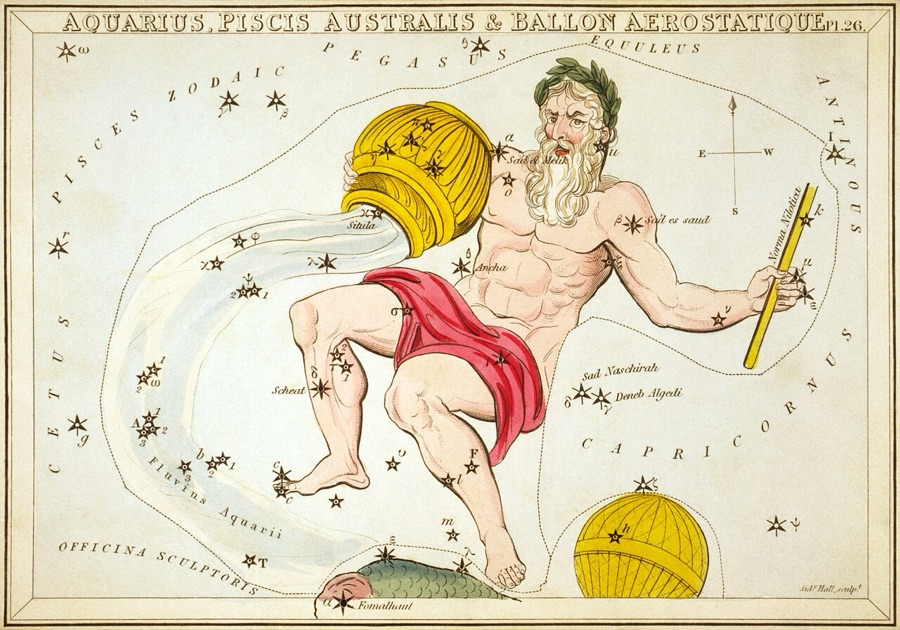
A fixed air sign with two rulers, drawn as a figure pouring water. Aquarius describes a position held on principle, which is why the sign is far less changeable than its reputation suggests.
- principle
- detachment
- systems
- reform
- fixity
What this describes
Aquarius is fixed air, and the first half of that is the half most descriptions ignore. Fixed signs hold. They are the least changeable of the three modalities, and Aquarius is one of them. Air is the element of pattern and argument. Together they describe a mind that arrives at a position and then does not move off it, which is close to the opposite of the free-spirited restlessness the sign is usually sold as.
What it actually describes is principle. Aquarius placements tend to reason from a rule about how things ought to work rather than from the particular case in front of them, and they will hold that rule against social pressure, against personal cost and occasionally against the evidence. That capacity is why the sign is associated with reform. It is also why it is associated with being difficult, and both associations are earned.
The sign has two rulers and they disagree with each other. Traditionally it belongs to Saturn: structure, law, cold clarity. Since 1781 it has also been given Uranus: disruption and sudden change. Most modern writing uses the second and forgets the first, which is how a Saturnian sign acquired a reputation for chaos. Reading both is more accurate than choosing between them.
What it does well
Aquarius is good at seeing the system rather than the incident. Given a recurring problem, the instinct is to ask what structure keeps producing it, and that shift from the case to the pattern is genuinely useful and genuinely uncommon.
The sign also holds unpopular positions well. Where other placements need agreement in order to sustain a view, Aquarius does not, and it will keep saying something for years after the room has stopped listening. Occasionally the room comes round. That is the entire basis of the sign's association with progress.
Third, a real detachment. Aquarius can look at a situation it is inside without needing the answer to flatter it, which makes the placement unusually good counsel on other people's problems.
Where it goes wrong
The failure mode is a principle applied to a person. Aquarius reasons from the rule, and when the rule and the individual in front of it conflict, the sign frequently defends the rule and calls that consistency. It is consistency. From the other side it is also a refusal to look.
The detachment has a cost the sign underestimates. Distance is useful for analysis and expensive in a relationship, and Aquarius tends to hear a request for warmth as a request to be irrational.
Third, contrarianism mistaken for independence. A position held because it is unpopular is exactly as unexamined as one held because it is popular, and the fixed modality makes this one hard to shift once it has set.
In relationships
In relationships Aquarius is loyal and not especially warm, and it is far more constant than its reputation suggests. Fixed signs stay. The difficulty is not that Aquarius leaves; it is that the placement can be present for years without ever being close, and may not experience that as a shortfall.
It wants a relationship organised on terms both people have actually agreed, and it is unusually willing to build one that does not look like anybody else's. What it handles poorly is being needed unpredictably. Where the question is whether somebody cares, this placement expresses care as commitment and consistency rather than as attention, and reading that as coldness misses what is being offered.
In work
At work Aquarius is strongest where the job is to redesign something rather than to run it: analysis, systems, research, policy, anything that rewards seeing a structure whole. It is comfortable being the dissenting voice in a room, which is valuable and costly in roughly equal measure.
The recurring difficulty is organisational politics, which Aquarius tends to treat as a corruption of the process rather than as part of it. That position is defensible and it reliably limits the placement's reach. The Eleventh House covers adjacent ground, groups and collective projects, and is often confused with the sign itself.
In money
Aquarius is the least sentimental sign about money and often the least engaged with it. The pattern is indifference to display, resistance to spending on status, and a tendency to hold strong views about money as a system while paying limited attention to its own.
There is a specific blind spot. The sign is comfortable with abstraction and can carry a plan that works in principle for a long time without checking whether it is working in fact. Testing the principle against a statement is the useful move. That is an observation about a habit of mind, not guidance about anybody's finances.
How to read it in a chart
Aquarius cools and formalises whatever it touches. On the Moon it produces emotional evenness and a strong preference for handling feeling by understanding it. On Venus it reads as loyalty without much display, and an attraction to the unconventional. On Mercury it is systemic, pattern-first thinking, strong on structure and weak on the exception.
The important caution concerns Uranus. Because Uranus takes about eighty-four years to orbit the Sun, it spends roughly seven years in each sign, so everybody born within a seven-year window shares the placement. Uranus in a sign is a generational marker and says almost nothing about an individual; only its house and its aspects make it personal. The same caution applies to Neptune and Pluto, and popular writing routinely ignores it.
How it meets other placements
Element and modality carry this. Aquarius shares air with Gemini and Libra, which usually means conversation as the main medium and a shared assumption that a position ought to be defensible. It sits easily with the fire signs, which supply momentum the air signs prefer to theorise about.
The instructive axis is Leo, its opposite. Both are fixed and both are concerned with what an individual is worth; Leo locates that in the particular person and Aquarius in the principle the person serves. Opposition is not incompatibility, and the useful question is what each end will not do.
The hardest contacts are with the other fixed signs, where two settled positions meet and the modality supplies neither of them with a way to move.
The part people leave out
The part popular astrology leaves out is that Aquarian detachment can be a way of avoiding being known. Being the one who sees the system is a position outside the room, and it protects whoever holds it from ever being in the middle of anything.
There is also a quiet superiority that the sign's own self-description conceals. Aquarius is described, usually by itself, as egalitarian and open-minded, and the placement is frequently neither. It holds its conclusions harder than most signs and treats disagreement as evidence that the other person has not thought about the question. The fixed modality is doing that work, and the reform vocabulary hides it.
Where the symbol comes from
The figure pours water and the sign is air, which is the first thing to notice and the thing most descriptions skip. The Babylonian constellation behind it, GU.LA, the Great One, was associated with Ea, god of fresh water, and the water-pouring figure is considerably older than the Greek scheme that later filed it under air.
The glyph is two parallel wavy lines. It is usually described as water, and it is at least as likely to represent air currents, or simply to be the older water figure left in place when the elements were assigned. Nobody knows, and books that state one derivation confidently are overstating what survives.
What the image does carry is distribution: something being poured out for other people, from a vessel the figure does not drink from.
Where this meaning came from
The zodiac is Babylonian, and the constellation behind Aquarius is among its older figures. The equal twelve-sign scheme was fixed by roughly the fifth century BCE, and Hellenistic astrologers in Egypt built the rest of the system on top of it from about the second century BCE.
In that scheme Aquarius belonged to Saturn, which also ruled Capricorn. The two signs furthest from the Sun and Moon were given to the slowest and most distant of the visible planets. Almost everything the older tradition says about Aquarius follows from that: a cold, formal, structural sign, far closer in temperament to Capricorn than to anything in its modern description.
The modern description depends on a planet nobody knew existed. Uranus was found by William Herschel in 1781, and nineteenth-century astrologers assigned it to Aquarius. The reading of the sign as disruptive, inventive and radical is therefore at most about two hundred years old, while the Saturnian reading is roughly two thousand. Both are in circulation. Only one of them is usually labelled as recent.
What the astronomy actually says
The Age of Aquarius is the astronomical claim attached to this sign, and it is worth stating precisely. Because Earth's axis precesses, completing a circle in about 25,772 years, the March equinox point drifts backwards through the constellations at roughly one degree every seventy-two years. It currently sits in Pisces.
When it reaches Aquarius depends entirely on where the boundary between the two constellations is drawn, and there is no natural line. Using the International Astronomical Union boundaries set in 1930, the crossing falls somewhere around the twenty-seventh century. Other conventions give dates centuries earlier or later, and some popular accounts placed it in the twentieth. That spread is not a disagreement about the sky. It is a disagreement about definitions.
Uranus, the sign's modern ruler, orbits the Sun in about eighty-four years and is barely visible to the unaided eye, which is why no ancient tradition includes it.
The common misreading
Aquarius is most often read as the rebel of the zodiac, and the sign's own modality contradicts that. Aquarius is fixed. Fixed signs are the ones that hold a position and resist being moved, and no amount of unconventional content changes the structural fact that this is among the least flexible signs in the system. What looks like rebellion is usually one firmly held rule meeting a different firmly held rule.
The second misreading is treating the sign as sociable and egalitarian by nature. That comes from the eleventh house association with groups and from the reform vocabulary attached to Uranus. The tradition describes something cooler: a placement that thinks in terms of collectives rather than one that particularly enjoys being inside them.
The third is the Age of Aquarius, announced repeatedly since the 1960s. On every standard boundary convention the equinox point is still in Pisces. It is entirely reasonable to like the idea. It is not accurate to say it has happened.
Questions to sit with
- Which of your positions have you actually retested, and which have you only defended?
- Where has a principle you hold cost a specific person something?
- What would being close to somebody require that you have decided is irrational?
- Are you standing outside this situation because it is the clearest view, or because it is the safest place to stand?
See where this sits in your own chart.