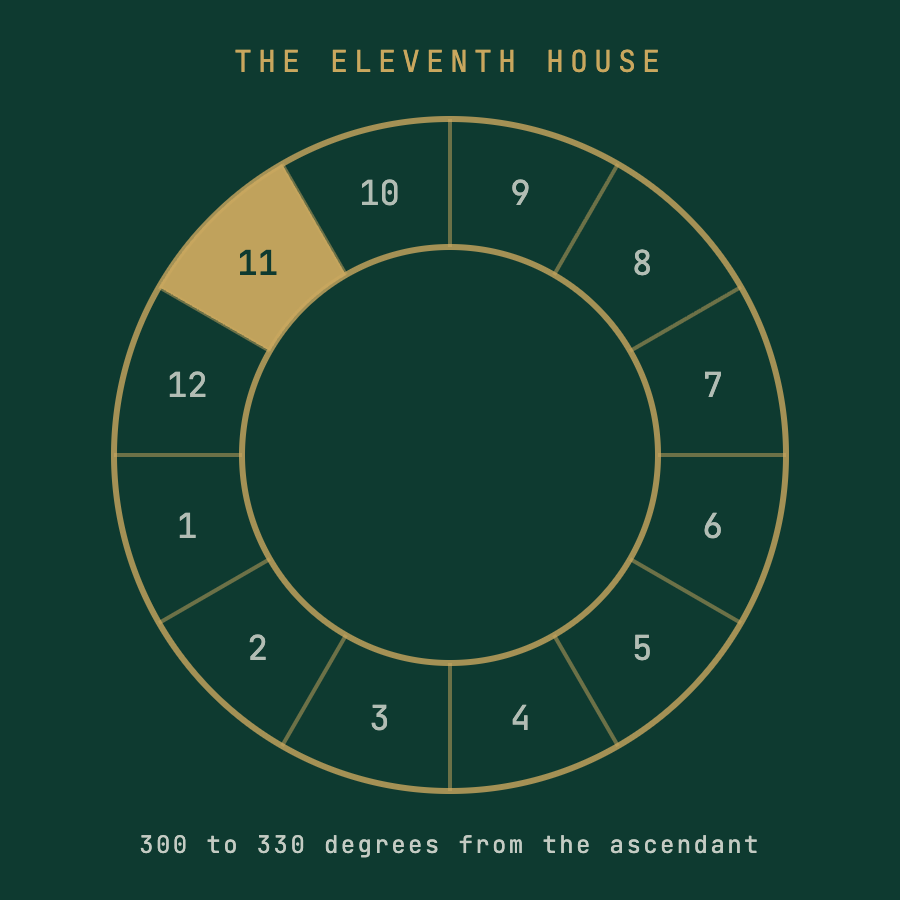
- Entry type
- House
- Number
- 11
- Element
- Air
- Modality
- Fixed
- Modern ruler
- Uranus
The Eleventh House
The house of the group a person belongs to by choice: friends, allies, and the future they are collectively working toward. It is read as the network rather than the individual friendship.
- friendship
- groups
- allies
- hopes
- belonging
What this describes
The Eleventh House covers the people a person is with by choice rather than by blood or contract: friends, colleagues who became something more than colleagues, movements, unions, the group that formed around a shared aim. The older name for it is the house of the Good Daemon, and it was read as one of the more fortunate places in a chart. It is a succedent house, following the tenth, and the tradition read it as what a person's standing in the world actually gets them.
The second half of its modern territory is hopes. That pairing looks arbitrary until you see the logic: what a person wants for the future is largely determined by the group they belong to, because a group is where an ambition becomes plausible enough to say out loud. The house covers both the company and what the company makes thinkable.
What it is not is the house of individual relationships. A specific friendship, like a specific partner, is a Seventh House matter; this house describes the collective, the many rather than the one. Read opposite the Fifth House, the pair divide social life into what a person creates alone and what they join, the audience of one and the crowd.
What it does well
What this house describes well is the part of a life that is genuinely elective. Family is given and work is largely negotiated, but the group somebody belongs to is chosen and re-chosen continuously, and it does more to determine what they think and want than almost anything else in a chart.
Its practical use is that it makes the network legible. Most people underestimate how much of what has happened to them arrived through people they know loosely, and this is the part of the chart that points at those rather than at the close relationships everybody already counts.
Third, it is one of the few places the tradition is straightforwardly optimistic. The Hellenistic reading of the eleventh place as fortunate is unusually uncomplicated, and it is about support arriving from a direction a person did not organise.
Where it goes wrong
The characteristic difficulty is that a group will supply a person with opinions and they will experience them as their own. This is not a failure of intelligence; it is how groups work, and the eleventh house is where it happens. Somebody who cannot name a belief they hold that their circle does not is describing this house accurately.
The second is breadth substituting for depth. A large network and no close friendship is a recognisable and specific loneliness, and it is invisible from outside because the person is demonstrably surrounded by people.
Third, the hopes half has a failure mode of its own. A future held collectively can be held indefinitely without anybody acting on it, and a group that shares an ambition is also a group that will keep agreeing the ambition is good instead of pursuing it.
In relationships
This house is not about romance and that is precisely why it matters in a relationship reading. It covers the social world a couple sits inside: shared friends, whether each partner has a life the other is not in, and whether the relationship has anybody around it at all.
The recurring pattern it names is a relationship that has quietly absorbed both people's friendships, which usually happens without either of them deciding to and is only noticed when something goes wrong and one of them has nobody to call.
It also covers friendships that become something else, and the tradition is entirely unbothered by that. What it cannot tell you is whether a specific friendship will change; it describes the terrain, not the events on it.
In work
At work this is the house of colleagues rather than of the job, and of everything that arrives through them. Most work does not come from applications; it comes from people who already know what you can do, and this is the part of a chart that describes that channel.
It also covers the professional body, the union, the industry, the group a person is a member of rather than an employee of. The distinction is old and it still holds: the Tenth House is your standing, this is your people.
Its practical reading is about maintenance. A network is not a possession, it is a set of relationships that decay without contact, and this house describes something that has to be tended rather than acquired. Nobody enjoys hearing that and it remains true.
In money
The Eleventh House has a specific and often overlooked financial meaning in the older material: it was read for what comes to a person from the powerful, from patrons, and from the resources of the tenth house next door. In modern terms it covers money that arrives through connection rather than through work.
That is worth naming plainly because it is one of the least meritocratic facts about how money moves and one of the least discussed. Nothing here forecasts an amount and nothing here is financial advice. What the symbolism supports is the observation that most people's opportunities have arrived through their network, and that this is worth being conscious of rather than embarrassed by.
How to read it in a chart
Read the sign on the cusp, then any planets in the house, then the ruler of that sign and where it sits. A crowded eleventh house describes a life organised around groups; an empty one describes nothing at all, since most charts have several empty houses and emptiness is not a deficiency.
The house system matters. Under whole sign houses the Eleventh is simply the eleventh sign from the rising sign; under Placidus its cusp is calculated and the house can be wide or narrow. A planet near the boundary can be eleventh under one system and tenth under another, so a reading should state which it uses.
This house is routinely confused with Aquarius, its natural sign, and with Uranus, the modern planet assigned to it. Those are analogies from the natural chart rather than identities, and Saturn was the traditional ruler of this territory long before Uranus existed as an idea.
How it meets other placements
Between two charts, contact to the Eleventh House is read as one person entering the other's world: being introduced around, absorbed into a circle, made part of a group rather than kept as a private relationship. It is one of the more socially consequential contacts and one of the least romanticised.
The comparison worth making is with the Fifth House opposite. The Fifth is the relationship as a private pleasure; the Eleventh is the relationship as a public membership. Most partnerships have to make that transition and many do not survive it, which is a more useful thing to say than a compatibility score.
This vocabulary names where pressure arrives. It does not grade a match, and no serious practitioner has claimed it could.
The part people leave out
What popular astrology leaves out about the Eleventh House is that a group is also a set of conditions. Belonging is granted on terms, most of them unstated, and the price of membership is usually a small continuous editing of what you say. The friendly modern reading of this house as community and support skips that entirely.
The second omission is exclusion. A group defined by who is in it is defined equally by who is not, and the warmth people experience inside one is partly produced by the boundary. That is not a criticism of anybody; it is how the thing works.
The third is that hopes held collectively are the easiest kind to abandon quietly. Nobody has to announce that they have stopped believing in something everybody was going to do together.
Where the symbol comes from
Like every house, the Eleventh has no picture and no myth attached to it. It is a sector of the local sky, and its meaning was derived from where it sits rather than from a story.
The Hellenistic name is the one worth knowing: the eleventh place was called the Agathos Daimon, the Good Spirit or Good Daemon, and it was counted among the fortunate places because it is the sector that rises just before the midheaven region and holds a favourable geometric relationship to the Ascendant. The name is doing the interpretive work, and it is a description of a position, not of a character.
The modern association with Aquarius and with Uranus comes from the natural chart, the teaching arrangement in which the houses are laid over the signs in order from Aries. That correspondence is a mnemonic. Treating it as an identity, so that the Eleventh House simply means Aquarius, is the most common way this material gets flattened.
Where this meaning came from
Houses are Hellenistic, not Babylonian. Babylonian astrology worked with signs, planets and omens and had no twelvefold division of the local sky; the house system appears in the Greek-speaking Mediterranean around the first century BCE and is what makes a chart a statement about one person's life.
The eleventh place had a clear early meaning: friends, allies, patrons and benefactors, and things received from people in a position to give them. Hellenistic sources read it alongside the tenth, treating it as what a person's standing actually yields. The name Agathos Daimon marks it as one of the places the tradition regarded as helpful without qualification, which is rare.
Hopes and wishes are a later gloss, well established by the medieval and Renaissance period and central by the time astrology reached the English-speaking public. The modern reading, which adds social movements, collective causes and humanitarian ideals, comes with the twentieth-century assignment of Uranus to Aquarius and from there to this house. That assignment postdates the discovery of Uranus in 1781 and did not settle until much later, so the associations with radicalism and reform are the newest layer here by a wide margin.
What the astronomy actually says
A house is a division of the local sky rather than anything out in space. It is defined relative to the horizon and the meridian at one place and one moment, which means two people born at the same instant in different cities share every planetary position and share no houses at all.
Where the Eleventh House begins depends entirely on the system in use. Whole sign houses take the eleventh sign from the rising sign. Placidus and Koch divide by the time degrees take to travel between the angles, producing houses of unequal width. Equal houses count in thirty-degree steps from the Ascendant. For identical birth data these produce different answers, and no test has shown one to be more accurate than another.
The time-based systems fail outright at high latitudes: above about sixty-six degrees, parts of the ecliptic never rise, and Placidus cusps become undefined. Software usually switches to another system without telling the user. None of this describes a physical influence, and no mechanism has ever been demonstrated by which the sector of local sky a planet occupied at somebody's birth would affect their friendships.
The common misreading
The commonest misreading of the Eleventh House is that it promises friends. It describes a person's relationship to groups, which is not the same as a supply of them, and a chart with a strong eleventh house belonging to somebody who is lonely is not a contradiction. It may be describing exactly why: an orientation toward the collective can be a way of never being close to anybody in particular.
The second is the humanitarian reading, which has become almost automatic. The modern association of this house with causes and reform arrives through Uranus and Aquarius and is roughly a century old. Presented as the ancient meaning it misleads; the older sources are talking about patrons and allies, which is a considerably more transactional idea and a more honest one.
The third is treating hopes as predictions. A wish in this house is a description of what somebody currently wants, and wants change. Reading it as a forecast of what will happen turns a useful question about direction into a promise nobody can keep, and it is the specific way this house gets used to sell people optimism.
Questions to sit with
- Name a belief you hold that your closest group does not. If you cannot, what does that tell you?
- Which of the good things in your life arrived through somebody you know only slightly?
- What does membership of your main circle actually cost you to maintain?
- Is there a hope you share with people that none of you has acted on?
See where this sits in your own chart.