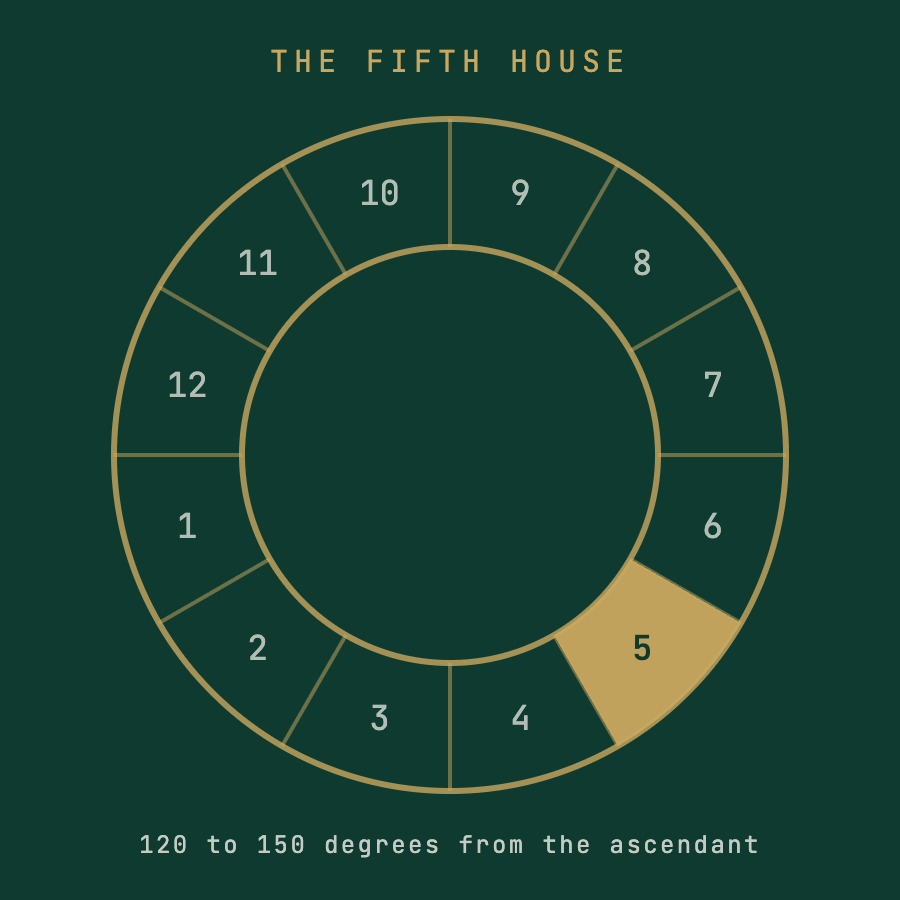
- Entry type
- House
- Number
- 5
- Element
- Fire
- Modality
- Fixed
- Modern ruler
- Sun
The Fifth House
The house the tradition called Good Fortune: play, romance, children and anything made for its own sake. The fifth house covers what a person does when nothing is required of them.
- play
- romance
- creativity
- children
- pleasure
What this describes
The fifth house covers what is done for pleasure. Play, games, romance in the sense of courtship rather than partnership, creative work made because somebody wanted to make it, and children. The Greek writers called it Agathe Tyche, Good Fortune, and it is one of the few places in the chart the tradition is straightforwardly warm about.
What links those significations is that none of them is instrumental. A fifth house activity is not done in order to get something; it is done because doing it is the point. That is why gambling and creative work sit in the same house without any strain, and why a chart can show somebody with a busy fifth house and very little to show for it.
It takes Leo as its natural sign and the Sun as its ruler, and it is a succedent house, which the tradition ranks between the angular and the cadent in how directly it acts. Venus is said to have its joy here, and that is where the name Good Fortune came from.
What it does well
A well-supported fifth house shows up as the capacity to enjoy something without justifying it. That sounds minor, and it is one of the harder things for an adult to keep hold of: most people lose the ability to do anything that does not report to a purpose.
It also produces genuine creative output in the ordinary sense of making things. The fifth house is not about talent, which is not a chart matter at all, but about whether making something feels available. A person with a strong fifth starts things.
Third, it supplies the capacity to be delighted by other people, which is the fifth house version of romance: interest in somebody for the pleasure of it, before any question of arrangement or future has been raised.
Where it goes wrong
The fifth house goes wrong through repetition without return. Pleasure that has stopped being pleasurable and continues anyway is a fifth house pattern, and gambling sits in this house for exactly that reason: it is the clearest case of an activity that keeps its form long after it has lost its content.
The second failure is performance. Because the fifth is ruled by the Sun and associated with Leo, its activities can quietly become about being seen doing them, and the moment that happens the house stops working, because a fifth house activity done for an audience is a tenth house activity in the wrong clothes.
Third, it can crowd out everything sustained. Starting is easy here. Finishing is not this house's business.
In relationships
The fifth house is romance and the seventh is partnership, and the tradition keeps them apart deliberately. The fifth covers courtship, attraction, the early stretch where two people are enjoying each other without having decided anything. The seventh covers the arrangement that follows, if one does.
Modern writing merges them, and the merger causes real confusion, because the qualities that make the fifth house work are not the ones that make the seventh work, and plenty of relationships are strong in one and thin in the other. Where a chart is read for a relationship question, it is worth establishing which of the two is actually being asked about. The chart cannot say what either will become.
In work
The fifth house is not a career house, and it is where a good deal of work originates. Anything made speculatively, before there is a client or a brief, starts here and only later becomes a tenth house matter.
For people whose work is creative, the practical difficulty is that a fifth house activity turned into an income is no longer straightforwardly a fifth house activity. The tradition has no problem with this and modern writing tends to romanticise it. Where the question is whether to make a living from something enjoyed, the honest answer from the chart is that it changes which house the activity lives in, and the chart has no view on whether that trade is worth making.
In money
The fifth house governs speculation: gambling, bets, anything where money is placed on an uncertain outcome partly for the interest of it. That is a genuine traditional signification, and it is the one place where a money question and this house properly meet.
It should be said plainly that nothing in a chart indicates whether a speculation will pay. Traditional texts did make such judgements. They were not reliable, and this site does not make them. What the house describes is a person's appetite for that kind of risk and what they get out of taking it, which is a question about temperament rather than about money, and none of it is financial advice.
How to read it in a chart
The fifth house is read like any other: the sign on its cusp, the ruler of that sign, and whatever occupies it.
The cusp sign describes the manner of play. A fifth cusp in an earth sign describes pleasure that wants something to show for itself; in an air sign, pleasure that is mostly conversation. The ruler of that sign then locates the activity: a fifth cusp in Scorpio puts the house under Mars in the traditional scheme or Pluto in the modern one, and wherever that planet sits is where the fifth house business actually happens.
Planets in the fifth dominate the reading when there are any. Saturn there is the classic marker of play that feels as though it has to be earned first. An empty fifth house is completely ordinary and says nothing whatever about whether somebody is creative or has children.
How it meets other placements
The fifth sits opposite the eleventh house, and the axis is among the more useful in the chart: the fifth is what a person enjoys individually, the eleventh is what they belong to collectively. Personal delight against shared purpose. Charts weighted heavily toward one end tend to be short of the other in a recognisable way.
As a succedent house it groups with the second, the eighth and the eleventh, which together describe what accumulates rather than what initiates.
Between two charts, planets falling in each other's fifth house describe people who enjoy each other's company. That is not the same as people who can run a household together, which is the seventh and the fourth, and a different question entirely.
The part people leave out
The part popular astrology leaves out is that Good Fortune was the name of a position, not a promise. The Hellenistic label describes where Venus operates freely. It does not say a person will be lucky, and reading the fifth house as an assurance of pleasure is treating a technical term as a horoscope.
The second omission is children. The tradition assigns them here literally, and modern writing has largely replaced them with creative projects, which is a reinterpretation rather than a translation. The substitution is often made to avoid saying anything uncomfortable, and it is better to be direct instead: a chart cannot tell anybody whether they will have children, and any page implying otherwise is doing something it has no basis for.
Where the symbol comes from
The Greek name is Agathe Tyche, Good Fortune, and the Latin is Bona Fortuna. The name comes from the doctrine of joys. Venus is said to have its joy in the fifth house, meaning this is where the Venusian function operates most freely, and the place took the planet's character as its own.
That derivation explains the house's odd combination of significations. Venus governs pleasure, attraction and what is valued for itself, and the fifth house collects exactly the activities fitting that description: courtship, games, making things, and children as the outcome of the first of them.
The alternative Latin name, Nati, means simply the born, and it is the older and narrower reading. The modern expansion of the fifth house into creativity in general is a twentieth-century development and a defensible one, but it is an expansion rather than a recovery.
Where this meaning came from
Houses are Hellenistic, appearing with the Greek and Egyptian synthesis from about the second century BCE, and the fifth was part of the scheme from the beginning. Babylonian astrology had no equivalent to it.
Vettius Valens and the other early writers treat it as the house of children and of good fortune, and the two significations sit side by side without much explanation in the sources. The doctrine of planetary joys, which assigns Venus to the fifth, is the connective tissue: it explains why a house about offspring is also a house about pleasure, and it is one of the parts of the system twentieth-century practice largely forgot.
The medieval Arabic and Latin traditions kept the children signification central, and it stayed central into the seventeenth century. William Lilly's Christian Astrology of 1647 treats fifth house questions largely as questions about pregnancy and offspring.
The reading of the fifth house as creativity and self-expression is modern, part of the same psychological turn that recast the whole system as a description of temperament rather than of events.
What the astronomy actually says
Houses are divisions of the local sky rather than regions of space, and the fifth is a good place to draw a distinction most readers never get made for them: the difference between whole sign and equal house systems, which sound identical and are not.
Whole sign houses take the entire sign containing the Ascendant as the first house, so every cusp falls at zero degrees of a sign and the houses line up exactly with the signs. Equal house takes the precise degree of the Ascendant and adds thirty degrees repeatedly, so the cusps sit at that same degree in every sign and the houses cut across sign boundaries. A planet late in a sign can be in the fifth house under one system and the sixth under the other.
Both produce twelve equal thirty-degree houses, and both work at any latitude, which quadrant systems do not. They still disagree, and the disagreement is about where to start rather than about the sky. Astrology has never demonstrated a mechanism for any of these divisions.
The common misreading
The fifth house is most often read as a prediction about children. It is not one and it cannot be. The tradition did make such judgements and they did not work. A birth chart contains no information about fertility, and a page suggesting otherwise is making a claim about somebody's body from a diagram of the sky. If children are the actual question, the people to ask are medical.
The second misreading is treating Good Fortune as a forecast. The name describes Venus's joy in this place, a technical position within the system, and it was never a statement that good things happen to people with planets here.
The third is the collapse of the fifth house into the seventh. Romance and partnership are separate significations in the tradition and they behave differently: the fifth is enjoyment without arrangement, the seventh is the arrangement. Merging them produces the very common reading in which a chart is said to describe somebody's love life as one thing, when the material is telling you it has at least two parts that do not always agree.
Questions to sit with
- What do you do that reports to nothing and to nobody?
- When did you last make something without deciding in advance what it was for?
- Which of your pleasures has kept its shape and lost its content?
- Are you enjoying this, or being seen to enjoy it?
See where this sits in your own chart.