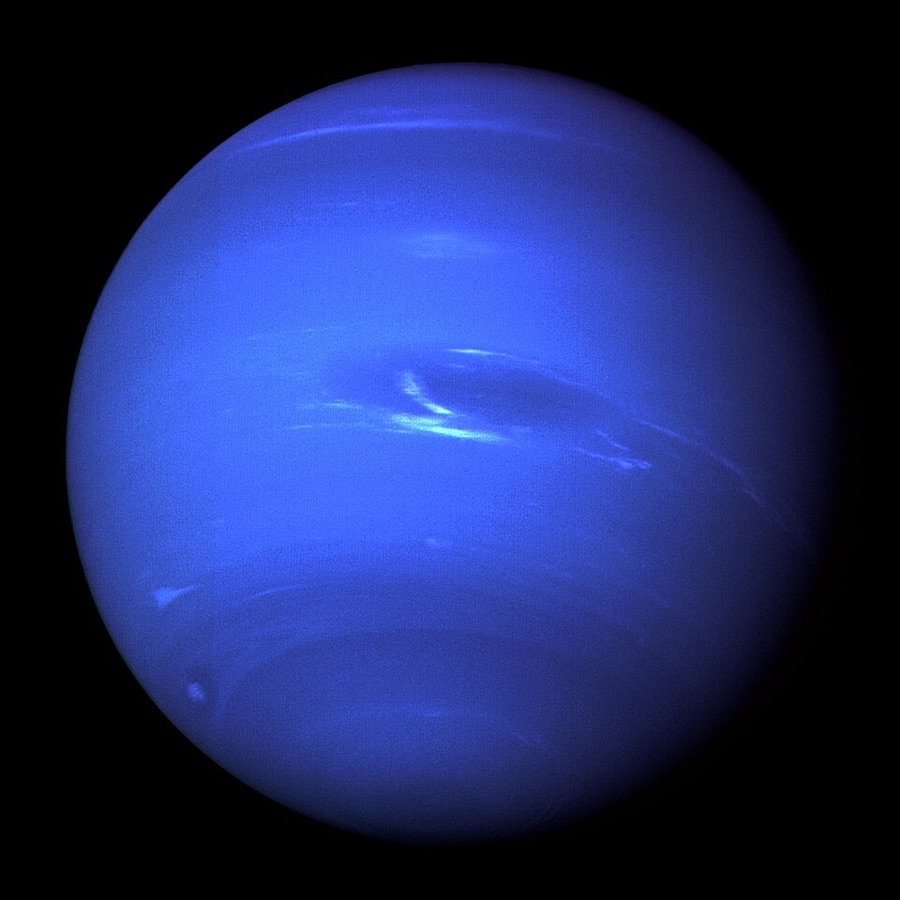
- Entry type
- Planet
- Abbreviation
- NEP
- Modern ruler
- Neptune
- Symbol
- Trident
- Matching tarot card
- The Hanged Man
Neptune
The planet astrologers assign to the blurring of edges. Neptune is read as imagination, longing and self-deception at once, and the tradition is unusually honest that it cannot tell the three apart.
- dissolution
- imagination
- longing
- deception
- compassion
What this describes
Neptune is read as the dissolving of boundaries. Where most of a chart describes definition, this describes the loss of it: where a person's edges blur, where they merge with something larger, and where they cannot see the situation clearly because they are inside it. It is assigned imagination, spirituality, compassion and deception, and the striking thing is that the tradition offers no way to distinguish them.
That refusal is the honest part of the symbolism. The same function that produces genuine empathy produces the inability to tell where somebody else's feelings end and your own begin. The same function that produces art produces the fantasy that stands in for a life. A reading that assigns the good half to the querent and the bad half to somebody else has stopped reading the placement.
Like Uranus, Neptune has a scale problem and a worse one. It spends about fourteen years in each sign, so its sign is shared by an entire fourteen-year cohort and describes nothing personal at all. Only the house and the aspects to personal planets bring it down to an individual, and even then it is describing a susceptibility rather than a settled trait, which is a weaker claim than most sources make.
What it does well
Neptune is the part of a chart associated with imagining something that does not exist yet. Every made thing was unreal before it was real, and the capacity to hold a thing vividly in the absence of evidence for it is the mechanism behind art, invention and most kinds of hope.
Its other genuine competence is empathy of an unusual depth. This is the placement that describes somebody able to feel their way into another person's position rather than reasoning about it from outside, which is a rare and useful capacity in almost any context involving people. The tradition also links it to the willingness to give without an accounting, and that reading holds, though the same lack of accounting is exactly what the weakness section is about.
Where it goes wrong
The failure is that Neptune cannot check itself. Where other placements can be tested against the world, this one is describing the faculty that does the interpreting, so an error in it is invisible from inside by definition. Somebody deceiving themselves about a relationship, a project or a person is using the same equipment they would need to notice.
The concrete forms are familiar: idealising a person and then feeling betrayed when they turn out ordinary, staying in a situation for what it might become, and the specific exhaustion of somebody with no boundary who has taken on more of other people's states than they can carry. The tradition also links it to escape, in every form from art to intoxication, without distinguishing between them.
In relationships
In relationship readings Neptune is the placement associated with idealisation, and it is the one most likely to be describing a real problem rather than a flavour. It marks the tendency to fall for a version of somebody rather than the person, and to notice the difference late.
The harder reading concerns sacrifice. Neptune contacts are traditionally described as selfless, which sounds like praise and often describes somebody giving up more than they have said out loud, in a relationship where that has become the arrangement. The chart cannot tell you whether a person is being generous or being used, and a reading that assumes the first because the language is flattering is doing real harm. Where the question was whether somebody else is being honest, this placement is not answering it.
In work
At work Neptune is linked to imagination, to caring work, and to fields where the product is an impression rather than an object: art, film, music, design, therapy, anything that depends on evoking something. The association is loose but not empty.
Its characteristic difficulty is definition. A Neptune-inflected work problem tends to involve unclear terms, a role nobody has written down, an agreement everybody remembers differently, or a person doing far more than their remit while assuming it is understood. That is not a forecast about anybody's career. It is a recognisable failure pattern, and the practical response is unglamorous: put the arrangement in writing, because this placement's difficulty is with edges rather than with effort.
In money
Neptune in a money context is read as vagueness. The tradition associates it with unclear finances, money given away without record, and a persistent reluctance to look at the actual numbers.
This is not financial advice and it forecasts nothing. The examinable question underneath the symbolism is simply whether a person knows their own figures. Neptune describes a relationship in which the details stay comfortably out of focus, and the practical test is easy to run: if somebody cannot say roughly what they owe and what they are owed, that is the placement's characteristic pattern rather than anything mysterious.
How to read it in a chart
Read the house first, always. The sign is shared with everybody born within about fourteen years, so it describes a generation's collective preoccupations and nothing about the person in front of you.
The aspects are where this planet gets personal, and they are worth reading carefully. Neptune touching the Sun, Moon or Ascendant is read as an identity with soft edges; touching Venus, as idealisation in love; touching Mercury, as a mind that works by impression rather than by argument. Neptune is commonly confused with the Twelfth House, which it is said in modern practice to rule, and with the Moon, since both describe feeling. The distinction is that the Moon has a shape and Neptune dissolves one, which is why the two read very differently in practice.
Retrograde
Neptune is retrograde for roughly five and a half months of every year, so about forty per cent of charts have it natally and its presence tells you almost nothing about a particular person.
The conventional reading is that the dissolving is turned inward, producing a private imaginative life or a clearer view of one's own illusions. Some astrologers argue, more interestingly, that a natal Neptune retrograde is less prone to projecting the ideal outward. Either way the caution stands: the apparent reversal is caused by Earth overtaking a far slower planet, nothing happens at Neptune, and a feature shared with two people in five is not an explanation for anybody's circumstances.
How it meets other placements
Neptune contacts between charts are described as romantic, spiritual and fated, which is precisely the vocabulary that should slow a reader down. What they more reliably describe is mutual projection: two people each seeing something in the other that may or may not be there.
That can be the beginning of real intimacy or the whole content of a relationship, and the contact does not distinguish. The useful application is temporal. Neptune pairings tend to look clearest at the start and get harder as the actual person comes into focus, which is the reverse of the Saturn pattern. Knowing which of those two you are in is worth more than knowing whether a book calls the aspect harmonious.
The part people leave out
What popular astrology leaves out is that Neptune is routinely used to make passivity sound spiritual. Language about surrender, flow, trusting the process and dissolving the ego describes something genuine in a contemplative context, and in an ordinary life it very often describes somebody not addressing a situation they could address.
The genuinely uncomfortable point is about victimhood. The tradition associates this planet with the victim as an archetype, and modern readings tend to handle that gently, framing it as sensitivity. Sometimes a person is being harmed and the framing obscures it. Sometimes a person is avoiding responsibility and the framing supplies a vocabulary for it. Neptune cannot tell you which, and readings that consistently resolve the ambiguity in the flattering direction are not being kind. They are removing the one question worth asking.
Where the symbol comes from
The planet was named for the Roman god of the sea, identified with the Greek Poseidon, and the choice was quick and largely uncontested, following the established habit of naming planets for Olympian deities. Le Verrier subsequently tried to have it named after himself, which did not survive contact with the rest of European astronomy.
The sea is doing real work in the symbolism rather than decorating it. Water takes the shape of its container, has no edge of its own, conceals what is under it, and is both the medium of travel and the thing that drowns people. Almost every astrological meaning attached to Neptune, dissolution, concealment, imagination, danger that is not visible from the surface, follows from that one image.
The glyph is a trident, Poseidon's weapon, and it is unusual among the planetary marks in being straightforwardly pictorial. Where the older glyphs descend from scribal abbreviations worn down over centuries, this one was designed in the nineteenth century by people who already knew what it depicted.
Where this meaning came from
Neptune is the only planet found by prediction rather than by looking. Irregularities in the orbit of Uranus suggested an unseen body, and Urbain Le Verrier in France calculated where it should be. Johann Galle at the Berlin Observatory found it on 23 September 1846, within a degree of the predicted position, on the first night he looked. John Couch Adams in England had reached similar figures independently and had been unable to get anyone to act on them.
The astrological meanings were assigned afterwards, and the nineteenth-century context shaped them heavily: spiritualism, mesmerism, the rise of photography and anaesthesia all cluster around the period, and all of them appear in the traditional keyword lists for the planet. That is a lot of interpretive weight resting on when a telescope happened to be pointed correctly.
Rulership of Pisces was transferred from Jupiter by twentieth-century practice, and traditional astrologers still do not accept it. As with the other outer planets, there is no ancient authority to appeal to on either side of that argument, and any source presenting Neptune's meanings as ancient wisdom is mistaken about a matter of simple chronology.
What the astronomy actually says
Neptune is the eighth and outermost planet, orbiting the Sun in about 165 years. That is the crucial figure for astrology: it spends roughly fourteen years in each sign, so its sign position is a property of a birth cohort rather than of a person, and it has completed only slightly more than one full orbit since its discovery in 1846.
It is not visible to the naked eye at about magnitude 7.8, which means no astrologer before the nineteenth century could have observed it, and none did. Galileo recorded it twice in 1612 and 1613 while watching Jupiter, and took it for a fixed star.
It has the fastest winds measured anywhere in the solar system, exceeding 2,000 kilometres per hour, which is a curious fact to sit under a symbol of dissolution and calm. Neptune retrogrades about five and a half months a year, purely as an effect of Earth's faster orbit. The positions used are tropical rather than sidereal, the two frames have drifted roughly a sign apart through precession, and no mechanism has been demonstrated by which the planet would act on anybody.
The common misreading
The commonest misreading is the sign again, and it is worse here than for Uranus. Fourteen years of births share a Neptune sign. Any description of what Neptune in a given sign says about a person is describing tens of millions of people at once, and presenting it as individual insight is simply an error about how slowly the planet moves.
The second is the spiritual reading applied without discrimination. Neptune's vocabulary is beautiful and it can be draped over almost any behaviour. Somebody avoiding a decision becomes somebody trusting the process; somebody being deceived becomes somebody with an open heart. The symbolism genuinely contains both readings, and a page that only ever selects the elevated one is not interpreting, it is flattering.
The third is more specific. Neptune is frequently invoked to explain a relationship in which somebody was misled, and the explanation lands on the deceived person's chart. This is worth stating plainly: a placement describing a susceptibility to idealisation is not an account of why another person behaved badly. Reading it that way relocates responsibility onto the person who was harmed, and it is one of the few places where a careless astrological reading can do direct damage.
Questions to sit with
- What are you currently seeing in somebody that you have not yet tested against their behaviour?
- Where in your life are the terms deliberately vague, and who does that vagueness serve?
- What are you waiting to become clear on its own rather than asking about?
- Which of your feelings this week were actually yours?
See where this sits in your own chart.