- Entry type
- Aspect
The Conjunction
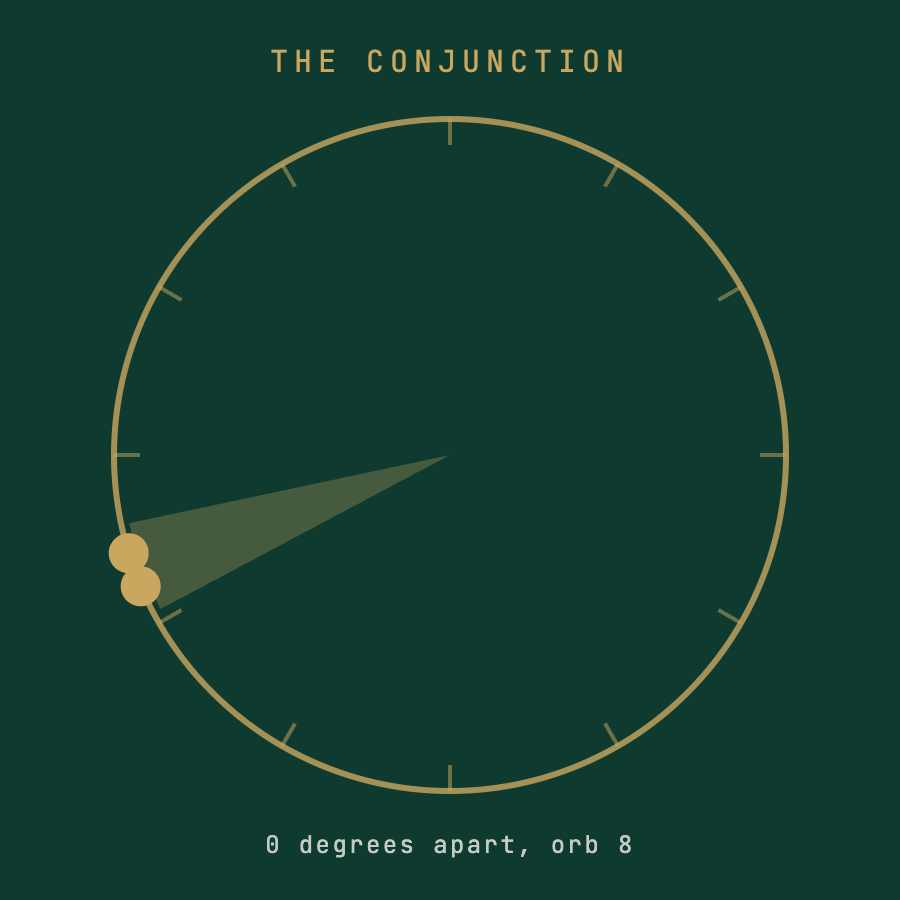
Two planets at the same degree of the zodiac, fused rather than related. The conjunction is the strongest of the five classical aspects and the only one with no character of its own, taking its tone entirely from the bodies involved.
- fusion
- emphasis
- intensity
- blending
- focus
What this describes
A conjunction is two planets at the same degree of ecliptic longitude, a separation of 0 degrees, or close enough to it that the tradition counts them as joined. It is conventionally listed as an aspect and strictly speaking it is not one: the Greek term for an aspect describes a looking or regarding across a distance, and two bodies in the same place are not looking at each other. Hellenistic sources call this an assembly instead.
That distinction matters for how it reads. The other four aspects describe two things in a relationship; the conjunction describes two things that have stopped being separable. Whatever the planets signify arrives fused, and a person with a tight conjunction usually cannot tell the two apart in themselves, because they have never been experienced separately.
It has no inherent quality. A trine is read as easy and a square as difficult, but a conjunction is only as benign as the planets in it. Venus with Jupiter and Mars with Saturn are the same aspect and nothing else about them is the same. This is why the conjunction is the aspect most often misreported: writers describe it as powerful, which is true, and then imply that powerful means good, which does not follow.
What it does well
What a conjunction does well is concentrate. Two functions that would otherwise operate independently are pointed in one direction, and the result is force rather than balance. Somebody with Mercury conjunct their Sun does not have a mind and an identity; they have one thing, and it is usually the most recognisable thing about them.
Its second value in a reading is that it is easy to see. Unlike most of a chart, a tight conjunction tends to correspond to something a person will recognise immediately when it is described, which makes it a reasonable place to start.
Third, it is the aspect least dependent on interpretation. Two bodies in the same degree is a fact about the sky. What it means is arguable; that it is there is not.
Where it goes wrong
The characteristic difficulty is the absence of perspective. Two things fused cannot observe each other, so a conjunction describes exactly the part of a person that is hardest for them to get outside of. A square is uncomfortable and therefore noticed; a conjunction is simply how things are.
The second is that a difficult pairing has nowhere to go. Mars conjunct Saturn is not a tension between drive and restraint that can be worked with; it is drive and restraint arriving as one object, and the tradition was straightforwardly grim about combinations like it.
Third, the conjunction concentrates whatever is there, including the parts a person would rather dilute. Force is not a virtue on its own. Everything depends on what is being concentrated, and that is a question about the planets rather than about the aspect.
In relationships
In synastry, a conjunction between two charts is the contact people describe as recognition: a planet in one chart sitting on a planet or angle in the other, producing an effect neither party can easily account for. It is the most commonly reported contact and the least analysable.
What it does not indicate is compatibility. Two people can be fused at one point of their charts and have nothing else in common, and the intensity of the contact says nothing about whether living together would work. The tradition is clear that the planets involved decide the tone: the same aspect between Venus and Venus and between Mars and Saturn describes very different weather.
A chart cannot tell you how somebody feels. It describes a geometry, and the feelings remain the property of the people having them.
In work
At work a conjunction describes a capability that operates as a single unit. Somebody whose Mercury and Mars are joined does not think and then argue; the thinking arrives already sharpened, which is useful in some rooms and expensive in others.
The practical reading is about specialisation. Fused functions are strong and narrow, and a person built this way tends to be excellent at a specific thing and unable to explain how they do it, which makes them hard to promote into roles that require teaching it to others.
Nothing here predicts a job or an outcome. What the geometry supports is a question about whether somebody's strongest capability is being used in a role that has any use for it, and that is answerable by looking at the last year of work rather than at a chart.
In money
The conjunction has no money meaning of its own, which is the honest answer most pages avoid. Whether it says anything financial depends entirely on which planets are involved and which houses they occupy.
Where it contributes something is emphasis. A conjunction falling in the second or eighth house concentrates attention on money in a way that is usually visible in how somebody talks about it, and a person who cannot stop thinking about a subject is describable without any forecast being attached.
Nothing on this page is financial advice, and no aspect has ever indicated an amount. The tradition made predictions of that kind and they did not work, which is worth stating rather than quietly dropping.
How to read it in a chart
The orb is the allowance either side of exactness within which an aspect is counted, and it is the least standardised thing in astrology. These pages use eight degrees for the conjunction, which is common modern practice. Other astrologers use ten, or twelve for the Sun and Moon; traditional practice gave each planet its own orb and combined the two. Whether a conjunction exists can therefore depend on whose table you are reading.
Within the orb, closer is stronger: a conjunction within one degree is a different statement from one at seven.
Two refinements worth knowing. An aspect is applying when the faster body is still moving toward exactness and separating once it has passed, and traditional practice weights applying aspects more heavily. And a planet within about eight degrees of the Sun is called combust, read as weakened; within about seventeen minutes of arc it is cazimi, in the heart of the Sun, and read as strengthened. Same aspect, opposite verdict, a fraction of a degree apart.
How it meets other placements
A conjunction is modified by everything else touching it. A third planet joining the pair changes the reading entirely, and a stellium of three or more bodies in one sign is a conjunction that has stopped being about any single pairing.
Aspects from elsewhere matter more here than with other configurations, because the fused pair has no internal perspective and whatever does look at it from a distance supplies the only outside view available. A square from Saturn to a Venus and Jupiter conjunction is doing something quite specific: it is the only part of the chart in a position to disagree with it.
What none of this produces is a score. Aspects describe how parts of a chart are arranged relative to each other, not whether the arrangement is good, and no serious practitioner has claimed a total can be computed from them.
The part people leave out
What popular astrology leaves out about the conjunction is that it is the aspect people cannot report on. Everything else in a chart describes something a person can, with effort, observe in themselves. A conjunction describes something they are, and noticing it is like noticing the language you think in.
The second omission is that the modern habit of calling every conjunction powerful has emptied the word. Power is a description of magnitude, not of quality, and a great deal of what a conjunction concentrates is not something anybody would have chosen to have doubled.
The third is that the tradition was not warm about this configuration. Two malefics joined was a straightforwardly bad placement, and the current practice of finding a growth opportunity in every geometry is a modern editorial decision rather than an inherited reading.
Where the symbol comes from
Aspects have no pictures. They are angles, and their symbolism is geometric rather than mythological: the meanings were derived from dividing a circle and from what the resulting figures were thought to imply.
The conjunction is the degenerate case, zero degrees, where no figure is produced at all. That is why the Greeks did not classify it with the others. Their word for aspect derives from seeing, and the five configurations were understood as ways two planets could look at one another across the zodiac. At zero degrees there is no distance to look across, so the older texts describe planets in the same sign as being in assembly or as co-present rather than as regarding each other.
The glyph is a circle with a short line projecting from it, conventionally read as two bodies at one point. Like the sign glyphs it is a medieval scribal form, and the meaning attached to it was settled long before anybody drew the symbol.
Where this meaning came from
Aspects are Hellenistic. Babylonian astrology tracked planets and omens without any systematic geometry of angular relationships, and the doctrine of aspects appears with the Greek-speaking synthesis in Egypt between roughly the first century BCE and the second century CE.
Ptolemy sets out the scheme in the Tetrabiblos in the second century CE, deriving the aspects by dividing the circle: halved gives the opposition, into three the trine, into four the square, into six the sextile. Only those four are aspects proper. The conjunction is included in the list by later convention because it is obviously significant, not because it fits the derivation, and Greek sources are careful about the distinction in a way modern ones are not.
The other change is evaluative. Traditional practice classified aspects as benefic or malefic and made concrete predictions from them. The twentieth century, following Alan Leo and then the humanistic astrologers, reframed every configuration as psychological material to be worked with, which is where the modern idea that a hard aspect is an opportunity comes from. That reframing is about a century old. It is more humane than what it replaced and it is not what the tradition said.
What the astronomy actually says
An aspect is an angular separation measured along the ecliptic, in celestial longitude, as seen from Earth. That is the whole definition, and it has two consequences most pages never state.
The first is that an aspect describes an appearance from one vantage point rather than a relationship between the bodies. Two planets conjunct in a chart are in the same direction from here and can be enormously far apart in space: Mars is minutes away at light speed and Saturn is over an hour. From Mars the same two planets would show a completely different angle, and every aspect in the chart would be different.
The second is that latitude is discarded. Aspects use longitude only, so two bodies described as conjunct can be several degrees apart north to south and visibly separated in the sky. This is why a new moon, which is a Sun and Moon conjunction, usually produces no eclipse: an eclipse needs the latitudes to line up as well, which happens only near the points where the Moon's tilted orbit crosses the ecliptic. No mechanism has been demonstrated for any of it.
The common misreading
The commonest misreading of the conjunction is that it is a good aspect. It is not an aspect with a quality at all. A conjunction of two difficult planets was, in every period of the tradition before the twentieth century, read as straightforwardly unfortunate, and the modern habit of describing all conjunctions as powerful and leaving the implication to do the work is a way of avoiding saying that.
The second is treating it as a fact independent of the orb. Whether two planets are conjunct depends on a convention that is not standardised, and a pairing that exists at a ten-degree orb does not exist at six. Any page that reports a conjunction without saying what orb it used is presenting a choice as an observation.
The third is the physical reading, which turns up more often than it should: the idea that two planets appearing close together are somehow acting on each other. They are not near each other. They are in the same direction as seen from one planet, and their actual separation is measured in hundreds of millions of kilometres. Nothing in astrology has ever required them to be close, and the pages that imply physical proximity are inventing a mechanism the tradition never claimed.
Questions to sit with
- Which two things about yourself have you never been able to describe separately?
- What do people consistently name in you that you cannot see at all?
- Where is your strongest capability being used, and does the role have any use for it?
- What in your life is concentrated rather than balanced, and is that working?
See where this sits in your own chart.