- Entry type
- Aspect
The Trine
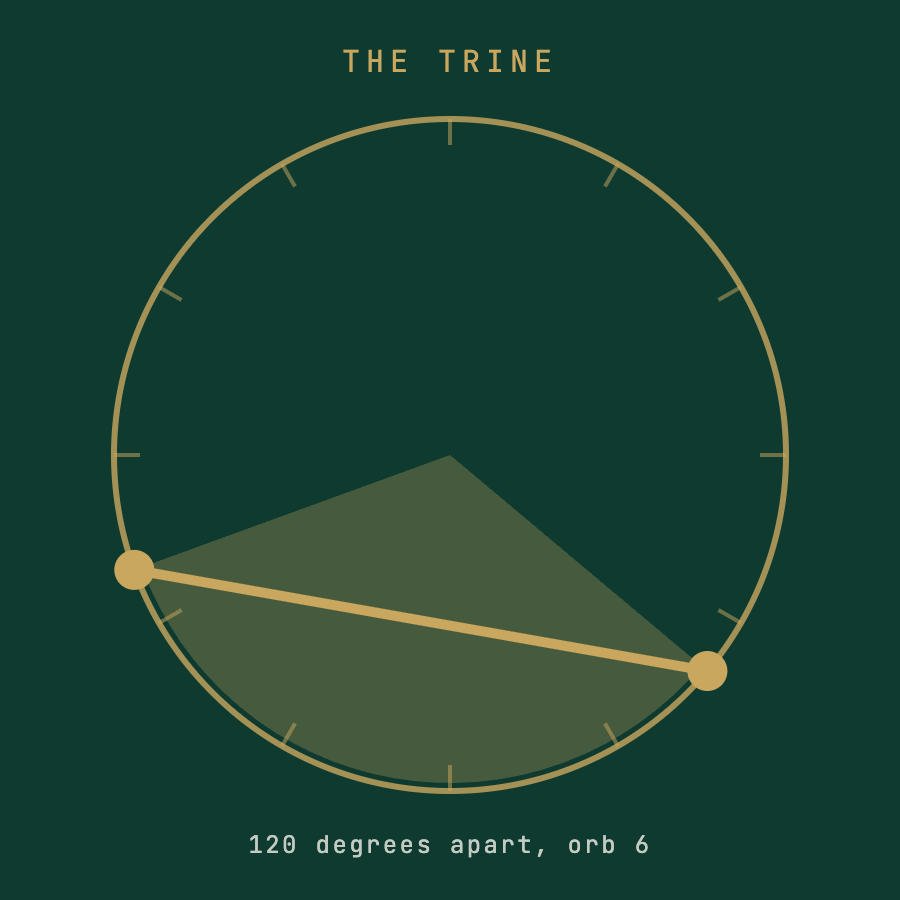
Two planets 120 degrees apart, a third of the circle, in signs of the same element. The trine is the tradition's most favourable aspect and the one most likely to describe something a person has never had to work at.
- ease
- talent
- flow
- complacency
- harmony
What this describes
A trine is a separation of 120 degrees, a third of the zodiac, putting the two planets four signs apart. Signs four apart always belong to the same element, and that is the entire basis of the reading: two functions made of the same material, operating without friction because there is nothing between them to resist.
The tradition rated it the most favourable of the aspects and did so without much hedging. Ptolemy calls it the trigonos after the equilateral triangle it produces, groups it with the sextile as harmonious, and places it above. The word survives in English as trigon, an old term for the four elemental groupings of signs. Medieval and Renaissance practice kept that assessment, and a trine between benefics was about as good a thing as a chart could report.
The modern reading adds the important caveat, and it is worth stating plainly: ease is not the same as development. A square forces a person to deal with something; a trine does not force anything, which is why the abilities it describes are so often the ones somebody has never examined, never trained, and cannot explain. What comes easily tends to stay at the level it arrived at.
What it does well
What a trine describes is genuine and generally real. Something in the person works, reliably, without maintenance, and other people usually notice it before they do. Abilities of this kind are the ones somebody is surprised to be complimented on, because from inside they do not feel like abilities at all.
Its practical use in a reading is identification. A trine is the best available answer to the question of what somebody should lean on when they are tired, because it is the part of the chart that does not cost anything to run.
Third, it stabilises. Where a chart is otherwise full of friction, a trine describes somewhere the pressure can discharge, and the tradition is right that a difficult configuration with an outlet behaves differently from one without.
Where it goes wrong
The characteristic difficulty is that nothing about a trine requires anything. It is the aspect most often attached to a talent that was never developed, because development is driven by resistance and there is none here. A person can be gifted at something for forty years and remain exactly as good at it as they were at twenty.
The second is invisibility. Because a trine does not hurt, it does not announce itself, and people routinely fail to notice their own strongest capacities until somebody else names them.
Third, the tradition's enthusiasm is worth resisting slightly. A trine between two difficult planets is still a trine, and easy access to something unhelpful is not a benefit. Ease describes the channel, not the contents, and the older texts were less careful about that distinction than they should have been.
In relationships
In synastry a trine between two charts describes comfort. Two people connected this way find each other easy, understand each other without much explaining, and rarely have the particular argument that the trine covers. That is a real thing and it is undervalued by anybody who has not lived with the alternative.
Its limitation is that comfort is not adhesion. A relationship built only on trines has nothing pulling it together and nothing forcing either person to grow, which is why these connections can be genuinely pleasant and quietly fail to become anything. The tradition has no vocabulary for that and modern practice mostly avoids saying it.
What it cannot tell you is whether two people will stay together. It describes the temperature of the contact, not its duration.
In work
At work a trine describes the thing somebody does well without preparation. It is usually the part of their job they would keep if the rest were taken away, and frequently the part they undervalue because it costs them nothing.
The practical warning is about career design. People tend to build careers around what they had to fight for, because that is what feels like an achievement, and then spend decades doing work that is harder for them than the work they are actually best at. A trine is the chart's answer to what that easier work would be.
The other honest note is that ease does not produce mastery. Somebody trading on a natural facility will eventually meet a person of equal talent who also trained, and this is the aspect that describes exactly that vulnerability.
In money
A trine carries no financial meaning by itself; it takes its subject from the planets and houses it joins. Where it touches money, it describes ease of flow rather than quantity.
The pattern it names is worth knowing. Money that arrives without much effort tends to be managed without much attention, and the tradition's most favourable aspect is also the one that describes somebody who has never had to learn how any of it works. That is an observation, not a prediction, and it is checkable by anybody who looks at their own arrangements.
Nothing on this page is financial advice, and no aspect indicates an amount, a date or a direction.
How to read it in a chart
These pages use an orb of six degrees for the trine. Others use seven or eight, and some widen it further for the Sun and Moon, so a trine that appears in one report is missing from another built on the same birth data. The orb is a convention and it should be stated rather than assumed.
Closeness matters less for a trine than for a square or an opposition, since the effect is a background ease rather than a recurring event, but a trine at seven degrees is still a weaker claim than one at one.
The sign flavour is worth reading. Fire trines are read as enthusiasm that carries, earth trines as competence that accumulates, air trines as fluency, water trines as attunement. And a trine that closes a triangle with two others, all three planets in the same element, is a grand trine, which the tradition reads whole and modern practice often treats as a closed circuit: very comfortable, and unusually hard to get out of.
How it meets other placements
A trine is easily overridden and rarely noticed, which is the main thing to know about how it sits with the rest of a chart. Where the same planets also carry a square from elsewhere, the square is what a person experiences and the trine is what they fall back on.
Three planets in mutual trines form a grand trine, and the tradition treats the figure as more than its parts. Modern practice adds a caution the older sources do not: a closed triangle of ease can describe a self-sufficient pattern that never has a reason to change, which is comfortable and can be quite limiting.
None of this adds up to a verdict. Counting trines against squares to decide whether a chart is fortunate is a modern habit with no support in the older practice and no evidence behind it.
The part people leave out
What popular astrology leaves out about the trine is that it describes the parts of a person least likely to change. Everything the modern tradition values, growth, insight, transformation, comes from friction, and this is the aspect with none. A page that presents a chart full of trines as good fortune is describing a life with very little pressure in it, which is pleasant and is not the same as a good life.
The second omission is that ease is often unearned in a more literal sense. What looks like natural facility frequently rests on circumstances, and a chart has no way to tell an inherited advantage from an innate one.
The third is that the tradition's benefic and malefic scheme was a value judgement made by particular people, and inheriting it without examining it is not neutrality.
Where the symbol comes from
Aspects are divisions of a circle rather than pictures. The trine is the circle divided by three, producing an equilateral triangle, and Ptolemy names it the trigonos after that figure.
The meaning was reasoned from the geometry and from what the division produces in the zodiac. Four signs apart always lands in the same element, so the triangle drawn between them connects three signs of one nature: the three fire signs, the three earth signs, and so on. Those groupings are still called trigons or triplicities in traditional practice, and the aspect is named for them rather than the other way round.
The equilateral triangle carried its own associations in Greek thought as the most stable and balanced of figures, and the favourable reading follows from that as much as from anything observed. The glyph is a plain triangle, a medieval addition to a doctrine that was already more than a thousand years old.
Where this meaning came from
Aspects arrive with Hellenistic astrology, worked out in Greek-speaking Egypt between roughly the first century BCE and the second century CE. Babylonian practice recorded planetary positions and omens without any doctrine of angular relationships at all.
The trine is one of the four Ptolemy derives in the Tetrabiblos by dividing the circle, and it is the one he rates highest. The reasoning is elemental: four signs apart puts two planets in signs of the same nature, and the tradition treats sameness of nature as the basis of agreement. Medieval Arabic astrologers and their Latin translators kept the ranking unchanged, and William Lilly in seventeenth-century London reads a trine as a plain indication that a matter will go well.
The caution is modern. Twentieth-century astrology, following Alan Leo around 1900 and then Dane Rudhyar and the humanistic school from the 1930s, reframed the whole benefic and malefic scheme as psychological material, and in doing so noticed something the older texts had not: that easy aspects describe capacities nobody is compelled to develop. The idea that a trine can be a liability is about a century old and it is one of the genuine improvements the modern turn produced.
What the astronomy actually says
An aspect is an angular separation measured along the ecliptic, in celestial longitude, as seen from Earth. A trine means two bodies appear 120 degrees apart in that one coordinate, from this one place.
The consequence worth stating is that a trine says nothing about the bodies themselves. It is a fact about the direction they lie in from here, and distance is discarded completely: a trine between Mars and Neptune connects an object a few light-minutes away with one several light-hours away, and the aspect treats them as equivalent points on a flat circle. Latitude is discarded too, so the two can be well separated north to south and still count as trine.
Nothing physical distinguishes 120 degrees from 119 or 121. Unlike the square, which coincides with the visible quarter phases of the Moon, the trine has no observable counterpart at all: a Moon 120 degrees from the Sun is simply a gibbous Moon on an unremarkable evening. No mechanism for any astrological effect has ever been demonstrated.
The common misreading
The commonest misreading of the trine is that it means good luck. It describes a lack of internal friction between two parts of a chart, which is not the same as a favourable outcome and has never been the same. Somebody can have a chart full of trines and a difficult life, and the geometry offers no account of why, because it was never describing events in the first place.
The second is the assumption that the ability is being used. A trine describes availability, not activity, and a great many of them belong to people who have never noticed the capacity in question. Telling somebody they have a natural gift, when the honest reading is that they have an unexamined facility they have never had to test, sounds better and helps less.
The third is inherited from the tradition and rarely questioned: that easy is better. Ptolemy rated the trine highest, and modern practice repeats the ranking while simultaneously teaching that difficulty is where development happens. Both cannot be right. The more defensible position is that the trine describes a channel and says nothing about what is going through it, and a page that treats every trine as a piece of good news is repeating an ancient value judgement without noticing that it is one.
Questions to sit with
- What do people compliment you on that you have never thought of as a skill?
- What are you naturally good at and have never actually trained?
- Did you build your working life around what came easily or around what you had to fight for?
- What in your life is comfortable enough that nothing is ever going to make you change it?
See where this sits in your own chart.