- Entry type
- Aspect
The Sextile
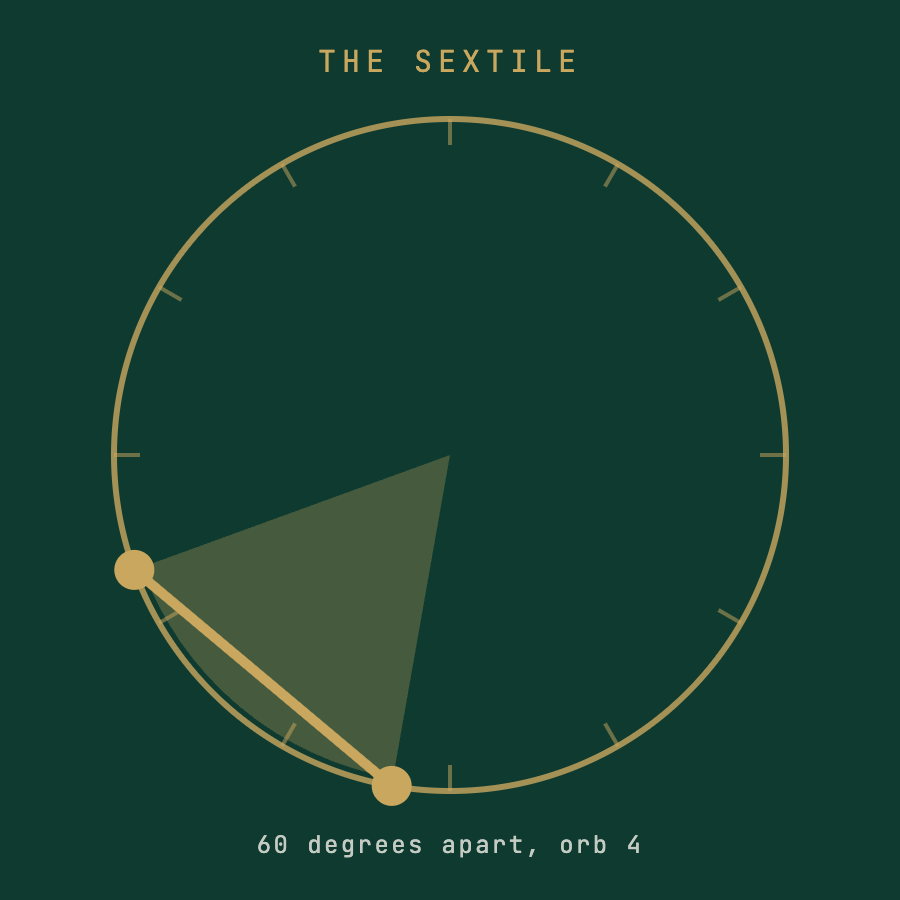
Two planets 60 degrees apart, a sixth of the circle. The sextile is read as an opportunity rather than a gift: cooperation that is available and does not happen unless somebody acts on it.
- opportunity
- ease
- cooperation
- potential
- mildness
What this describes
A sextile is a separation of 60 degrees, one sixth of the zodiac, which puts the two planets two signs apart. Those signs will always share a polarity and belong to compatible elements: fire with air, or earth with water. That compatibility is the whole basis of the reading.
The tradition classes it as harmonious and weak, and both halves of that matter. Ptolemy groups it with the trine as a favourable configuration and is explicit that it is the lesser of the two. The older texts call it the hexagon, after the six-sided figure it produces in the circle. What it describes is two functions that get on and are not fused, near enough to cooperate and far enough apart to remain distinct.
The modern gloss is opportunity, and it is a good one because it captures the conditionality. A trine is read as something that operates whether or not a person notices; a sextile is read as something available that requires a deliberate move. Nothing in the geometry says the move gets made. This is the aspect that most often describes a capacity somebody has and has never used, which is a more useful thing for a chart to say than most of what gets said.
What it does well
What a sextile describes well is a working relationship between two parts of a person that does not require effort to maintain but does require effort to use. The two planets are on speaking terms. Whether they say anything is a separate question.
Its practical value in a reading is that it points at unclaimed capacity. Most people have some combination of abilities that would work well together and have never been put in the same room, and this is the aspect that names them.
Third, it is the least dramatic aspect in the chart and that is a genuine advantage. Nothing about a sextile is a crisis, so a person is free to take it or leave it, and the things a person can decline are the things they can actually choose.
Where it goes wrong
The characteristic difficulty is that nothing forces the issue. A square produces friction a person has to deal with; a sextile produces an option they can ignore indefinitely, and most people do. The aspect is frequently a description of something that never happened.
The second is that it is easy to over-read. Because the tradition marks it as favourable, sextiles get counted in a chart as though each one were a small piece of good fortune. They are not events. They describe a possible cooperation and say nothing about whether it was ever attempted.
Third, its weakness is real. Ptolemy classed it as the lesser of the harmonious aspects and modern practice gives it the narrowest orb of the five, which are two ways of saying the same thing: this is the faintest signal in the standard set, and it should not carry much weight in a reading.
In relationships
In synastry a sextile between two charts describes ease that has to be acted on. Two people whose planets are sextile find each other straightforward and are not compelled toward each other by it, which is why this contact turns up in long friendships as often as in relationships.
That is a useful thing to be able to say. A great many connections are pleasant, workable and inert, and the tradition has a specific term for exactly that condition rather than treating everything as either passion or incompatibility.
What it cannot tell you is whether anybody will act. The aspect describes an open door. Whether either person walks through it is not in the chart, and any page claiming otherwise has stopped describing geometry and started making things up.
In work
At work the sextile describes a skill combination that is available and underused. Somebody with Mercury sextile Saturn has the capacity for sustained careful thinking and may have spent fifteen years in jobs that never asked for it.
The reading that follows is practical rather than predictive: it identifies something to try rather than something that will happen. A person can act on a sextile by deliberately taking work that requires both functions at once, and can equally go a whole career without ever doing so.
This is also the aspect most relevant to the ordinary business of getting better at things. Trines describe what somebody is already good at and does not think about; sextiles describe what they could become good at with effort that is genuinely available to them. The difference is worth keeping.
In money
A sextile has no financial content on its own. Like every aspect it takes its subject matter from the planets and houses involved, and the angle itself says only that two things could work together if somebody arranged it.
Where it is worth attending to is the unclaimed version. A sextile touching the second or eighth house describes a resource or an arrangement that is available and has not been set up, which is a different observation from a prediction and a checkable one: either the account exists or it does not.
Nothing on this page is financial advice, and the geometry cannot indicate an amount or a date.
How to read it in a chart
These pages use an orb of four degrees for the sextile, which is the narrowest of the five and reflects the tradition's view that it is the weakest. Other astrologers use three, five or six, and some scale the orb by planet rather than by aspect, so a sextile that appears on one chart will be absent from another drawn from the same birth data. Whenever a page reports aspects without naming its orbs it is presenting a convention as an observation.
Within that allowance, closer is stronger, and a sextile more than about two degrees off exactness is a faint signal that should not be carrying an argument.
In practice the sextile is worth reading last. It is the aspect most easily swamped: a sextile between two planets that are also in a tight square to something else is describing a possibility that the rest of the chart is busy overriding. Read the conjunctions, oppositions and squares first, then ask what quiet cooperation is available underneath them.
How it meets other placements
A sextile is easily overpowered, and that is the main thing to know about how it meets the rest of a chart. Where the same two planets also carry a square or an opposition from elsewhere, the harder aspect sets the tone and the sextile becomes a resource available during the calmer stretches rather than a description of the situation.
It also combines. Two sextiles converging on the same planet, with a trine closing the shape, produce the configuration sometimes called a minor grand trine, and the tradition reads the whole figure rather than the parts.
None of this yields a total. Counting favourable aspects against unfavourable ones is a modern habit with no basis in the older practice and no evidence behind it, and a chart is not a balance sheet.
The part people leave out
What popular astrology leaves out about the sextile is that it is mostly a description of things that did not happen. The language of opportunity is comfortable and the honest version is less so: a chart full of sextiles belonging to somebody who has done nothing with any of them is not a chart full of good fortune.
The second omission is that the aspect is frequently used as filler. It is the easiest thing to find in a chart, it always sounds encouraging, and it commits the reader to nothing. A page that leads with sextiles is usually a page with very little to say.
The third is that opportunity is not evenly distributed. Acting on a capacity requires time, money and the absence of an emergency, and none of that is in the geometry.
Where the symbol comes from
Aspects have no imagery. They are divisions of a circle, and the sextile is the circle divided by six, producing a regular hexagon whose vertices fall every 60 degrees.
The Greek name follows the figure directly. Ptolemy calls it the hexagonos, the six-sided one, exactly as he calls the square the tetragonos and the trine the trigonos. The names are geometrical descriptions rather than interpretations, which is worth noticing: the meanings were attached afterwards, reasoned from the properties of the shapes rather than derived from any observation of what planets at those angles appeared to do.
The reasoning for the sextile being mild runs through the elements. Signs 60 degrees apart always share a polarity and pair fire with air or earth with water, combinations the tradition treats as compatible without being identical. A trine joins signs of the same element and is read as stronger for that reason, and the sextile sits one step down from it by the same logic.
Where this meaning came from
Aspects are a Hellenistic development. Babylonian astrology recorded planetary positions and omens without any doctrine of angular relationships, and the system of aspects appears with the Greek-speaking synthesis worked out in Egypt between roughly the first century BCE and the second century CE.
The sextile is one of the four Ptolemy derives in the Tetrabiblos by dividing the circle, and he is consistent about its rank: harmonious, like the trine, and weaker. Later traditional practice kept that assessment for well over a thousand years, through Arabic and then Latin transmission, and gave it correspondingly small orbs. William Lilly, writing in seventeenth-century London, treats it as a mild benefic and rarely rests a judgement on one.
The modern reading as opportunity or potential comes with the twentieth-century psychological turn, running from Alan Leo around 1900 through Dane Rudhyar and the humanistic astrologers from the 1930s. That reframing suits this aspect better than most, because conditionality was already in the older assessment. It is still a reinterpretation rather than a translation, and a page that presents opportunity as the ancient meaning is overstating the continuity.
What the astronomy actually says
An aspect is an angular separation measured along the ecliptic, in celestial longitude, as seen from Earth. A sextile means two bodies appear 60 degrees apart in that one coordinate, from this one vantage point, and nothing more than that.
The consequence worth stating is that an aspect is not a relationship between the planets. It is a fact about how they line up from here. Move the observer and every angle changes: from Mars, the same two bodies at the same moment would be at a completely different separation, and the entire aspect pattern of a chart would dissolve and reform. A sextile is therefore a statement about the Earth's position as much as about the planets.
Latitude is also discarded, since aspects use longitude alone, so two bodies described as sextile may be further apart in the sky than the number suggests. And 60 degrees has no physical significance. There is no known process by which bodies at that separation interact differently from bodies at 59 or 61, and no mechanism for any of it has ever been demonstrated.
The common misreading
The commonest misreading of the sextile is that it means something good is going to happen. It describes a standing possibility, not an event, and the difference is the whole aspect. A sextile that nobody acts on produces precisely nothing, which is the ordinary outcome rather than the exception.
The second is inflation by counting. Sextiles are common, they are easy to spot, and a reading can be padded with them indefinitely without ever saying anything a person could check or disagree with. When a chart interpretation feels warm and weightless, sextiles are usually why. The tradition rated this aspect as the weakest of the five and modern practice gives it the smallest orb, and both of those are instructions to lean on it less, not more.
The third is treating the opportunity framing as neutral. It carries an implication that anybody could act if they chose, and that implication does a lot of quiet work. Whether a capacity can be developed depends on circumstances a chart has no access to, and telling somebody their difficulties are unrealised potential is a judgement dressed as a reading.
Questions to sit with
- What are you good at that your current work has never asked for?
- Which two of your abilities have never been used on the same problem?
- What have you been meaning to start that nothing is forcing you to?
- Is what you call unrealised potential actually available to you, or does it need time and money you do not have?
See where this sits in your own chart.