- Entry type
- Aspect
The Square
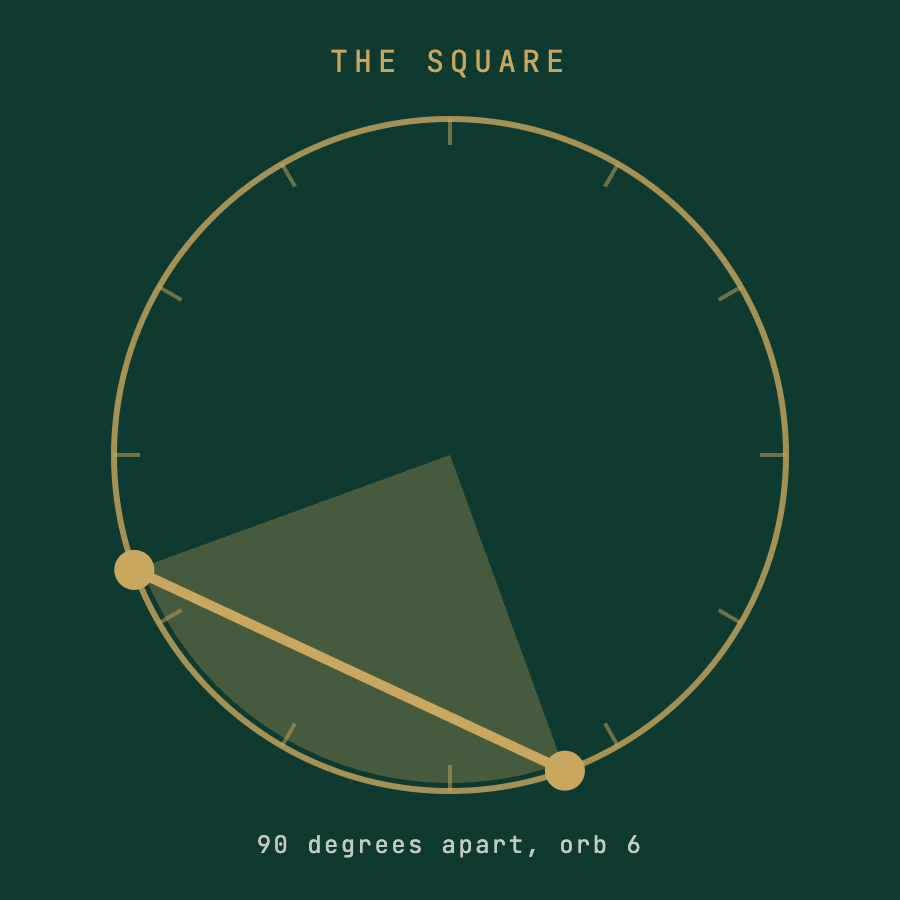
Two planets 90 degrees apart, a quarter of the circle. The square is the aspect of friction: two functions that both demand action and cannot both have it, in signs that share a modality and nothing else.
- friction
- tension
- obstruction
- pressure
- conflict
What this describes
A square is a separation of 90 degrees, a quarter of the zodiac, putting the two planets three signs apart. Those signs always share a modality and never share an element or a polarity, which is the geometry of the reading: two things operating at the same tempo, wanting incompatible outcomes, and unable to ignore each other. Unlike a conjunction, which fuses, a square keeps the two functions distinct and at odds.
The tradition classed it as malefic without qualification. Ptolemy groups the square with the opposition as the difficult configurations, and traditional practice through the medieval and Renaissance periods read it as obstruction, conflict and things going wrong. The Greek name is the tetragonos, the four-sided figure, since the square divides the circle in four. That is not a metaphor for growth. It is what the texts say.
Modern astrology reframed it as productive tension, the aspect that makes a person do something, and that reframing is roughly a century old. It is a genuine improvement in a lot of ways and it is worth knowing which layer you are reading. The honest position is that a square describes pressure between two parts of a chart. Whether that pressure produces anything depends entirely on the person, and neither the ancient reading nor the modern one can tell you which it was.
What it does well
What a square does that no easy aspect does is compel attention. A trine can be ignored for a lifetime because nothing about it hurts. A square arrives repeatedly, in the same form, until something is done about it, and that is why the placements people actually develop tend to be the ones they were forced to.
Its second value is diagnostic precision. A square is specific. It names two functions and says they are in conflict, which is a far more useful statement than a general observation about somebody being conflicted.
Third, the friction is often where the work comes from. A person with a square between their Sun and Saturn will usually have built something, because the alternative was living with the pressure. That is not a promise and it is a pattern the tradition and modern practice both recognise.
Where it goes wrong
The characteristic difficulty is that a square does not resolve. Two planets three signs apart stay three signs apart, and the tension between what they describe is a permanent feature of the chart rather than a phase. Somebody expecting to finish with it is going to be disappointed.
The second is repetition. The same conflict tends to arrive in a new costume every few years, and because the costume is new it can take a very long time to notice that the shape underneath is identical.
Third, the modern reframing has a cost. Calling a square an opportunity for growth is kinder than calling it malefic, and it also quietly implies that anybody still struggling with theirs has failed to do the work. Some squares describe circumstances rather than character, and no amount of insight rearranges a circumstance.
In relationships
In synastry a square between two charts is the contact that produces heat and does not go away. Two people connected this way tend to find each other compelling and difficult in the same proportion, and the pattern usually repeats: the same argument, in different words, for years.
The tradition read this as straightforwardly bad and modern practice reads it as chemistry. Both are describing the same observation, which is that the connection does not settle. Whether that is worth having is a judgement about a life rather than about a chart.
What it cannot tell you is whether to stay. A square describes a structural friction between two people, and structural friction is compatible with a good relationship and with a bad one. That decision has never been available from geometry.
In work
At work a square describes a recurring bind rather than a weakness. Somebody with Mars square Saturn has drive and caution operating at the same speed and pulling opposite ways, which shows up as a person who is either pushing too hard or stalling and rarely finds the middle setting.
The practical value is that binds can be designed around once they are named. A person who knows their conflict is between speed and thoroughness can build a process that handles it rather than continuing to experience it as a personal failing every time.
What the aspect does not do is predict a career or explain an outcome. Plenty of accomplished people have difficult charts and plenty of unaccomplished people have easy ones, and any page implying that squares produce achievement is reading backwards from success stories.
In money
A square has no financial meaning of its own; it takes its subject from the planets it connects. Where it touches money, what it describes is a recurring tension rather than a shortage.
The common shape is a conflict between two legitimate demands on the same resource: security against opportunity, obligation against want. Both sides are reasonable, which is why the conflict repeats rather than resolving, and naming it as structural is more useful than treating each instance as a fresh failure of discipline.
Nothing on this page is financial advice and no aspect indicates an amount. The tradition did make predictions of that kind, they did not work, and modern practice quietly dropped them rather than saying so.
How to read it in a chart
These pages use an orb of six degrees for the square. Common alternatives run from five to eight, and some widen it for the Sun and Moon or use per-planet orbs, which means a square present on one chart is absent from another built from the same birth data. Any page reporting aspects without stating its orbs is presenting a convention as a finding.
Closeness matters more here than with a sextile, because a tight square is recognisable and a wide one often is not. Within two degrees, expect it to land; at five or six, treat it as background.
Two further distinctions. A square is applying when the faster planet is still closing on the exact angle and separating afterwards, and traditional practice treats applying aspects as the live ones. And the signs involved tell you the flavour: cardinal squares are read as conflicts about direction, fixed squares as deadlocks, mutable squares as conflicts that keep changing shape. That refinement costs nothing and improves the reading.
How it meets other placements
A square rarely operates alone. Where a third planet sits opposite one of the pair and square the other, the configuration becomes a T-square, which the tradition reads as a whole rather than as its parts and treats as considerably more forceful.
Other contacts change the tone rather than removing it. A trine reaching one side of a square gives the tension somewhere to discharge; nothing reaching it at all describes a bind with no outlet, which is the harder configuration and the one worth naming plainly.
What none of this supports is arithmetic. Counting squares against trines to decide whether a chart is good is a modern habit, it has no basis in the older practice, and there is no evidence that the totals mean anything at all.
The part people leave out
What popular astrology leaves out about the square is that the growth framing is a sales position. Difficult charts are harder to sell than easy ones, and reinterpreting every hard aspect as a challenge to be overcome makes the product bearable. That does not make it false. It makes it a choice, and choices should be visible.
The second omission is that some squares are about circumstances. The tradition read this aspect for obstruction arriving from outside, and the modern habit of locating everything inside the psyche has quietly transferred responsibility for a person's difficulties onto the person.
The third is the survivorship problem. Squares get credited with the achievements of people who managed, and no page ever counts the people the same configuration described who simply had a harder time.
Where the symbol comes from
Aspects are geometry rather than imagery. The square is the circle divided by four, producing the four-sided figure Ptolemy calls the tetragonos, and every claim about its meaning was reasoned from that division rather than observed in the sky.
The reasoning runs through the signs. Three signs apart puts two planets in the same modality and in elements the tradition treats as incompatible: fire with water or earth, earth with air or fire, and so on. Same tempo, opposed material. A trine, by contrast, joins signs of one element and is read as easy for exactly that reason. The whole benefic and malefic scheme is built out of this kind of correspondence.
The glyph is a plain square, and it is one of the few astrological symbols that means what it depicts. It postdates the doctrine by more than a thousand years; the Greeks wrote the word rather than drawing a sign.
Where this meaning came from
Aspects appear with Hellenistic astrology, assembled in Greek-speaking Egypt between roughly the first century BCE and the second century CE. Babylonian practice tracked planets and omens and had no systematic geometry of angles at all.
The square is one of the four Ptolemy derives in the Tetrabiblos by dividing the circle, and he places it firmly among the difficult configurations alongside the opposition. That classification held for a very long time. Medieval Arabic astrologers kept it, Latin translators carried it into Europe, and William Lilly in seventeenth-century London treats a square as a straightforward indication that a matter will be obstructed.
The reversal is twentieth-century. Alan Leo began recasting the chart as psychology around 1900, and Dane Rudhyar and the humanistic astrologers from the 1930s completed the shift, turning malefic aspects into developmental tasks. By the later twentieth century the square had become the aspect that builds character. That is a reinterpretation of the same geometry, made for defensible reasons, and it is about a hundred years old rather than ancient. Both readings are in circulation now and most pages do not distinguish them.
What the astronomy actually says
An aspect is an angular separation measured along the ecliptic, in celestial longitude, as seen from Earth. A square means two bodies appear 90 degrees apart in that single coordinate, from this single vantage point.
That makes it a statement about an appearance rather than about the planets. Nothing physical distinguishes 90 degrees from 89 or 91, and no known process makes two bodies behave differently at one separation than at another. From anywhere other than Earth the angles would all be different and the entire aspect pattern of a chart would be a different pattern.
The square does have one visible counterpart worth knowing. When the Moon is 90 degrees from the Sun it is at quadrature, and that is exactly when we see it half lit: the first quarter and the last quarter are squares between the two bodies. The Moon's phases are the one place where an aspect corresponds to something anybody can go outside and check, and the correspondence is a matter of geometry and sunlight rather than of influence. No mechanism has ever been demonstrated for the astrological claim.
The common misreading
The commonest misreading of the square is that it is good for you. The growth framing has become so standard that a person told they have a difficult aspect is now routinely told in the same breath that it is secretly an advantage. Sometimes it is. Often it is a description of a recurring difficulty that has cost somebody a great deal, and the reflex to find the upside is a way of not sitting with that.
The second is the opposite error, inherited from the tradition: reading a square as a verdict. It is not an event, a prohibition or a forecast. It describes a standing tension between two parts of a chart, and standing tensions are compatible with every kind of life.
The third is treating it as rare or significant by its presence. Squares are common. Almost every chart has several, and a reading that presents one as an explanation for a person's difficulties has selected it from a set of candidates rather than found it. If a square is going to carry weight in an interpretation, it should be tight, it should involve the relevant planets, and the reader should be told the orb it was found at.
Questions to sit with
- What argument have you been having, in different words, for years?
- Which two things you want are genuinely incompatible, rather than merely hard to schedule?
- What did you build because the alternative was living with the pressure?
- Is this difficulty inside you, or is it a circumstance you have been blaming yourself for?
See where this sits in your own chart.