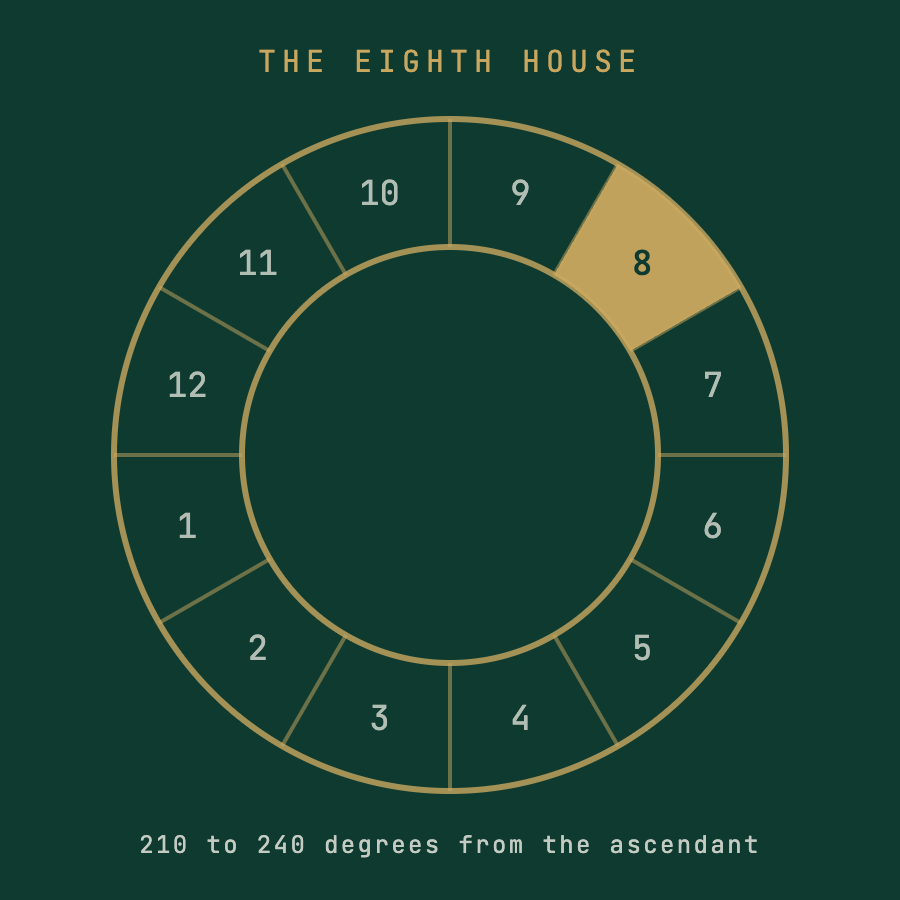
- Entry type
- House
- Number
- 8
- Element
- Water
- Modality
- Fixed
- Modern ruler
- Pluto
The Eighth House
The house the Greeks called Idle: inheritance, other people's money, and death. The eighth house covers what a person does not control alone, and what changes hands when circumstances change without being asked.
- inheritance
- joint finance
- debt
- intimacy
- exposure
What this describes
The eighth house covers what is not solely yours. Money held jointly, inheritance, debts, a partner's resources, and anything that changes hands because of an event rather than a transaction. The Greek writers called it Argos, the Idle place, and the Latin name is simply Mors, death.
The modern reading of this house as transformation, intimacy and psychological depth is real, and it is recent. The older significations are considerably more concrete and considerably bleaker: this was the house of dying, of what is inherited when somebody does, and of the fear attached to both. Almost everything warm now attached to the eighth arrived in the twentieth century, much of it after Pluto was discovered in 1930 and assigned to the house's natural sign.
It takes Scorpio as its natural sign, is succedent rather than angular, and is the counterpart of the second house, which covers what a person owns outright. The pair divide a single subject between them: resources you control, and resources you are entangled in.
What it does well
A well-supported eighth house shows up as competence with the things other people avoid. Wills, debts, the finances of a dead relative, the conversation nobody wants to start: somebody has to handle these, and this house describes whoever can.
It also produces genuine tolerance for depth. The eighth is where a person can stay in a subject past the point where it becomes uncomfortable, which is the actual basis of the modern association with intimacy. Closeness is largely a matter of not leaving when the material gets difficult.
Third, it supplies realism about dependence. A strong eighth knows what it is entangled in and with whom, which is unglamorous and prevents a specific and expensive category of surprise.
Where it goes wrong
The eighth house goes wrong through unexamined entanglement. Joint arrangements accumulate without ever being stated, and the trouble only surfaces when something forces an accounting: a separation, a death, a default.
The second failure is the house's own subject matter turning into a preoccupation. The eighth covers what cannot be controlled, and a difficult eighth often describes somebody managing that through constant vigilance, which does not reduce the risk and does consume the life.
Third, secrecy that has outlived its reason. This is the house of what is not discussed, and information withheld for a good reason at the time has a way of staying withheld long after the reason has gone. That is how ordinary financial facts turn into family secrets.
In relationships
The eighth house is the entangled part of a relationship rather than the agreed part. The seventh is the arrangement; the eighth is what two people are jointly exposed to because of it.
The modern association with sex belongs here and is worth stating carefully. What the house actually describes is what two people come to share that cannot easily be separated again, and physical intimacy is one instance of that rather than the definition of it. Where a chart is read for a relationship question, the eighth is the house that asks what would have to be untangled if it ended, which is an uncomfortable question and usually a clarifying one.
In work
At work the eighth house governs other people's money in a professional sense: budgets held rather than owned, client funds, investment, insurance, tax, debt, and the administration of estates. It is the natural house of several real professions and the tradition is straightforward about it.
It also covers the part of a job that involves handling what other people find distasteful. Every organisation has work of this kind, and it is usually done by a small number of people who turn out to be quietly indispensable. Where a chart is read for vocation, the eighth is worth checking before the tenth, because it often explains what somebody is actually valued for.
In money
This is the joint finance house, and the distinction it draws with the second is the useful part. The second house is what a person owns; the eighth is what they hold with somebody else, owe, are owed, or stand to receive.
Traditional texts assign it inheritance and dowry, and the underlying signification survives intact: money that arrives or departs because of a relationship or an event rather than because of work. The practical observation is that these are the arrangements least often written down. Nothing here is advice about anybody's finances, and nothing in a chart indicates whether money will arrive.
How to read it in a chart
Read the eighth as you read any house: the sign on its cusp, the ruler of that sign, and whatever occupies it.
The cusp sign describes the manner of entanglement. An eighth cusp in an air sign describes joint arrangements that get discussed; in a water sign, ones that are felt and left unspoken. The ruler of that sign then locates the matter: an eighth cusp in Gemini puts the house under Mercury, and Mercury's placement is where the joint business actually gets settled, or avoided.
Planets in the eighth take over the reading. Saturn there is the classic marker of joint arrangements experienced as a weight. An empty eighth house is entirely ordinary and carries no implication whatever about death, which is not something a chart can speak to at all.
How it meets other placements
The eighth sits opposite the second, and the axis is about resources: what is yours alone against what is shared or owed. Charts weighted heavily toward the second can be self-sufficient to the point of isolation; weighted heavily toward the eighth, entangled to the point of having no independent position.
As a succedent house it groups with the second, the fifth and the eleventh, the places describing what accumulates.
It relates closely to the twelfth as well, since both fail to aspect the Ascendant in the classical scheme and both cover what operates outside a person's view.
Between two charts, planets falling in each other's eighth describe people who become financially or psychologically entangled, which is not the same thing as people who are good for each other.
The part people leave out
The part popular astrology leaves out is how grim this house was. Argos means idle or inactive, and the Latin name is Mors. The eighth was not a place of transformation in the sources. It was the place of dying, and of the property that moved because somebody had.
The second omission is that the modern reading has made the house glamorous. The eighth is now routinely described in terms of intensity, taboo and psychological power, and that framing is attractive enough to obscure the ordinary content: most eighth house material in a real life is paperwork about money belonging partly to somebody else, conducted at a bad time.
Where the symbol comes from
The Greek name, Argos, means idle or inactive, and the reason is technical rather than poetic. In the Hellenistic system a house takes strength from aspecting the Ascendant, and the eighth forms no classical aspect to the first: it cannot see the house of the self. Places that could not see it were described as inactive, and the eighth was among the worst regarded of them.
The Latin name is Mors, death, and the significations follow directly from it. What happens at a death is that property moves, so inheritance sits here, and so do debts, dowries and anything else changing ownership through an event rather than an exchange.
No planet has its joy in the eighth. The tradition simply left it unassigned, which in a system mapped as thoroughly as this one is itself a kind of statement about the place.
Where this meaning came from
The twelve houses come from the Hellenistic synthesis in Egypt from about the second century BCE, and the eighth was a difficult place in the scheme from the beginning. Vettius Valens treats it as the house of death and of what is inherited, and Firmicus Maternus does the same.
Predicting the manner and timing of death from the eighth house was a serious technical exercise in traditional astrology, pursued through the medieval Arabic and Latin material and into the seventeenth century. It did not work. That failure is one of the clearest cases in the whole history of the subject where a specific, testable claim was made repeatedly and did not hold up.
The modern eighth house is a different construction. Pluto was discovered in 1930 and assigned to Scorpio, and the psychological astrology of the mid-twentieth century, particularly the work following Dane Rudhyar, rebuilt the house around transformation, depth and intimacy. That reading is now dominant, and it is about ninety years old against roughly two thousand for the older one.
What the astronomy actually says
This is a good place to say where house systems stop working altogether.
Quadrant systems such as Placidus and Koch divide the time or the space between the angles, and both assume that every degree of the ecliptic rises and sets. Above the Arctic and Antarctic circles, at latitudes beyond about sixty-six and a half degrees, that assumption fails: on a given day some degrees of the ecliptic never rise at all. Placidus cannot generate cusps for them, and well before those latitudes it produces houses of wildly unequal size. Charts for Tromso or Fairbanks are the standard example.
Whole sign and equal house have no such problem, because they ignore the horizon geometry and simply count thirty degrees at a time from a starting point. They work at any latitude, including the poles.
That the most widely used system cannot produce an answer for people born in northern Norway is worth knowing. It does not settle which system is right, and astrology has never demonstrated a mechanism for any of them.
The common misreading
The eighth house attracts one genuinely harmful misreading: that it says something about how or when a person will die. The tradition made those judgements for well over a thousand years and they failed. Nothing in a chart indicates the timing or the manner of anybody's death, and a reader who suggests otherwise is producing fear in exchange for no information.
The second misreading runs the other way. Popular writing has replaced death with transformation so completely that the house's actual content has disappeared: joint finances, debts, inheritance, and the practical business of things belonging partly to somebody else. Those are the eighth house matters most people will actually encounter, and they are hard to look up, because the pages are all about intensity.
The third is the sex signification, which is modern and frequently overstated. The older sources do not make the eighth a house of sexuality; that association arrived with Scorpio and Pluto in the twentieth century. It is a defensible extension of the idea of what two people share inseparably. It is not what the tradition said.
Questions to sit with
- What are you financially entangled in that has never been written down?
- What would have to be untangled if your closest arrangement ended tomorrow?
- Which family fact is not discussed, and who does the silence protect?
- What do you avoid handling because it is somebody else's to handle, and is it actually theirs?
See where this sits in your own chart.