- Entry type
- Sign
- Number
- 8
- Abbreviation
- SCO
- Element
- Water
- Modality
- Fixed
- Polarity
- Receptive
- Modern ruler
- Pluto
- Traditional ruler
- Mars
- Dates
- October 23 - November 21
- Symbol
- The Scorpion
- Traditional body rulership
- Reproductive system
- Matching tarot card
- Death
Scorpio
The sign of what is not being said. Scorpio describes the appetite for what lies under a situation, and the tradition treats that as a way of paying attention rather than as a talent for secrecy.
- depth
- privacy
- intensity
- persistence
- suspicion
What this describes
Scorpio is the eighth sign, fixed water, and it is the only one in the modern scheme with two rulers in circulation. Mars ruled it for about two thousand years; Pluto was assigned to it in the decades after 1930. Most contemporary writing uses Pluto and does not mention that the substitution is ninety years old, which is the single most useful thing to know about the sign.
What it describes is depth of attention. Fixed water holds, and what it holds is whatever it has decided matters: a person, a question, a grievance. The sign is associated with the parts of life that are not discussed in public, money held jointly, death, sex, inheritance, what somebody is actually afraid of, and that association comes from the eighth house rather than from the scorpion.
Read opposite Taurus, the pair divide the material world into what a person owns alone and what is shared, held or owed. Taurus accumulates; Scorpio deals with the things that cannot be kept. The tradition is unusually unsentimental here, and the modern reputation for intensity is a thinner version of something colder and more precise. Nothing in the older sources describes the sign as dangerous; they describe it as thorough.
What it does well
Scorpio is good at not being deflected. Most people accept the surface account of a situation because pressing further is socially awkward; this placement does not, and it is the reason the sign turns up in every list of investigators, therapists and researchers ever compiled.
It is also good in a crisis of a particular kind. Fixed water does not panic and does not look away, so it is unusually able to sit with somebody in a bad hour without needing to fix it, cheer them up or leave. That is rarer than general competence and much more valuable.
Third, it keeps its word. The tradition describes loyalty here as absolute and slow to grant, and the two halves of that are the same fact: a thing given carefully is a thing given properly.
Where it goes wrong
The failure is not cruelty, which is the accusation the sign attracts and mostly does not earn. It is that the same attention which sees through a situation also builds a private case, and the case is constructed without the other person present. By the time a Scorpio raises something, it has usually been decided for months.
The second is the withholding. Fixed water can simply stop, and a person who has quietly closed a door does not always announce it. That is not manipulation; it is worse in a way, because manipulation at least assumes the other person is still in the conversation.
Third, the depth becomes a standard. This placement is described as finding ordinary sociability slightly fraudulent, which is a lonely position to hold and an unfair one to apply to people who are simply being pleasant.
In relationships
In relationships the tradition reads Scorpio as all or nothing, and the phrase is more literal than it sounds. The sign is described as slow to commit and total once it has, with very little available in between, and the people who find this overwhelming and the people who find it the only thing worth having are usually describing the same behaviour.
The recurring difficulty is that intensity gets confused with intimacy. Knowing everything about somebody is not the same as being known by them, and this placement is far more comfortable with the first than the second.
What a specific person actually does is not readable from a Sun sign. Venus, the Moon and the eighth house all carry more weight here.
In work
Scorpio is the placement the tradition assigns to work involving what other people would rather not handle. The older lists say surgeons, undertakers and tax collectors; the modern equivalents are auditors, investigators, security researchers, crisis managers and anybody who deals professionally with other people's money or other people's secrets.
Its advantage is stamina on a single problem. This is not a fast sign and it is not a broad one. It is the placement that is still working on the same question in month fourteen, when everybody else has concluded there is nothing there.
The characteristic cost is that it does not explain itself while working, which reads as secretiveness to colleagues and produces a great deal of avoidable suspicion. Saying what you are doing, before somebody asks, is the correction.
In money
Scorpio is the sign attached to the eighth house, which in traditional practice covers shared resources rather than personal ones: joint accounts, debts, inheritance, insurance, anything where the money belongs to more than one party. That is a much more specific claim than the modern shorthand about power and control.
The characteristic pattern is privacy. This placement is described as reluctant to disclose its position even to people who need to know it, which is defensible in general and expensive inside a household or a partnership. The observation is about the habit, not about the balance, and nothing on this page is advice about either.
How to read it in a chart
The Sun in Scorpio describes what somebody is trying to get to the bottom of. The Moon in Scorpio describes a person who does not show distress and feels it at full volume, which the tradition calls a difficult placement and means it. A Scorpio Ascendant reads as watchful and self-contained, and is frequently experienced by other people as being assessed.
Rulership is where care is needed. Mars is the traditional ruler and Pluto the modern one, and they give different readings: Mars describes drive, appetite and conflict; Pluto describes compulsion and things that cannot be undone. Traditional practice reads Mars and treats Pluto as a late addition; most modern books do the reverse without saying so. Checking both is more honest than choosing.
Scorpio is most often confused with Capricorn, because both are reserved. Capricorn is guarding a position; Scorpio is guarding information.
How it meets other placements
Element logic puts Scorpio with the other water signs, Cancer and Pisces, and with earth, which is described as containing it. Fire and air read as friction: fire finds the sign's pace unbearable and air would rather keep the conversation general, which this sign experiences as evasion.
Modality is the sharper axis. Scorpio is fixed, and the other fixed signs, Taurus and Leo and Aquarius, sit at ninety or a hundred and eighty degrees. Fixed pairs do not resolve conflicts so much as outlast them, and two of these together can maintain an unspoken disagreement for years without either raising it.
None of this grades a relationship, and the compatibility charts built from Sun signs alone are the thinnest use anyone has ever made of this material.
The part people leave out
What popular astrology leaves out about Scorpio is how much of the intensity is fear of exposure. The sign is written up as powerful, and the older material describes something more defensive: a person who knows a great deal about everybody else partly so that nobody has to know much about them.
That is worth saying plainly because the flattering version has done real damage. Being hard to read is not the same as being strong, and a placement built around never being caught out is a placement that has decided in advance that being caught out would be unsurvivable.
The other omission is the pleasure taken in it. The tradition is honest that this sign enjoys knowing, and enjoying knowing is a form of appetite like any other, with the same capacity to become the point.
Where the symbol comes from
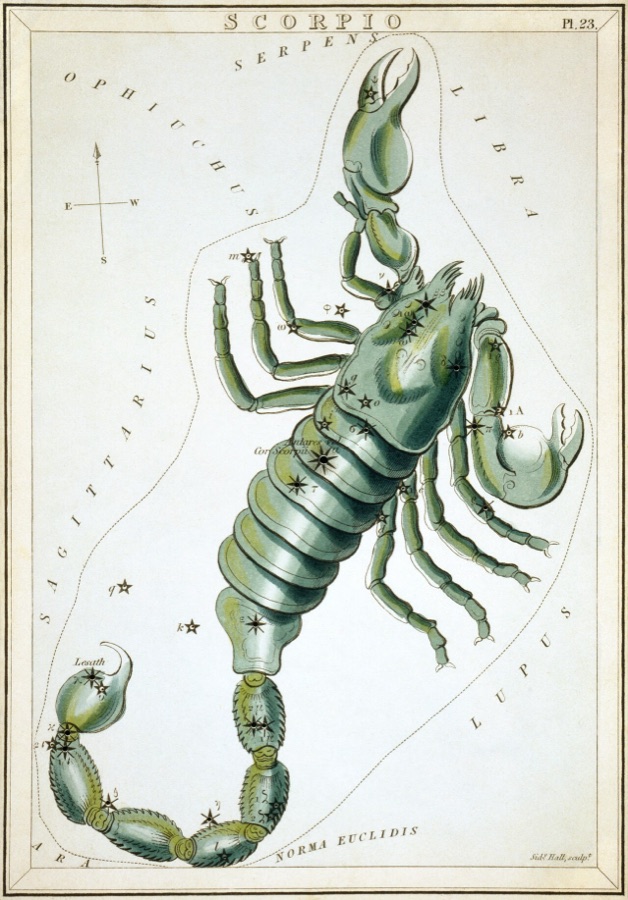
The scorpion is Babylonian and it is very old, one of the earliest identified figures in that part of the sky. The Greek story attaches it to Orion: a scorpion sent to kill the hunter, with both placed in the sky afterwards on opposite sides, so that one sets as the other rises and they are never visible together. That is a good piece of observational astronomy dressed as a myth, and it is accurate.
The scorpion is also the only zodiac animal whose defining feature is a weapon that is not used first. A scorpion stings when cornered, which is a more exact emblem for the sign than the predatory reading it usually receives.
The glyph is an M with an arrow on the final stroke, and it is conventionally paired with the Virgo glyph, which is an M with a closed loop. The two are usually explained as a matched pair, and the explanations offered for what they originally depicted are guesswork.
Where this meaning came from
The scorpion is on the earliest Babylonian star lists, and for most of antiquity it was much larger than it is now: the stars that became Libra were its claws until Roman practice separated them. The twelve equal signs were standardised in Mesopotamia by about 500 BCE.
The Hellenistic system, assembled in Greek-speaking Egypt between roughly 100 BCE and 200 CE, gave Mars rulership of both Aries and Scorpio, made Scorpio fixed water, and connected it to the eighth house, which covered death, inheritance and shared property. Ptolemy recorded the arrangement in the Tetrabiblos. That is the version that ran, essentially unchanged, for the next eighteen centuries.
Pluto changes the picture and the change is recent. Discovered in 1930 by Clyde Tombaugh, it was assigned to Scorpio by astrologers over the following decades, and the modern vocabulary of transformation, power and the underworld arrived with it. The sign was read perfectly well without any of that for two thousand years. Anybody presenting Pluto's Scorpio as the ancient meaning is describing a twentieth-century revision, and the honest thing is to say which layer a given claim comes from.
What the astronomy actually says
Scorpius is the constellation the Sun crosses fastest. It spends only about seven days in front of it, from roughly the twenty-third to the twenty-ninth of November, and then about eighteen days in Ophiuchus, a thirteenth constellation the ecliptic passes through and which the standard zodiacs do not use. Every few years this is rediscovered and reported as news.
Antares, its brightest star, is a red supergiant several hundred times the diameter of the Sun and roughly five hundred and fifty light years away. Its name means rival of Ares, given for its colour, which is why Mars ruled the sign long before anybody thought about Pluto.
Pluto is the other astronomical point worth making plainly. It takes about two hundred and forty-eight years to orbit the Sun, so it spends a decade or more in each sign and describes generations rather than individuals. The International Astronomical Union reclassified it as a dwarf planet in 2006. That reclassification is a decision about naming conventions and has no bearing on astrological practice either way, which is worth saying because both sides have claimed otherwise.
The common misreading
The most common misreading of Scorpio is as danger. The sign has acquired a reputation for vengeance and manipulation that the older sources simply do not support; Ptolemy has nothing of the kind, and the vocabulary of darkness and power arrives with Pluto in the twentieth century. What the tradition describes is a fixed water sign that pays close attention and does not let go, which is a description of persistence rather than of malice.
The second is the sexual caricature. It comes from the eighth house, which in Hellenistic practice covered death, inheritance and shared property, and acquired its modern association with sex through a long chain of reinterpretation. The house is about what is held jointly and cannot be separated cleanly; sex is one instance of that and the tradition never made it the headline.
The third is people with the placement believing the caricature about themselves. A sign described as intense and secretive gives somebody permission to withhold and to call it depth. The tradition offers no such licence, and the difference between a person who is genuinely private and a person who is simply not answering is one that only the people around them can see.
Questions to sit with
- What have you concluded about somebody without telling them?
- What are you keeping private, and who is it protecting?
- Is your attention on this still useful, or has it become a habit?
- When did you last let somebody know something about you before they found out?
See where this sits in your own chart.