- Entry type
- Sign
- Number
- 4
- Abbreviation
- CAN
- Element
- Water
- Modality
- Cardinal
- Polarity
- Receptive
- Modern ruler
- Moon
- Traditional ruler
- Moon
- Dates
- June 21 - July 22
- Symbol
- The Crab
- Traditional body rulership
- Chest and stomach
- Matching tarot card
- The Chariot
Cancer
The sign of what gets protected. Cancer describes the instinct to build a safe interior and defend it, and the tradition reads that as a strategy for surviving exposure rather than a temperament of weakness.
- protection
- memory
- attachment
- indirectness
- loyalty
What this describes
Cancer is the fourth sign, cardinal water, and it begins at the June solstice. Cardinal signs start a season, so despite the reputation for softness this is an initiating sign: it does not wait to be approached. What it initiates is closeness rather than action, which is why it is so often mistaken for passivity. The solstice matters here: it is the longest day, the point at which the light stops increasing and begins to withdraw.
The tradition reads it as the placement concerned with belonging, home, family, memory, the people you would answer the phone to at three in the morning. That is a narrower claim than it sounds. The sign is not about being nice. It is about where somebody's loyalty is actually filed, and loyalty of that kind is exclusive by definition. Cancer is warm inside a boundary and considerably less warm outside one.
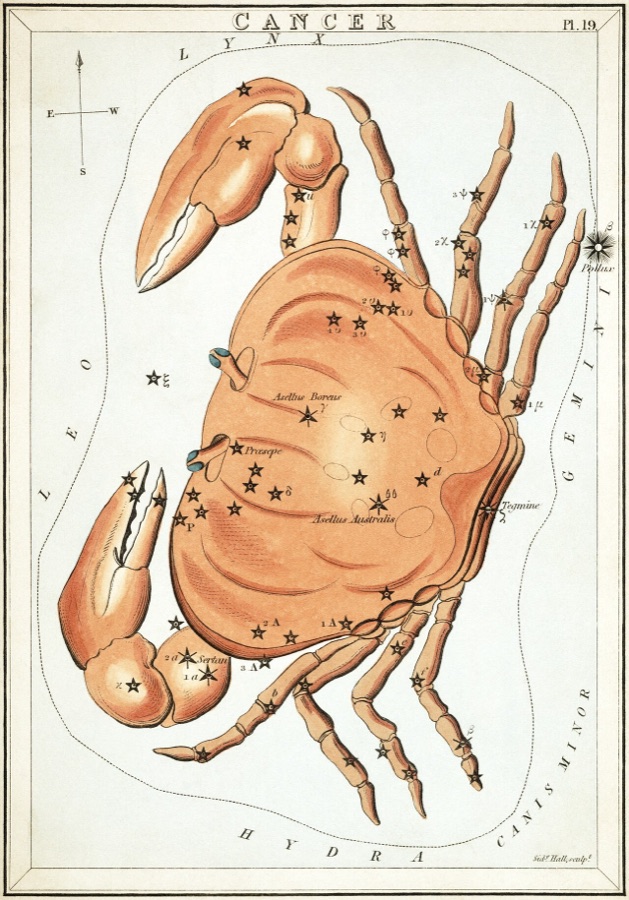
The crab is a good emblem for this and a poor one for the modern reading of it. It has armour on the outside and nothing inside, and it moves obliquely rather than head-on. Read opposite Capricorn, the pair divide the world into the private and the public, the household and the institution, and each is unusually bad at the other one's job.
What it does well
Cancer is good at care that costs something. Not sentiment: the practical, repeated, unglamorous work of noticing what somebody needs and doing it without being asked. Most households run on one person doing this, and the tradition puts that person here.
It is also good at memory. The sign is associated with holding the history of a family or a group, which is a real function and usually an invisible one, and it is the reason this placement is often the person everybody rings when something goes wrong.
Third, it is far tougher than the reputation. Cardinal water initiates, and a Cancer defending someone else is direct in a way that surprises people who had filed the sign under gentle.
Where it goes wrong
The failure is not moodiness, which is the standard accusation and mostly means the person had a feeling in public. It is indirectness. Cancer is described as asking sideways, hinting, withdrawing and waiting to be pursued, and then treating the failure to be understood as evidence of not being loved.
The second is the ledger. Care given at cost is easy to start counting, and a person who counts becomes a person owed. Very few resentments in the world are as durable as the ones built out of unrequested help.
Third, the boundary hardens. The same instinct that makes a safe interior makes a small one, and a life can be arranged so that only four people are ever admitted to it.
In relationships
This is the placement the tradition associates most strongly with domestic attachment: not romance in the pursuit sense but the long, ordinary business of sharing a kitchen with somebody. Cancer is described as slow to open and very difficult to dislodge once it has.
The recurring difficulty is that the sign wants to be known without having to explain itself. Being asked directly what is wrong can feel like a failure of the relationship rather than a repair to it, and the person on the other side is usually not a mind reader and has not been told so.
A Sun sign is thin evidence here. The Moon, which rules Cancer, describes emotional need far more directly, and the fourth house describes home in a way no sign alone can.
In work
At work Cancer is the person who holds the team together, and the tradition is old enough to be blunt about how that goes: it is essential, it is invisible, and it does not appear on a performance review. The associated occupations in the older lists are all custodial: nursing, catering, teaching the young, keeping house, managing property.
The modern translation is anything where the work is looking after a system or a group over time. It is a poor fit for roles that require constant exposure to strangers, and a very good fit for roles where the same twelve people have to keep functioning for years.
The practical warning is about being taken for granted, which this placement is unusually vulnerable to and unusually reluctant to raise.
In money
Cancer is read as saving for a reason rather than saving in general. The reason is usually a person or a house, and the sign is described as unusually willing to go without in order to protect somebody else's position.
The characteristic pattern is money as security rather than as opportunity, which produces caution that can be either sensible or costly depending on circumstances this page cannot see. The thing worth naming is emotional: for this placement a financial decision is rarely only financial, and the anxiety attached to it is often about somebody who is not in the conversation. That is worth noticing before the spreadsheet, not instead of it.
How to read it in a chart
The Sun in Cancer describes what somebody is trying to protect. The Moon in Cancer is the strongest version of the sign, because the Moon rules it: the tradition calls that domicile, and it describes emotional needs that are unmistakable and hard to negotiate with. A Cancer Ascendant reads as guarded and courteous on first meeting.
The ruler is the Moon, which moves through the whole zodiac in about twenty-seven days, so its sign is the most rapidly changing thing in a chart and the most sensitive to an inaccurate birth time.
Cancer is most often confused with Pisces. Both are water and both are read as sensitive. Pisces is mutable and diffuse, absorbing whatever is around it; Cancer is cardinal and defended, with a clear inside and outside. If somebody has no boundaries at all, that is not this sign.
How it meets other placements
Element logic puts Cancer with the other water signs, Scorpio and Pisces, and with earth, which is described as giving it something solid to attach to. Fire and air are the classic friction: fire moves too fast for the attachment to form and air wants the feeling explained rather than simply received.
Modality is again more informative. Cancer is cardinal, and the other cardinal signs, Aries and Libra and Capricorn, sit at ninety or a hundred and eighty degrees. All four want to set the direction, and they disagree about what direction even means: action, fairness, structure, safety.
This is a vocabulary for describing friction, not a scoring system. Two whole charts contain a hundred times the information in two Sun signs, and any compatibility claim built on the latter is throwing away the former.
The part people leave out
What popular astrology leaves out about Cancer is control. The sign is written up as nurturing, and care is one of the most effective forms of leverage available to anybody. A person who has made themselves indispensable has also made everyone else dependent, and the tradition, unlike the greetings-card version, does not pretend those are different things.
The second omission is the withdrawal. Cancer retreats rather than argues, and a retreat that nobody is allowed to ask about is a punishment being administered silently. It works. That is why it persists.
The third is that the interior being protected is sometimes an old injury rather than a household. Guarding it is reasonable. Never examining what is being guarded is the part the sign does not volunteer.
Where the symbol comes from
The Greek myth is small and unflattering. A crab, sent by Hera, nipped Heracles during his fight with the Hydra and was crushed for it; Hera put it in the sky as thanks for a gesture that achieved nothing. It is the only zodiac figure whose story is about being insignificant and loyal anyway.
Babylonian sources are older and less specific, naming the region with a crab or a turtle. The Greek word for the constellation, karkinos, is also the word Hippocratic writers used for hard swellings because of their shape, which is where the medical term comes from. The two uses share an etymology and nothing else.
The glyph is two curved shapes facing away from each other, usually described as claws, sometimes as breasts, and occasionally as the two halves of a shell. Like the other zodiac glyphs it is a medieval scribal form with no ancient authority behind it.
Where this meaning came from
The constellation is on the Babylonian lists, and the twelve-sign zodiac that replaced those uneven constellations with equal thirty-degree segments was in place in Mesopotamia by about 500 BCE. The motive was arithmetical: equal segments can be computed, observed constellations cannot.
The sign's character is Hellenistic. Astrologers in Greek-speaking Egypt, between roughly 100 BCE and 200 CE, assigned the Moon to Cancer, made it cardinal water and connected it to the fourth house, which governs home and ancestry. That triple association is the origin of nearly everything modern books say about the sign. Ptolemy's Tetrabiblos in the second century CE recorded the arrangement, and Arabic and then Latin translators carried it into medieval Europe.
The domestic, emotional Cancer of contemporary writing is a twentieth-century refinement of that inheritance. Alan Leo turned the signs into character types around 1900, and the newspaper Sun sign column, which began in Britain in 1930, fixed them as popular archetypes. The specific modern habit of describing Cancer as a mother is not in the Hellenistic material; the older sources are describing a functional position in a household, which is not the same thing and did not assume a gender.
What the astronomy actually says
Cancer is the faintest of the twelve zodiac constellations. Its brightest star is only about magnitude three and a half, which means that from anywhere with streetlights the whole figure is effectively invisible. Almost nobody who talks about the sign has ever seen it.
It does contain something worth looking at: the Beehive Cluster, an open cluster of several hundred stars roughly six hundred light years away, visible to the naked eye under dark skies as a small smudge and resolved into stars by any pair of binoculars.
The name Tropic of Cancer records where the sign used to be. That line marks the northernmost latitude at which the Sun passes directly overhead, at the June solstice, and it was named when the solstice point sat in the constellation Cancer. Precession has since carried that point into Taurus, so the name is now purely historical. Tropical astrology is unaffected by this, because it measures from the solstices and equinoxes rather than from stars; sidereal astrology tracks the stars and produces different sign placements as a result. Neither has demonstrated a mechanism.
The common misreading
The most common misreading of Cancer is as fragility. The sign gets written up as the one that cries, and the person with the placement is then treated as something to be handled. The tradition describes a defended sign: armour outside, cardinal initiative underneath. Somebody who feels a great deal is not somebody who cannot function, and confusing the two is condescension rather than reading.
The second is the assumption that nurturing means selfless. Care is a form of power as well as a form of love, and the older material is comfortable with that ambiguity in a way modern books are not. A reading that presents this placement as purely giving has removed the most interesting thing about it.
The third concerns the name. The sign has no connection to the disease beyond a shared Greek word for the shape of a crab, and the coincidence has produced a genuinely unpleasant subgenre of jokes and, occasionally, real anxiety. Nothing in astrology has ever claimed a link, this page is not making a medical claim of any kind, and anybody with a health question should be talking to a doctor rather than reading a zodiac page.
Questions to sit with
- Who is inside your boundary, and when did you last add somebody to it?
- What have you been hinting at that you have not actually said out loud?
- Are you keeping a record of what you have given, and does the other person know?
- What are you protecting, and is it still the thing that needs protecting?
See where this sits in your own chart.