- Kind of topic
- Angle
The Midheaven
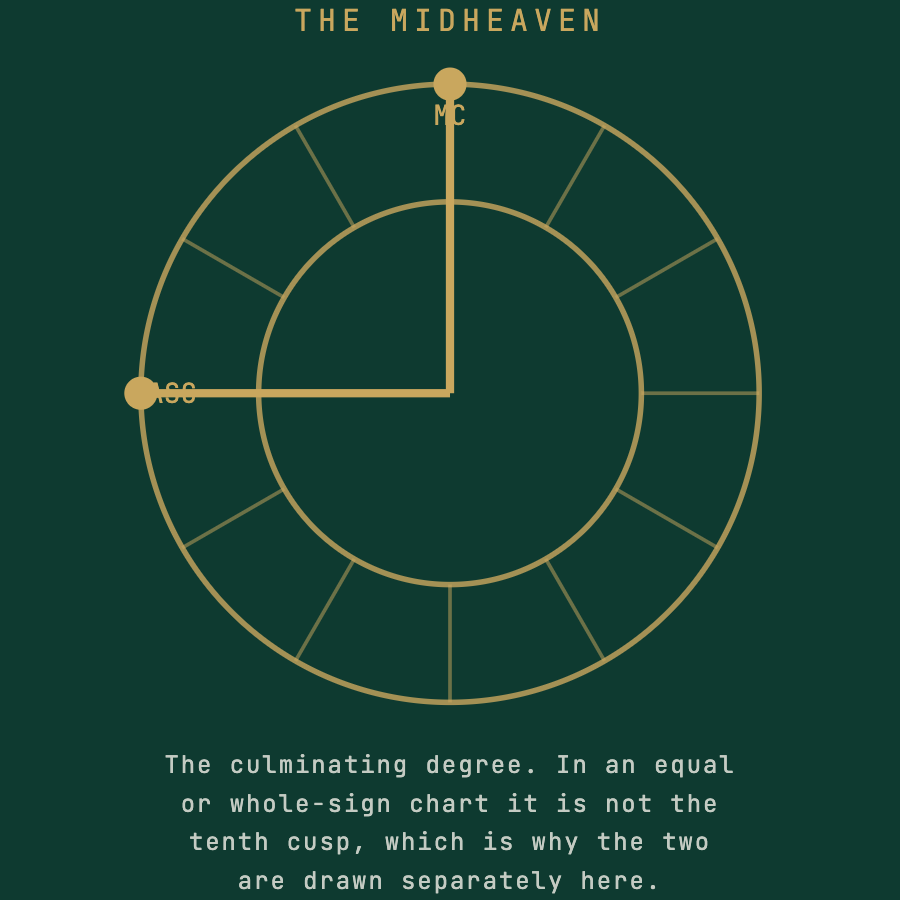
The degree of the ecliptic crossing the meridian, the highest point the zodiac reaches at a given moment. It needs no latitude to compute, and in two of the three house systems on this site it is not the tenth-house cusp.
- midheaven
- culmination
- tenth house
- angles
- meridian
What it is
The midheaven is where the ecliptic crosses the local meridian, the great circle running from due north through the zenith to due south. It is often called the MC, from the Latin medium coeli. Because the meridian is where a body reaches its highest point in the sky, the midheaven is the degree of the zodiac that is culminating.
It is the second of the two angles a chart is built on, the other being the ascendant, and the two are independent quantities. The ascendant depends on latitude; the midheaven does not. Two people born at the same instant in Cairo and in Helsinki share a midheaven if they share a longitude, and have quite different ascendants.
The point that trips people up is the relationship to the tenth house. In quadrant systems such as Placidus the midheaven is the tenth cusp by construction. In whole sign and equal houses it is not a cusp at all. It is computed, it is displayed, and it lands wherever it lands, which is often the ninth or eleventh house.
How it is computed
The midheaven is closed form and simpler than the ascendant, because only two inputs go into it: the local sidereal time and the obliquity of the ecliptic. Latitude does not appear.
Local sidereal time expressed in degrees is the right ascension of the meridian, written RAMC. The midheaven is then the arctangent of sin RAMC over cos RAMC times cos of the obliquity, taken as a two-argument arctangent so the quadrant resolves itself. That is all of it. There is no iteration and no special case.
The absence of latitude has a consequence worth stating. The midheaven is defined at every latitude, including inside the polar circles and at the poles themselves, where the ascendant's tangent term misbehaves and the Placidus cusps have no solution at all. A chart cast at eighty degrees north still has a perfectly well-defined midheaven.
One caveat belongs here rather than in the interpretation. The formula returns the ecliptic point on the meridian, but it does not check whether that point is above the horizon. At high latitudes it need not be. Calling it the culminating degree is exact at ordinary latitudes and becomes a statement about geometry rather than about anything visible as you go north.
How to read it
The midheaven is conventionally read as the public end of a chart: vocation, reputation, what a person is known for, the direction they are visibly heading. It is the most exposed point in the figure, on the reasoning that whatever culminates is what everyone can see.
In practice most of that reading is carried by the tenth house rather than by the degree, which is where the cusp question starts to matter. A practitioner using Placidus is reading a house that begins at the midheaven. A practitioner using whole sign is reading a house that may not contain the midheaven at all, and has to decide whether the degree or the house is the thing being asked about.
As with everything on these pages, the calculation is checkable and the interpretation is not. That the ecliptic crosses the meridian at a particular degree is a fact. That the degree says something about a career is a convention with a long history and no demonstrated mechanism, and treating the first as evidence for the second is the move to avoid.
How much the birth time matters
The midheaven is as time-sensitive as the ascendant, and for the same reason: it is driven by the Earth's rotation rather than by anything moving in the sky. The right ascension of the meridian advances at exactly fifteen degrees an hour, which is one degree every four minutes.
The midheaven's motion along the ecliptic is not quite uniform, because the ecliptic is tilted. Working through the formula, the rate varies between about 13.8 and 16.4 degrees an hour depending on which part of the zodiac is culminating, so one degree takes somewhere between three and three-quarter minutes and four and a half. For practical purposes, four minutes to the degree.
An hour of error therefore moves the midheaven fifteen degrees, half a sign. Unlike the ascendant, which speeds up and slows down dramatically with latitude, the midheaven's sensitivity is the same everywhere, so the same clock error costs the same amount in Nairobi and in Reykjavik. Where the birth time is unknown the calculator omits the midheaven along with the ascendant and the houses, because there is nothing honest to put there.
Where practitioners disagree
The live disagreement about the midheaven is whether it should be a house cusp at all. Quadrant systems make it the tenth cusp and treat that as structurally necessary: the chart is divided by the horizon and the meridian, and the meridian has to be a boundary. Whole sign and equal house practitioners divide by the ascendant alone, which leaves the midheaven free to fall in the ninth, tenth or eleventh house.
Neither camp thinks the other is making an arithmetic mistake. The quadrant argument is that a chart which does not use the meridian has discarded half its geometry. The whole sign argument is that houses were originally sign-based, that the midheaven was a separate significant point rather than a boundary, and that forcing it to be a cusp is a later imposition. Both are defensible readings of the same history.
A second dispute concerns what to do when the midheaven falls outside the tenth house. Some practitioners read it in the house it actually occupies, some keep reading it as a career point regardless, and some use both and let them qualify each other. There is no test that decides this, and this site does not pick. It computes the midheaven, shows it, and leaves the tenth cusp wherever the chosen system puts it.
What the astronomy says
The meridian, like the horizon, is a local construction. It is the plane containing the observer, the zenith and the two celestial poles, and it slices the sky into an eastern half and a western half. Any body crosses it twice a day, once above the pole and once below, and the upper crossing is the culmination.
The reason latitude drops out of the midheaven calculation is that everyone on the same line of longitude shares a meridian plane. Move north or south along it and the plane is unchanged; what changes is where the zenith sits within it, and therefore how high the culminating point appears. So the midheaven is the same degree for everyone at that longitude, while its altitude above the horizon is different for each of them.
This is also why the midheaven survives where quadrant houses do not. Dividing the sky by time between horizon and meridian requires the bodies concerned to actually cross the horizon. Locating the meridian requires no such thing, and the poles have a perfectly good meridian even though nothing rises or sets there for six months at a stretch. A house is a division of the local sky rather than a region of space, and the midheaven is one of the two lines that division is drawn from.
Where it came from
In Hellenistic Greek the midheaven is the mesouranema, the mid-heaven, and it appears alongside the ascendant in the earliest surviving technical astrology of the second and first centuries BCE. Both were understood from the start as the two pivots of a chart, and both required a known time.
What was not settled from the start is the relationship between the midheaven and the tenth place. In much early practice houses were whole signs counted from the rising sign, and the culminating degree was a separate marker that fell wherever it fell. The identification of the midheaven with the tenth cusp comes with the quadrant systems, which develop later and become dominant much later still.
The modern English-language habit of treating midheaven and tenth cusp as synonyms is largely an artefact of Placidus becoming the default in printed twentieth-century ephemerides and then in the first generation of astrology software. Defaults are powerful. A great deal of what looks like doctrine in contemporary Western astrology is the shape of the tables people happened to have, and this is one of the clearer cases.
The common misreading
The commonest error is assuming the midheaven is the tenth-house cusp. In Placidus it is. In whole sign and equal houses it is not, and a reader who carries the assumption across systems will put the midheaven in the wrong house and then interpret the mistake. If you switch house systems on this site and the tenth cusp moves while the midheaven does not, nothing has gone wrong: those are two different quantities and only one of them depends on the system.
The second is reading the midheaven as a career prediction. The convention associates it with public standing; it does not contain a job title, and no study has found that it contains anything. A page that tells you your midheaven indicates a career in medicine has moved from a defensible statement about tradition to an indefensible one about your life, and the move usually happens in a single sentence.
The third is subtler and worth naming because the formula invites it. Latitude is absent from the midheaven calculation, and people sometimes take that to mean the midheaven is less local or more objective than the ascendant. It is not. It still depends entirely on the exact instant and on the longitude, which is to say on a clock and a place. Independence from latitude is a fact about the geometry, not a promotion in status.
Questions to sit with
- Which house system produced the tenth house you have been reading, and does it put the midheaven there?
- Do you know your birth longitude as precisely as you think you know the time?
- What have you been told your midheaven means about your work, and who decided that?
- If the midheaven fell in your ninth house instead, would the reading you have been given still stand?
Cast your own chart and see it in place.