- Kind of topic
- House system
Placidus houses
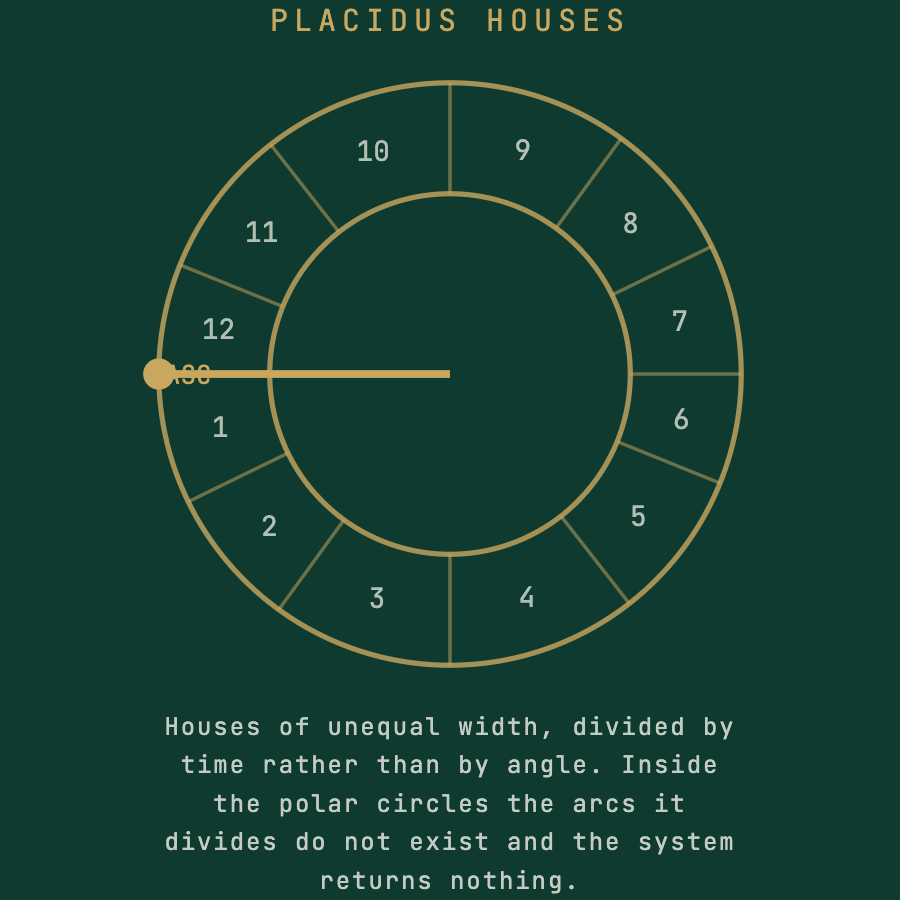
The modern English-language default. It divides each body's day-arc by time rather than the ecliptic by space, has to be solved by iteration, and genuinely has no answer inside the polar circles. The calculator here refuses rather than inventing one.
- placidus
- house system
- quadrant
- polar circle
- iteration
What it is
Placidus is a time-based house system. Instead of cutting the ecliptic into equal arcs, it asks how long each degree of the zodiac takes to travel from the horizon to the meridian, and puts the cusps at fixed fractions of that journey.
Concretely: the eleventh cusp is the ecliptic degree that has completed one third of its climb from the eastern horizon to the meridian, and the twelfth is the degree that has completed two thirds. The second and third cusps are the same construction below the horizon, measured from the lower meridian. The first cusp is the ascendant and the tenth is the midheaven, and the remaining six are the exact oppositions of those.
Because different degrees take different lengths of time to make that climb, Placidus houses come out unequal. At mid latitudes a house can be forty-five degrees wide while its neighbour is fifteen. That unevenness is the point of the system rather than a defect in it: it is what you get when you divide by time instead of by longitude.
How it is computed
Placidus has no closed form. The four intermediate cusps, the eleventh, twelfth, second and third, each have to be found by iteration, and the calculator on this site marks a Placidus house set as not exact for that reason, where it marks whole sign and equal as exact.
The reason it needs solving is circular. To place a cusp you need the semi-diurnal arc of the ecliptic point that sits there, and that arc depends on the point's declination, which depends on which point it is, which is what you are trying to find. So the method guesses, computes, and refines.
Each pass does the same four things. Convert the current guess, a right ascension, into an ecliptic longitude. Take that point's declination, which is the arcsine of sin of the obliquity times sin of the longitude. Form the product of tan of the latitude and tan of that declination, and take its arcsine: that is the ascensional difference, the amount by which the point's semi-diurnal arc exceeds or falls short of ninety degrees. Then step the required fraction, a third or two thirds, along that arc from the meridian, and use the result as the next guess. This site's implementation stops when two successive passes agree to within a billionth of a degree, and gives up after sixty passes.
Look at the product of the two tangents, because everything on the rest of this page follows from it. An arcsine is only defined for arguments between minus one and one. If tan of the latitude times tan of the declination exceeds one in absolute value, there is no angle to take, and the calculation stops. It does not stop because the code is cautious. It stops because there is no answer.
How to read it
Placidus is read the same way as any quadrant system: the cusps are boundaries, planets are in the house whose cusp they have passed, and a planet close to a cusp is often read as spilling into the next house. Because houses are unequal, some are conspicuously large and get read as emphasised.
The tenth house begins at the midheaven in this system, which is why the two get treated as synonyms by readers who have never used anything else. Intercepted signs, where a whole sign falls inside one house without touching either cusp, are a Placidus phenomenon and carry their own interpretive literature.
None of the interpretation is astronomy. The cusps are computed from real geometry and the meanings attached to them are convention, with no demonstrated mechanism and no study showing that a planet on one side of a cusp differs from a planet on the other. Both statements belong on the same page, and the precision of the iteration is not evidence for the reading it feeds.
How much the birth time matters
Placidus is the least forgiving of the three systems on this site, because every cusp depends on the exact degree of the ascendant and midheaven rather than only on which sign they fall in.
Four minutes of error moves the ascendant one degree and the midheaven about one degree, and every intermediate cusp moves with them. Ten minutes moves the whole framework about two and a half degrees. An hour moves it fifteen, which in a chart with a forty-degree house and a fifteen-degree house can move several planets between houses at once.
There is no clean threshold below which the layout is safe, which is the practical difference from whole sign. Errors degrade a Placidus chart continuously rather than all at once. If your birth time is known only to the nearest hour, a Placidus chart is not meaningfully more informative than a whole sign one, and it looks considerably more precise than it is. Where the time is unknown entirely the calculator omits houses altogether.
Where practitioners disagree
Placidus is the modern English-language default and it is also the system its critics attack hardest, which makes the dispute unusually direct. Its defenders argue that dividing by time is the only approach that reflects what the sky actually does: bodies rise, culminate and set, and a system built on those events is describing something real.
The objections come in three kinds. The historical one is that Placidus is late, reaching dominance only after the seventeenth century, and that treating it as standard misrepresents the tradition. The geometric one is that it fails inside the polar circles, which critics take as evidence that the underlying idea is not general. The practical one is that unequal houses and intercepted signs create interpretive problems that would not exist under a different convention.
Defenders answer the polar objection by pointing out that many systems degrade somewhere and that most people are not born above the Arctic Circle. That is true, and it does not dispose of the argument, because the failure is not a rounding problem but the absence of a solution. None of this is settled by evidence. There is no experiment anyone has designed that would distinguish a correct house system from an incorrect one, and until there is, the choice is made on historical and aesthetic grounds. This site offers whole sign, Placidus and equal, and declines to nominate one.
What the astronomy says
A house is a division of the local sky, not a region of space, and Placidus divides it by time. The quantity it needs is the semi-diurnal arc: how long a given point spends above the horizon between rising and culminating. That is a real, measurable thing at ordinary latitudes, and it is the whole basis of the system.
Now consider a point that never rises and never sets. Inside the polar circles that is an ordinary situation: bodies are circumpolar for months, either permanently above the horizon or permanently below it. Such a point has no rising, so it has no arc between rising and culminating, so there is no arc to take a third of. The system does not become inaccurate there. It becomes undefined.
The arithmetic and the geography agree exactly, which is the satisfying part. A point is circumpolar when its declination exceeds ninety degrees minus the latitude. Points on the ecliptic reach a maximum declination equal to the obliquity, about 23.44 degrees. Set those equal and you get a latitude of about 66.56 degrees, which is the definition of the polar circle. The latitude at which Placidus starts failing is not near the Arctic Circle by coincidence. It is the Arctic Circle, arrived at from the same constant.
This tool was tested at seventy-eight degrees north. At that latitude any ecliptic point with a declination past twelve degrees is circumpolar, which is most of the zodiac, so the intermediate cusps have no solution for most of the day. The calculator refuses and falls back to whole sign. Software that returns a number there is returning an artefact of whatever fudge its author chose, not a Placidus cusp, because there is no Placidus cusp to return.
Where it came from
The system is named after Placidus de Titis, a Benedictine monk and mathematician who taught at Pavia and published on it in the mid seventeenth century. He did not invent the underlying idea. Dividing the diurnal arc by time goes back much further, and versions of it appear in medieval Arabic and Latin sources long before his name attached to it.
What made Placidus the default was not an argument being won. It was tables. The system requires iteration, which is impractical by hand, so its spread depended on somebody doing the arithmetic in advance and printing it. Nineteenth and twentieth-century English-language ephemerides and house tables were overwhelmingly Placidian, and generations of astrologers used it because it was what the book on the shelf contained.
The same accident carried into software. Early astrology programs defaulted to Placidus because their authors had learned on Placidus tables, and the default propagated. It is a good example of a technical choice becoming doctrine through distribution rather than through anybody deciding it was correct, and it is worth knowing when someone describes Placidus as the standard system.
The common misreading
The most consequential misreading is not about interpretation at all. It is believing a Placidus chart cast above the Arctic Circle. A great deal of astrology software returns cusps at any latitude you give it, and near the poles those numbers are not approximations to a right answer. There is no right answer for them to approximate. If you have a Placidus chart for Tromso or Utqiagvik, the houses in it were manufactured by a fallback nobody told you about.
The second is treating Placidus as the neutral or default option, the one you use when you have not chosen. It is a specific and contested convention with a seventeenth-century name and a nineteenth-century distribution story. Using it is a choice, and it is worth making deliberately rather than by inheriting a software setting.
The third is reading the iteration's precision as authority. The solver on this site converges to a billionth of a degree, which sounds impressive and means only that the arithmetic has settled. It says nothing about whether dividing the sky this way corresponds to anything, and it certainly says nothing about whether a birth time known to the nearest hour deserves a cusp quoted to the arc-second. Precision in the method never rescues imprecision in the input.
Questions to sit with
- What latitude were you born at, and is it inside the polar circles?
- Which house system did the chart you have been reading use, and did you choose it?
- Do any of your planets sit within a degree or two of a cusp?
- If a house layout changes when you change convention, what were you reading?
Cast your own chart and see it in place.