- Kind of topic
- Angle
The Ascendant
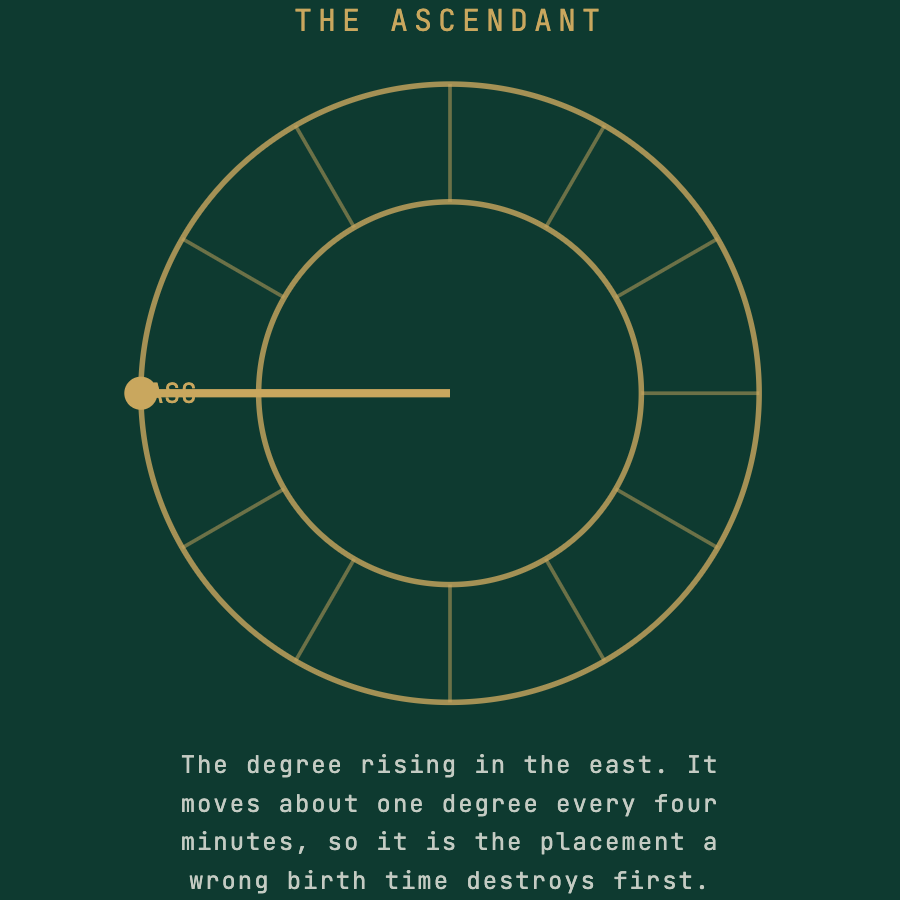
The degree of the ecliptic rising on the eastern horizon at the moment and place of birth. It is the fastest-moving thing in a chart, and the first placement a wrong birth time destroys. The planets survive an uncertain birth time. This does not.
- ascendant
- rising sign
- angles
- birth time
- horizon
What it is
The ascendant is the point where the ecliptic, the apparent path of the Sun through the sky, crosses the eastern horizon at a given moment and place. Because the Earth turns, that point moves continuously: the whole ecliptic passes the horizon once a day, so the ascendant travels the full three hundred and sixty degrees in roughly twenty-four hours.
Two things follow. It is a local quantity: two people born at the same instant in Quito and in Oslo have identical planetary positions and different ascendants, because they have different horizons. And it is a degree, not a sign. The sign containing it is what most people mean by their rising sign, but the underlying quantity is a position to a fraction of a degree, and several house systems care which.
In every house system on this site the ascendant sets the first house. Whole sign takes the entire sign containing it, equal houses start a thirty-degree house at the exact degree, and Placidus uses it as the first cusp and derives the others from it. Get the ascendant wrong and every house in the chart moves with it.
How it is computed
The ascendant is closed form. There is no iteration and no approximation beyond the ephemeris itself. Three inputs are needed: the local sidereal time, the obliquity of the ecliptic, and the geographic latitude.
Local sidereal time is Greenwich apparent sidereal time plus the observer's longitude. Expressed in degrees it is the right ascension of the meridian, usually written RAMC. The obliquity is the tilt of the Earth's axis relative to its orbit, currently about 23.44 degrees and decreasing slowly; the calculator on this site evaluates the standard polynomial in Julian centuries rather than using a fixed value.
With those three the ascendant is the arctangent of cos RAMC over minus the quantity sin RAMC times cos of the obliquity plus tan of the latitude times sin of the obliquity. Written as a two-argument arctangent the quadrant comes out correctly and no case analysis is needed. That is the whole computation.
Note where the latitude enters: inside a tangent. As latitude approaches ninety degrees the tangent diverges, which is the mathematical reason charts behave strangely at extreme latitudes. The ascendant itself stays computable at any latitude short of the pole, unlike the Placidus cusps, which stop having solutions inside the polar circles.
How to read it
Practitioners read the ascendant as the chart's point of contact with the world: the manner rather than the motive, how a person meets a situation before they have decided anything about it. The sign on it is the rising sign, and it is the second thing most people learn about their chart after the Sun.
The planet ruling that sign is conventionally given extra weight and called the chart ruler, so an Aries ascendant directs attention to Mars wherever it sits. Any planet within a few degrees of the ascendant is read as conspicuous, on the grounds that it is rising with the person.
None of that is astronomy and this site does not pretend otherwise. The rising degree is a real, checkable quantity; what it is taken to indicate about a person is a body of interpretive convention with no demonstrated mechanism behind it. Both things can be said in the same paragraph, and the honest version of this page says them.
How much the birth time matters
This is the placement birth time governs completely. The ascendant advances through three hundred and sixty degrees in about twenty-four hours, which averages fifteen degrees an hour, or one degree every four minutes. Those numbers are worth holding on to.
A four-minute error moves the ascendant a degree. A one-hour error, which is what a missed daylight-saving adjustment costs, moves it about fifteen degrees, and since signs are thirty degrees wide that changes the rising sign roughly half the time. Two hours of uncertainty and the rising sign is a guess.
The average is not the whole story. Because the ecliptic is tilted against the equator, equal arcs of it cross the horizon in unequal times, and the effect grows with latitude. At mid-northern latitudes the signs from Cancer to Sagittarius take noticeably longer to rise than those from Capricorn to Gemini, so some rising signs are wide targets and others are narrow ones. Where the time is not known, the calculator on this site omits the ascendant rather than computing one. See when you do not know your birth time.
Where practitioners disagree
The first disagreement is whether the ascendant is a sign or a degree. In whole sign houses only the sign matters: the first house is that entire sign and the exact degree changes nothing about the house layout. In equal and quadrant systems the degree sets the cusp directly, so a few minutes of birth time shift every house boundary.
The second is the zodiac itself. Tropical astrology measures the ascendant from the March equinox; sidereal astrology, dominant in India and used by a minority in the West, measures it from a fixed star reference. The two now differ by about twenty-four degrees, so a tropical and a sidereal chart for the same birth usually disagree about the rising sign outright. Neither is a computational error. They are answers to different questions about where zero should be.
The third is how wide the ascendant's influence reaches. Some practitioners treat a planet as conjunct the ascendant out to eight or ten degrees, others only within three, and some count planets above the horizon in the twelfth house as rising while others do not. There is no standard and no test that would settle one. This site uses eight degrees for a conjunction and says so on the aspects page.
What the astronomy says
The horizon is not a feature of space. It is the plane tangent to the Earth at the observer's position, and it exists only relative to that position. The ascendant is therefore a statement about where one particular person was standing, and it has no meaning detached from a latitude, a longitude and an instant.
What actually moves is the Earth. The ecliptic is effectively fixed over a human lifetime; the observer rotates underneath it once a day, and the rising point sweeps the zodiac as a consequence. Nothing is happening at the ascendant. No body needs to be there, and usually none is.
Latitude changes the geometry substantially. At the equator the ecliptic stands steeply to the horizon and every sign rises in close to two hours. At sixty degrees north the angle is much shallower for part of the day, and some signs take four hours to rise while their opposites take under one. Inside the polar circles the ecliptic can lie almost along the horizon, and points on it neither rise nor set for months at a time. The ascendant is still calculable there; what it means to say a sign is rising when nothing rises is a fair question, and the answer is that the formula returns the intersection whether or not anything crosses it.
Where it came from
The ascendant is the oldest technical element in Western astrology and the one the whole system is named after. In Hellenistic Greek it is the horoskopos, the hour-marker, and that word is where the English word horoscope comes from. Originally the horoscope was not the whole chart. It was this one point.
The technique appears in the Greek-speaking Mediterranean around the second or first century BCE, drawing on older Babylonian planetary records but adding something the Babylonians did not have: an interest in the exact moment and place of an individual birth. Babylonian astrology was largely concerned with kings and states. Casting a chart for an ordinary person requires an ascendant, and the ascendant requires a clock.
That dependence shaped the whole history. For most of the period between antiquity and the nineteenth century, birth times were recorded badly or not at all, and a great deal of traditional technique exists to work backwards from a life to a plausible rising degree. The practice is called rectification and it is still in use. What changed the field was not a theoretical advance but the ordinary spread of accurate clocks and, later, of hospital records that wrote the minute down.
The common misreading
The most common misreading is treating the rising sign as a second and truer sun sign. It gets described as the real you, or the mask, or what people see first, and those glosses are doing a lot of work that nothing in the technique supports. The ascendant is a marker of orientation in a chart. Nothing about the astronomy makes it a description of character, and no study has shown that it is one.
The second is accepting a rising sign computed from a time nobody actually knows. An enormous number of charts in circulation were cast from a rounded hour, a remembered approximation, or a default noon, and a chart cast for noon has an ascendant that is simply wrong. It will still look precise. The calculator will still print a degree and a minute. Precision in the output says nothing about accuracy in the input, and this is the placement where that gap does the most damage.
The third is quieter. Because the ascendant is genuinely computable and genuinely local, it is easy to slide from the accuracy of the arithmetic to the authority of the reading. The formula is exact. What the exact answer is taken to signify is not, and the first thing does not lend anything to the second.
Questions to sit with
- Do you know your birth time to the minute, or to the nearest hour?
- Where did that time come from, and has anyone checked it against a document?
- If your rising sign turned out to be the next one along, what would you actually have to give up?
- Which of the things you have been told about your rising sign would you have recognised without being told?
Cast your own chart and see it in place.