- Kind of topic
- Chart part
Aspects and orbs
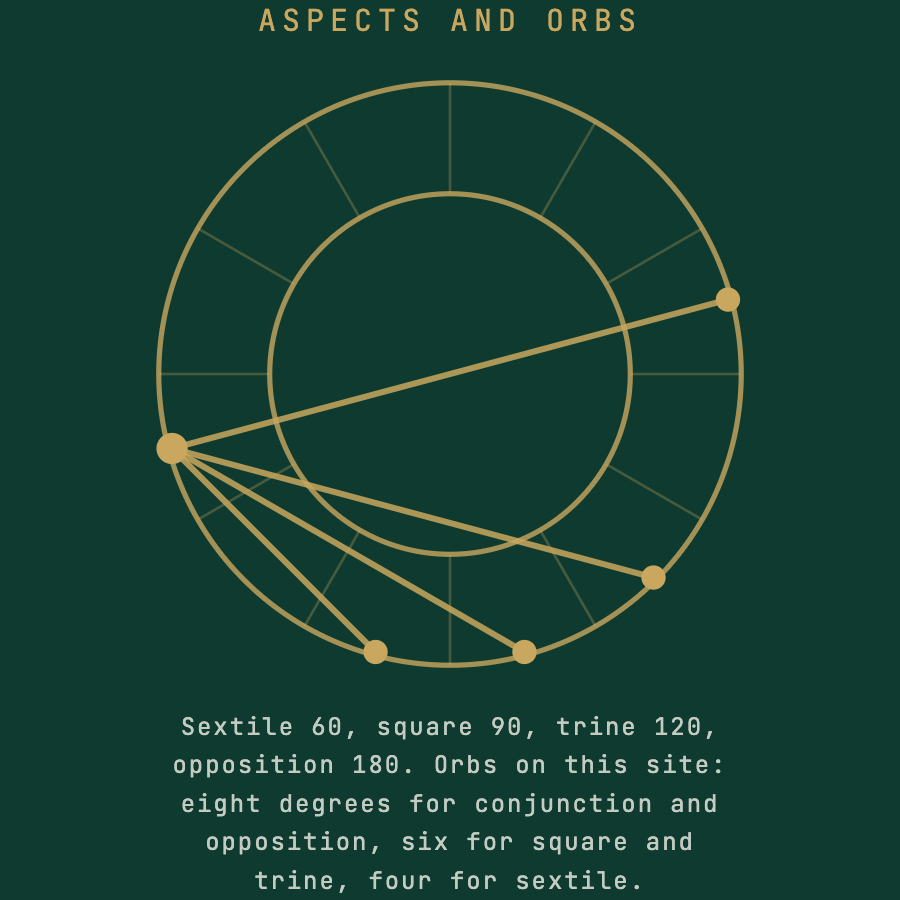
The five major angles between planets, and the tolerance allowed around each. This site uses eight degrees for conjunction and opposition, six for square and trine, and four for sextile, and there is no standard it could have followed instead.
- aspects
- orbs
- conjunction
- square
- trine
What it is
An aspect is an angular separation between two points in a chart, measured along the ecliptic. Five are treated as major: the conjunction at zero degrees, the sextile at sixty, the square at ninety, the trine at one hundred and twenty, and the opposition at one hundred and eighty.
Exact angles almost never occur. The orb is the tolerance: how far from exact a separation can be and still count. If two planets are ninety-four degrees apart and the square orb is six, that is a square with a four-degree orb. If the orb were three, the same two planets would have no aspect at all.
That last sentence is the whole difficulty. Orbs are not measurements of anything. They are a convention chosen by the practitioner or the software, and changing them changes which aspects exist in a chart. This site publishes its values rather than leaving them implicit, because a list of aspects with no stated orbs is not a checkable claim.
How it is computed
The calculation is straightforward. For every pair of points, take the difference in ecliptic longitude, reduce it to a value between zero and three hundred and sixty, and if it exceeds one hundred and eighty subtract it from three hundred and sixty. That gives a separation between zero and one hundred and eighty degrees.
Then compare that separation against each of the five exact angles. If the difference is within the orb for that aspect, the aspect is recorded together with how far from exact it is. The five orb windows on this site are zero to eight degrees for a conjunction, fifty-six to sixty-four for a sextile, eighty-four to ninety-six for a square, one hundred and fourteen to one hundred and twenty-six for a trine, and one hundred and seventy-two to one hundred and eighty for an opposition. Those windows do not overlap, so no separation can match two aspects at once.
The points compared are the ten planets, the lunar node, and the two angles, so aspects to the ascendant and midheaven appear alongside planet-to-planet ones. The list is sorted with the tightest orbs first. Two things the tool does not do: it does not distinguish applying from separating aspects, and it uses the same orb for every pair regardless of which bodies are involved.
How to read it
Conventionally the aspects divide into two groups. Conjunction, sextile and trine are read as easy or reinforcing; square and opposition as friction. Conjunction is the odd one, since it is read as intensification and takes its character from the bodies involved rather than having one of its own.
Tighter orbs are read as stronger. A trine two degrees from exact is treated as more consequential than one eleven degrees off, and the tool sorts by orb for that reason. This is a convention that at least has an internal logic to it, and it is still a convention: nothing establishes that a two-degree trine differs from a nine-degree one.
The honest framing is that aspects are a real geometric relationship with an interpretive tradition attached. Two planets ninety degrees apart is a fact you can verify from an ephemeris. That the separation indicates tension in a person's life is a claim nobody has demonstrated, and the arithmetic being correct does not make the claim any more likely.
How much the birth time matters
Aspects between planets are the most robust part of a chart, because planets move slowly relative to the day. Over twelve hours of uncertainty the Sun moves about half a degree, Mercury and Venus about a degree, and the outer planets essentially nothing.
The Moon is the exception and it matters here. It covers up to about seven degrees in twelve hours, which is comparable to a whole orb. A lunar aspect that sits three degrees from exact on the assumption of a noon birth might be eight degrees off, and therefore not an aspect at all, if the birth was actually at midnight. Every aspect involving the Moon inherits that uncertainty.
Aspects to the angles are a different matter entirely. The ascendant and midheaven move roughly fifteen degrees an hour, so an aspect to either is destroyed by an hour of error and is meaningless without a reliable time. If you do not know your birth time, the planet-to-planet aspects are worth having and the ones involving angles are not. See when you do not know your birth time.
Where practitioners disagree
Orbs are unstandardised and always have been. Published values in current use range from about ten degrees down to about five for a conjunction, and the variation is not narrowing. Some schools set orbs by aspect, as this site does. Some set them by body, giving the Sun and Moon wider orbs than Mercury. Some use both and combine them, and there are several incompatible rules for how.
A second dispute is whether aspects should be counted by sign or by degree. Traditional practice generally requires the two signs to be in aspect: a planet at twenty-nine degrees of Aries and one at two degrees of Taurus are three degrees apart, but Aries and Taurus form no aspect, so on the traditional view these planets are not conjunct. This site measures by degree only, so it records that pair as a conjunction. Practitioners working in traditional technique would disagree, and the disagreement is substantive rather than cosmetic.
A third is which aspects count at all. Minor aspects, the quincunx at one hundred and fifty degrees, the semi-sextile at thirty, the sesquiquadrate and others, are used by many practitioners and ignored by many more. This tool computes only the five majors. That is a choice, not a finding, and a chart drawn with minor aspects included will show relationships this one does not.
What the astronomy says
An aspect is a projected angle, not a physical relationship. The separation is measured in ecliptic longitude, which means both bodies are flattened onto the same plane before the angle is taken. Two planets described as conjunct are not necessarily near each other in the sky; they can be several degrees apart in latitude, and they are always at wildly different distances.
The angles are geocentric, which is to say measured from the Earth. That is the right convention for a system about a person standing on it, and it is worth being explicit that the same three bodies would show entirely different aspects viewed from Mars. Nothing about the ninety-degree separation is intrinsic to the two planets.
The positions themselves are checkable and accurate. This site uses an open-source ephemeris that places the Sun within about a thousandth of a degree of the published equinox and solstice instants, which is far finer than any orb in use. That precision is genuine and it is also beside the point, since an eight-degree orb makes a thousandth of a degree irrelevant. Better astronomy would not produce better aspects, because the imprecision is in the convention rather than in the sky.
Where it came from
The five major aspects are Hellenistic and are built on simple divisions of the circle: the whole, the half, the third, the quarter and the sixth. Opposition, trine, square and sextile are the circle divided by two, three, four and six, and the conjunction is the degenerate case. Ptolemy set out this scheme in the second century and it has been stable ever since.
Orbs have never been stable. Ancient practice often worked by sign rather than by degree, so the question of tolerance did not arise in the modern form. Medieval Arabic and Latin astrology developed orbs attached to the planets, sometimes quite large, on the reasoning that each body had a sphere of influence of its own. Modern practice moved toward orbs attached to the aspect, which is what this site uses, and no authority ever adjudicated between the two.
The minor aspects are largely seventeenth-century and later, introduced by Kepler among others, who was interested in whether other divisions of the circle produced observable effects. He thought the question was empirical. It remains open in the sense that nobody has answered it, and closed in the sense that nobody is seriously trying.
The common misreading
The most consequential misreading is treating an aspect list as a fixed property of a chart. It is not. It is a property of the chart plus the orb table, and the orb table is a choice. Widen the sextile orb from four degrees to six and new sextiles appear; narrow the conjunction from eight to five and some conjunctions vanish. A page that lists your aspects without stating its orbs has given you a conclusion and withheld the assumption it rests on.
The second is reading hard aspects as bad news. Square and opposition are conventionally friction and trine and sextile are conventionally ease, and a great deal of popular writing converts that into misfortune and good fortune. The tradition itself does not, and most practitioners will say the hard aspects are where the interesting material is. More to the point, no aspect has been shown to correspond to any outcome, so grading them as good or bad is a convention layered on a convention.
The third is trusting a borderline aspect. A square at five and a half degrees of orb is inside this site's six-degree window and outside a five-degree one, which means whether it exists at all depends on software you did not choose. Aspects near the edge of an orb should be held loosely, and if a reading turns on one, the honest thing to notice is that a different practitioner would not have seen it.
Questions to sit with
- Which of your aspects sit within a degree of their orb limit?
- Do you know what orbs the chart you usually read was drawn with?
- If an aspect disappeared under a narrower orb, how much of your reading would change?
- Which aspects in your chart involve the Moon or an angle, and how good is your birth time?
Cast your own chart and see it in place.