- Kind of topic
- House system
Equal houses
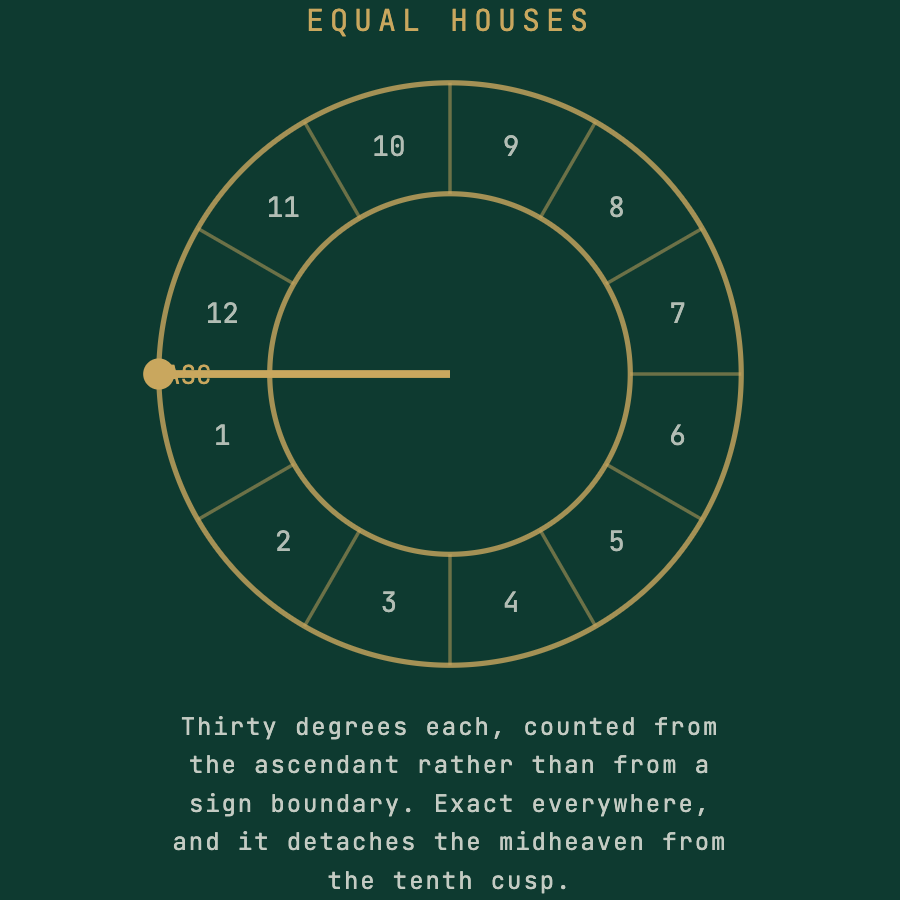
Twelve houses of exactly thirty degrees, measured from the ascendant's precise degree rather than from its sign. It is exact at every latitude, and it is the system in which the midheaven stops being the tenth cusp.
- equal houses
- house system
- ascendant
- cusps
- midheaven
What it is
Equal houses put the first cusp on the ascendant itself and then count thirty degrees at a time. If the ascendant is at nineteen degrees of Libra, the first house runs from nineteen Libra to nineteen Scorpio, the second from nineteen Scorpio to nineteen Sagittarius, and so on all the way round.
That is the one difference from whole sign, and it is a real one. Whole sign rounds the ascendant down to the start of its sign; equal keeps the exact degree. So in equal houses every house straddles two signs, and the exact minute of birth sets every boundary in the chart.
The tenth cusp is the ascendant plus two hundred and seventy degrees, by construction. The midheaven is computed separately from the meridian and is not tied to that cusp. The two coincide only when the ascendant and midheaven happen to be exactly ninety degrees apart, which is not the general case, so in most equal charts the midheaven falls somewhere in the ninth, tenth or eleventh house.
How it is computed
There is nothing to solve, exactly as with whole sign. Take the ascendant's ecliptic longitude, call it the first cusp, and add thirty degrees eleven times. The calculator on this site marks the result as exact, in contrast to Placidus, which it marks as not exact because that system is iterative.
All the astronomy is in the ascendant, which needs the local sidereal time, the obliquity and the latitude. After that the house layout is addition. No declination is required, no semi-arc, no convergence test, and there is no configuration of latitude and time for which the answer fails to exist.
The midheaven is still computed, because the chart displays it, but it plays no part in building the houses. That is the structural fact that separates equal from the quadrant systems: the horizon supplies the framework and the meridian is decoration. Whether that is an economy or a loss is the argument, and the arithmetic itself is a single line either way.
How to read it
Equal houses are read like any other cusp-based system: a planet is in the house whose cusp it has passed, and planets near a boundary get argued about. Because every house is thirty degrees, none is emphasised by size, and there are no intercepted signs.
The distinctive interpretive question is what to do with the midheaven. Practitioners who use equal houses generally read it as an independent point of public standing while reading the tenth house as a house in its own right, so the two carry related but separate meanings. That is a workable arrangement and it is also more bookkeeping than a quadrant chart requires.
As everywhere on these pages, the boundaries are computable and their meanings are not. A cusp at nineteen degrees of Scorpio is an exact consequence of a time and a place. That crossing it changes what a planet signifies is a convention, held with varying conviction, and no study has shown that it corresponds to anything.
How much the birth time matters
Equal houses sit between the other two systems in their sensitivity to the clock. Every cusp is pinned to the exact ascendant degree, so every cusp moves when the time moves, which makes equal as time-sensitive as Placidus in that respect.
The numbers are the ascendant's numbers. One degree every four minutes, fifteen degrees an hour. Ten minutes of error slides the entire house framework two and a half degrees; an hour slides it fifteen, which is half a house. Any planet within that distance of a cusp can change houses.
What equal does not inherit from Placidus is the uneven damage. Because all twelve houses are the same width and all shift together, an error moves everything by the same amount in the same direction, and no house is disproportionately distorted. A Placidus chart with a fifteen-degree house can lose that house's contents to a clock error that an equal chart would absorb evenly. Where the birth time is unknown the calculator omits houses entirely rather than defaulting to a time.
Where practitioners disagree
Equal houses occupy an awkward middle position in the house systems argument, and get attacked from both sides. Whole sign practitioners regard the exact degree as a needless complication that breaks the identity between house and sign and buys nothing. Quadrant practitioners regard thirty-degree houses as ignoring the geometry that makes a house system worth having.
Its defenders make two arguments. The first is that the ascendant is a real degree, not a sign, so a system that uses it precisely is more faithful to the one piece of local information a chart actually has. The second is robustness: equal produces twelve well-behaved houses at any latitude, which quadrant systems do not, without the sign-rounding that whole sign applies.
The specific point of contention is the detached midheaven. Critics say a house system that cannot place the meridian has given up on half the chart's geometry. Users answer that treating the midheaven as a free point rather than a boundary is closer to older practice and avoids distorting house sizes to accommodate it. As with the rest of this dispute, no evidence decides it. Nobody has proposed a test that would, and this site offers equal alongside whole sign and Placidus without recommending any of them.
What the astronomy says
A house is a division of the local sky rather than a region of space. Equal houses divide it using exactly one locally determined line, the horizon, and specifically one point on that line: the degree of the ecliptic rising at the moment of birth. Everything else is thirty-degree steps around the zodiac.
This means the seventh cusp is genuinely the western horizon, which is worth noting because it is not true in whole sign. Opposite the rising degree is the setting degree, so the equal first and seventh cusps really do mark where the ecliptic meets the horizon in both directions. The fourth and tenth cusps have no comparable physical meaning: they are simply ninety degrees along the ecliptic from the horizon points, and the meridian crosses the ecliptic somewhere else.
Because no arc has to be divided by time, there is no polar failure. Quadrant systems need bodies to rise and set, and inside the polar circles many do not; equal needs only a rising degree, and the ascendant formula returns one at any latitude short of the pole. As with whole sign, that reliability comes from asking less of the sky rather than from modelling it more accurately.
Where it came from
Equal houses are old, though how old is genuinely disputed. Passages in Ptolemy's second-century Tetrabiblos are read by some scholars as describing an equal division from the ascendant, and by others as describing something else, and the Greek does not settle it. What is clear is that both whole sign and equal-style divisions circulated in antiquity.
Its modern prominence is much easier to date and is largely British. Equal houses were adopted and taught by influential twentieth-century English astrologers and became the house system of choice in a substantial part of British practice, in contrast with the Placidus dominance in the United States. Margaret Hone's mid-century textbook is the usual reference point for that shift.
That national split is itself informative. Two large communities of practitioners, working from the same astronomy and much of the same interpretive literature, settled on different house systems for reasons that had more to do with which teachers and which books were locally available than with any argument either side won. It is a reminder that a good deal of astrological doctrine is transmitted rather than derived.
The common misreading
The commonest confusion is between equal houses and whole sign. They are not the same system and they agree only when the ascendant sits at exactly zero degrees of a sign. Whole sign rounds down to the sign boundary; equal keeps the degree. In an ordinary chart the two produce house cusps up to thirty degrees apart, and planets routinely fall in different houses under each.
The second is assuming the midheaven is the tenth cusp here because it is in Placidus. It is not, and a reader who imports that assumption will place the midheaven in the wrong house. If you switch to equal on this site and find the midheaven sitting in the ninth or eleventh house, nothing has malfunctioned; that is what the system does, and it is one of the reasons people choose it or refuse it.
The third is treating equal as a compromise between the other two, on the grounds that it sits between them structurally. It was not designed as a middle path and its users do not generally regard it as one. It is a distinct position with its own argument: that the horizon is the one thing a chart genuinely knows about a place, and that a house system should be built from that and nothing else.
Questions to sit with
- Where exactly does your ascendant fall in its sign, in degrees?
- Under equal houses, which house does your midheaven land in?
- Which planets change house between equal and whole sign for you?
- If two systems put a planet in different houses, what would settle which is right?
Cast your own chart and see it in place.