- Method
- Three coins
- Difficulty
- Beginner
The three-coin method
Three coins, thrown six times, build a hexagram from the bottom up. It is the fast method and the one nearly everyone learns first, and it treats yin and yang as exact mirrors of each other.
- three coins
- casting
- moving lines
- hexagram
- beginner method
How the method works
Take three coins of the same kind. Decide before you start which face is which: conventionally heads counts three and tails counts two, though the assignment is arbitrary as long as you keep it. Throw all three together and add the values. The three coins can only produce four totals: six, seven, eight or nine.
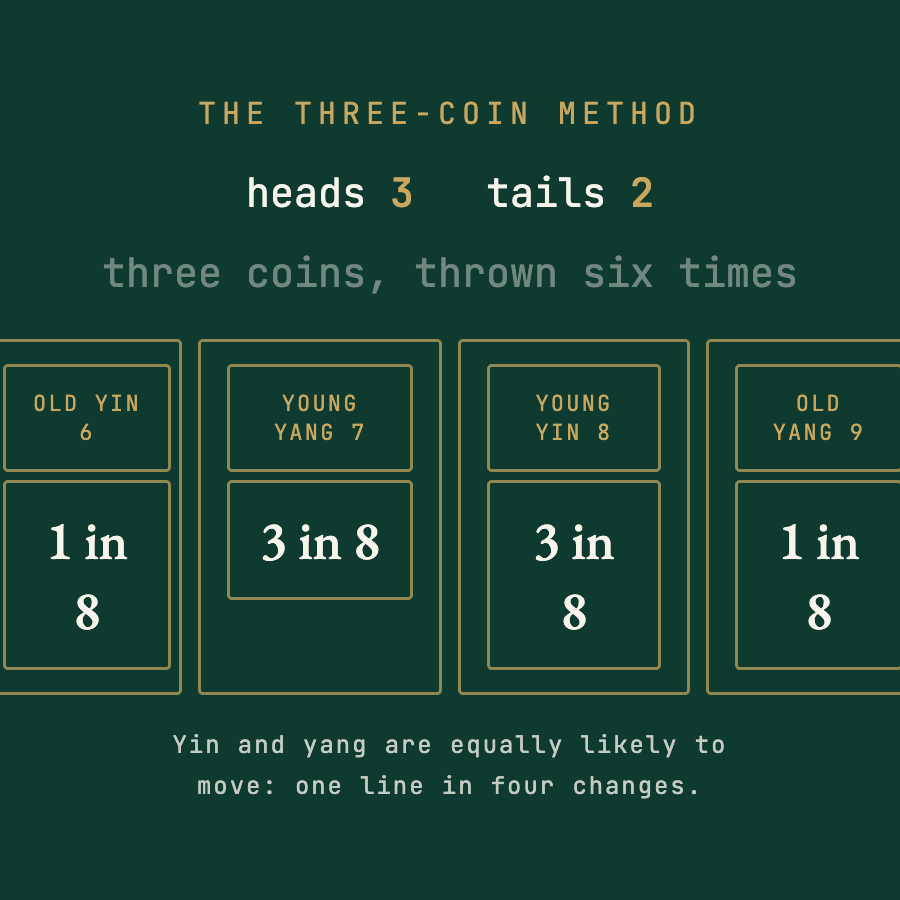
The arithmetic is worth seeing once, because it explains everything that follows. Three coins land in eight equally likely combinations. Only one of those is three heads, giving nine, and only one is three tails, giving six. The other six combinations are mixed, and they split three and three between seven and eight.
Each total is one line. Six is old yin, a broken line that is changing to yang. Seven is young yang, a solid line at rest. Eight is young yin, a broken line at rest. Nine is old yang, a solid line changing to yin. The odd numbers are yang and the even numbers are yin, and the extremes, six and nine, are the ones that move.
Throw six times. The first throw is the bottom line and the sixth is the top, because a hexagram is built upward and written downward. When you have six lines you have a hexagram. If any of them were sixes or nines, change those lines to their opposites and you have a second hexagram as well, the one the first is moving into.
That is the whole procedure. It takes about a minute, which is both its virtue and the thing the older method's defenders object to.
What the odds actually are
Three coins give eight equally likely outcomes, and the four line types fall out of them directly. Old yin is one in eight. Young yang is three in eight. Young yin is three in eight. Old yang is one in eight. Those are the figures this tool uses.
Two consequences follow and they are worth separating. The first is that a quarter of all lines move, since one in eight plus one in eight is two in eight. The second is that yin and yang are perfectly balanced: a yang line has a one in four chance of being a moving line, and so does a yin line. The coins cannot tell the difference between them.
That symmetry sounds like a virtue and is the whole objection to the method. The yarrow stalks are not symmetric, and their asymmetry is the older behaviour. With stalks, old yang is three in sixteen and old yin is one in sixteen, so a change out of yang is three times as likely as a change out of yin. The classical text is built on the assumption that yang is the restless principle and yin the settled one, and the coins flatten that.
What the two methods share is more surprising than what divides them. Both make yin and yang equally likely overall, at one half each. Both move a quarter of lines, so both average one and a half moving lines per casting. Both give the same odds of a still hexagram, 729 in 4,096, or about one casting in six, and the same odds of all six lines moving, one in 4,096. The distribution of how many lines move is identical. What differs is only which lines move, and that is enough to change what a reading tends to say.
How to read the result
Read the primary hexagram first, as a whole. Its Judgement and its Image are the answer to the question you asked; everything else is commentary on how that answer is moving.
If lines are moving, read those line texts next, and then the second hexagram. The order matters. The second hexagram is not a prediction of what happens later, and treating it as a sequence in time is the commonest way readers go wrong with it. It describes the same situation seen from the far side of the change the moving lines are making.
The two trigrams are worth a look before you finish. Every hexagram is two three-line figures stacked, and the relationship between them is often the quickest route into a reading: which is above, which below, and whether they are working with or against each other. Qian, three solid lines, behaves very differently as the upper trigram than as the lower one.
Finally, write down the question before you cast. Readers who do not almost always discover afterwards that they were asking two things.
What to do with changing lines
How many lines moved decides how you read the casting, and the classical conventions are specific. This tool states them on screen as you cast; they are set out here in full.
No lines moving. Read the Judgement and the Image of the hexagram you got, and no line text at all. A still hexagram is a complete answer. Reading line texts into it is the commonest beginner's mistake, and it happens on roughly one casting in six.
One line moving. That line text carries the reading. The second hexagram shows where the situation is going, but the single moving line is the answer.
Two lines moving. The upper of the two is usually taken as governing, though many readers weigh both and there is no settled agreement here.
Three lines moving. The middle one is commonly read as governing, and the second hexagram starts to matter more than the individual line texts.
Four lines moving. The convention inverts: read the two unchanged lines of the second hexagram rather than the four that moved.
Five lines moving. Read the single unchanged line of the second hexagram.
All six moving. This is the one case with a genuine special rule, and it applies only to Hexagram 1, The Creative and Hexagram 2, The Receptive, which each carry a seventh line text written for exactly this situation. For every other hexagram, read the Judgement of the second hexagram. It happens once in 4,096 castings.
Where this method came from
The coin method is the younger of the two by a long way. The yarrow stalk ritual is the one described in the Great Treatise, the Xici, a commentary layer attached to the I Ching well before the common era, and it is the procedure the classical text assumes.
Coins enter later. The usual account places the three-coin method in the Tang or Song period, roughly the eighth to twelfth centuries of the common era, with the first clear descriptions in Song dynasty sources; earlier dates are asserted more often than they are evidenced. It was a simplification, and it was adopted for the obvious reason: the stalk ritual takes a quarter of an hour and the coins take a minute.
What is genuinely uncertain is whether the change in odds was noticed at the time. The coin method reproduces the four line values but not their frequencies, and there is no evidence that anyone intended that. It looks like an accident of convenience that went unexamined for centuries.
The discrepancy became widely discussed only in the twentieth century, once the text had a large Western readership and people began working out the arithmetic rather than following the ritual. It has been argued about ever since, and neither camp has won, which is why this tool offers both methods and prints the odds for whichever you pick.
The common misreading
The first misreading is that the coins are a lesser oracle. They are a different one. The line values are the same, the reading conventions are the same, and the distribution of how many lines move is identical to the stalks. What differs is the direction of movement, and if you do not weight yang and yin differently in your own reading, the difference may not reach you at all.
The second is treating the second hexagram as the future. It is not later; it is the same situation described from the other side of the change. Readers who take it as a forecast end up with two predictions and no reading.
The third is casting repeatedly until something acceptable arrives. The tradition is unusually blunt about this. Hexagram 4, Youthful Folly contains the line about asking two and three times and being told nothing further, and it is there precisely because people have always done it. If you want to ask again, change the question rather than repeat it.
Questions to sit with
- What exactly are you asking, in one sentence, before you throw?
- Did any lines move, and if none did, can you accept a still answer?
- Are you reading the second hexagram as a later time, or as the same situation from the far side?
- If you are about to cast again, has the question changed or only the answer you wanted?
Put a real question to the lines.