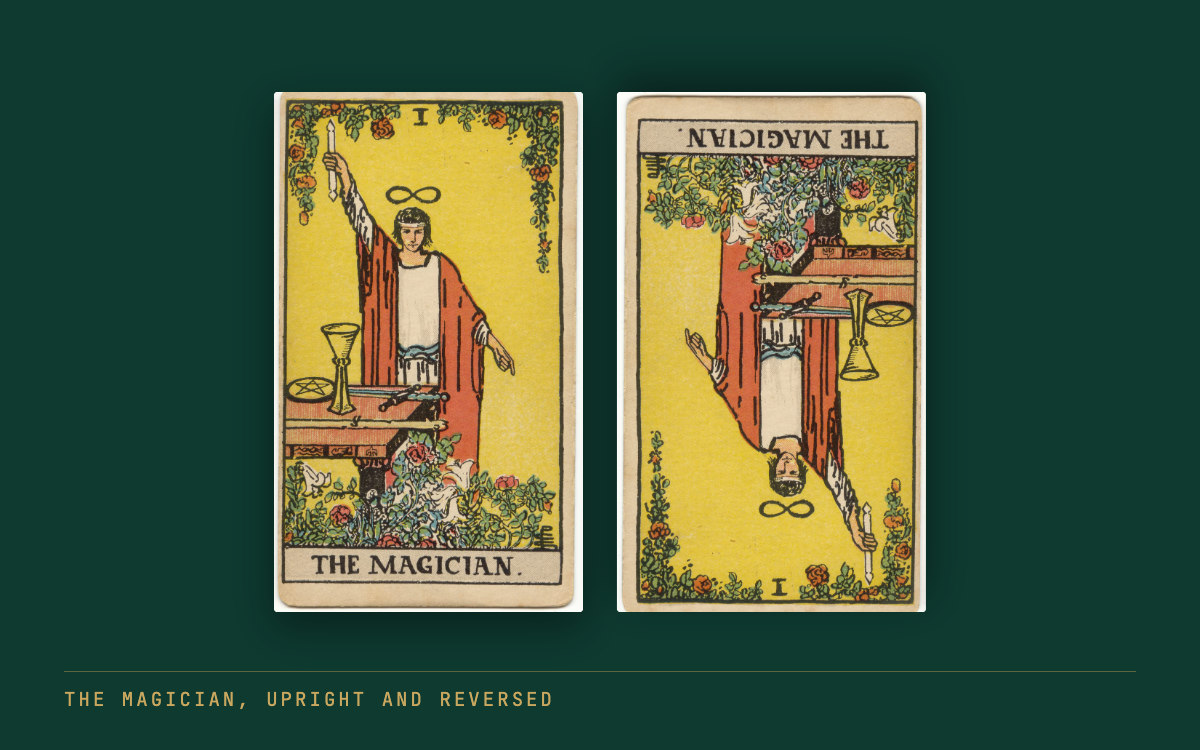
Should you read reversed cards? The question gets answered with far more confidence than the evidence supports, in both directions. One camp treats reversals as essential and the other treats them as noise, and each side tends to present its position as obvious.
It is not obvious. What follows is the honest version: where the practice comes from, the real case for each side, and the thing both camps get wrong.
What the tradition actually says
Reversals are not a modern invention. Etteilla, working in Paris in the 1780s and 1790s, sold printed lists that gave every card two meanings, one for upright and one for reversed. That is the point at which the practice enters the record, and it is roughly a century before the deck most English readers use existed.
Arthur Edward Waite continued it. The Pictorial Key to the Tarot, published in 1910 to accompany the deck Pamela Colman Smith had drawn the year before, gives a reversed divinatory meaning for all seventy-eight cards. So the tradition is on the side of reading them.
The tradition is also, on inspection, uneven about it. A fair number of Waite's reversed entries are the upright meaning with a negative turned on, and a few are close to non sequiturs, arriving without any visible connection to the picture or to the upright sense. Both facts are worth holding at once: the practice is old and well attested, and the specific reversed meanings handed down are of variable quality. Inheriting the practice does not oblige you to inherit every entry in the list.
The case for reading upright only
This position is held by serious readers and it is not laziness, so it deserves a fair statement.
The deck already contains its own opposites. There are seventy-eight cards, and the range from The Tower to The Star, or from Death to The Sun, covers the emotional territory without anyone having to turn anything upside down. If a spread needs to say that a situation has gone badly, it has plenty of cards for that.
Second, reversals double the vocabulary without doubling the information. A reader working with a hundred and fifty-six meanings has considerably more room to retrofit an interpretation onto a situation after the fact. More options can mean less precision, and precision is the only thing that makes a reading checkable.
Third, whether a card comes out reversed depends on how the deck was handled: which way a previous reader put it back, whether the pack was turned during a riffle. Some readers regard that as mechanical noise rather than signal, and that is a coherent view about what the shuffle is doing.
The case for reversals
The counter-argument is about resolution rather than range.
A card describes a situation, and situations have modes. The same quality can be present and working, present and blocked, present and overdone, or present and turned inward. Reversal gives a reader a way to say this quality, not functioning, without substituting a different card and thereby changing the subject. Ten of Wands upright is a person carrying too much; the reversal is about that same load being put down or dropped, which no other card in the deck says in quite that way.
The second argument is that the reversal is frequently the more interesting reading. A great many upright meanings are agreeable, and a deck read upright-only can drift toward the consoling. The reversals are where the deck keeps most of its capacity to say something a querent did not want to hear.
There is a third position, less often stated, which is that reversals are worth reading but the inherited meanings are not. On this view you keep the mechanism and throw away Etteilla's and Waite's specific entries, deriving the reversed sense from the picture and the upright meaning each time. It is more work and it produces better readings, and it is probably what most experienced readers actually do while describing themselves as being in one of the other two camps.
What both camps get wrong
Here is the actual error, and it is shared: reversed does not mean bad.
Most cards reverse two contradictory ways, and choosing between them is the entire work. Three examples, all of them standard rather than clever.
Five of Wands reversed reads either as conflict avoided, with the disagreement still present and pushed underground, or as conflict genuinely ending and the noise dropping. Those are opposite situations. They call for opposite responses. The card supplies neither.
Nine of Wands reversed is either depletion, where the defences have finally failed and the reserves are gone, or the opposite: the guard has become the problem, and the wariness that once protected something is now the main thing keeping the person alone. Again opposite, and the second reading is considerably less flattering, which is why it gets skipped.
The Fool reversed is either recklessness, the same step taken with none of the openness that made it worth taking, or the leap refused, with hesitation dressed as diligence. The first is doing too much and the second is doing nothing.
Notice what this does to both camps. The upright-only reader often declines reversals because they think a reversed deck produces a bleak reading, which is a misunderstanding of what reversals contain. The reversal-using reader frequently reads them as simply negative, which throws away half of each card. The two positions are opposite in practice and identical in the assumption underneath.
How the spread decides
If a reversal points two ways, something has to choose, and it is not the card. It is the position and the neighbours.
Take Five of Wands reversed in the final position of a ten-card spread. If the cards around it describe silence, withholding, a person committed to not saying anything, the avoided reading has the weight of the spread behind it. If they describe movement, decisions being taken, things being said, the subsiding reading does. Same card, same position, opposite readings, and the difference is entirely in what else is on the table.
The same test applies to the other two examples. Nine of Wands reversed sitting beside cards about load and pressure reads as depletion; sitting beside cards about isolation it reads as the fence that outlived its purpose. The Fool reversed among cards of haste is recklessness, and among cards of stalling it is the leap refused. In each case the deciding evidence is somewhere else on the table, which is why a single reversed card pulled on its own is the hardest reading in tarot and not the easiest.
That is the discipline, and it is simple to state and hard to keep: name both readings out loud before choosing between them, then say which one you picked and what in the spread made you pick it. If you cannot point at the specific card that tipped it, you have not chosen. You have preferred.
A practical rule
Decide before you shuffle, not after you see the card.
That is the whole of it, and it is the only rule here that matters. Either you are reading reversals in this session or you are not, and the decision is made while the deck is still face down. The failure mode is not choosing wrong; it is choosing late, when a reversed card has landed in an awkward position and you find yourself deciding that reversals do not really count today. The reading tool on this site has the toggle above the deal button for exactly that reason: you set it before the shuffle, and the setting is recorded in the link to the spread.
Beyond that, three habits. Be consistent within a reading; a deck that is half reversed and half not is a deck being edited. If you are new, work upright-only for a while, because seventy-eight meanings are enough to be going on with and you will read them more carefully without a second set competing. And if you do use reversals, treat each one as a question rather than an answer, on the assumption that the card is offering two readings and expecting you to do the work of deciding.
None of this makes a reading more accurate about the future, because nothing does. What it does is stop a reversal being the place where a reader quietly inserts whatever they had already decided.