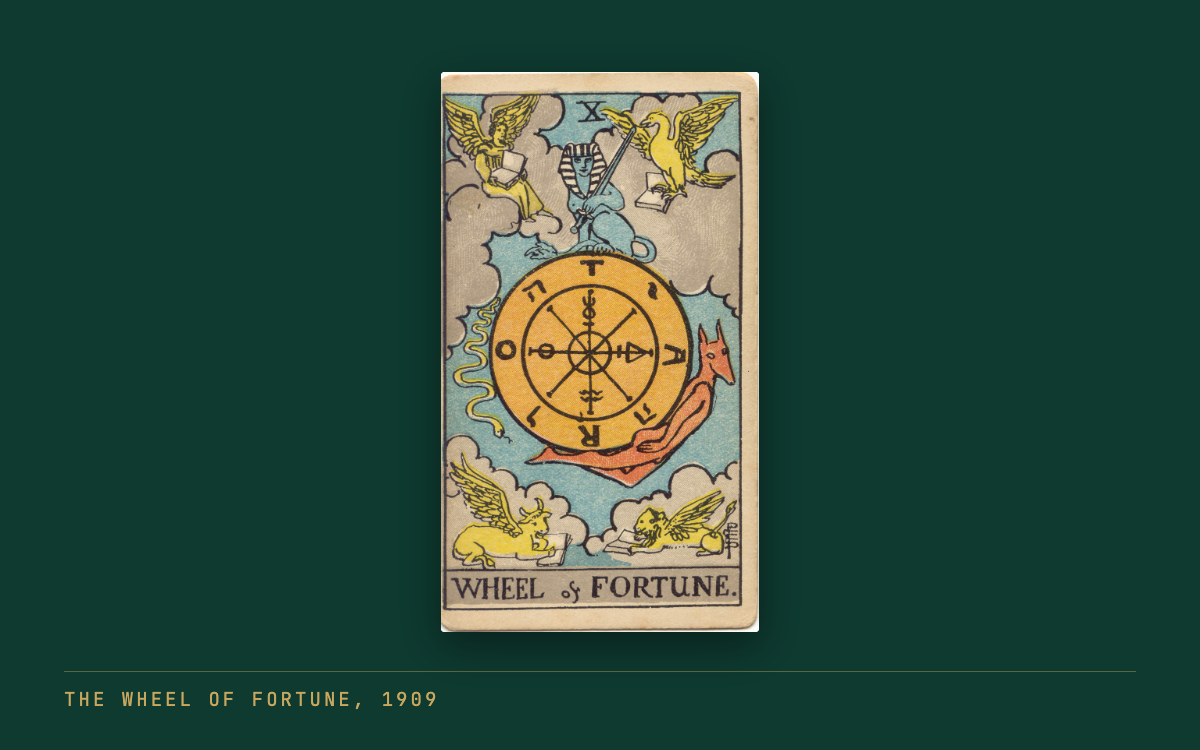
Most writing about tarot is about what the cards can do. This is about what they cannot, stated plainly, because a practice that will not name its own limits is not a practice. It is a sales pitch.
None of what follows is an argument against reading. It is an argument for reading the thing that is actually in front of you.
It cannot tell you what happens
There is no mechanism by which a shuffled deck knows the future, and no reader has ever demonstrated one. That is the first and largest limit, and everything else follows from it.
What a card describes is a situation with a shape: a posture, a pressure, a way things are arranged. Death describes a conclusion without naming what concludes. The Fool describes a step taken before the ground is known, and says nothing about whether the step lands. The cards are good at describing conditions and silent about results, and a reader who converts the first into the second has stopped reporting and started inventing.
This applies to the yes-or-no question too, which is the hardest case because people want an answer so badly. The yes or no spread on this site deals three cards and tallies them, and a good many of the seventy-eight are marked It depends rather than yes or no, which is not evasion. It is the honest answer to a question the deck cannot settle. A tally of three cards is a summary of a tendency in the imagery, not a verdict on your situation.
It cannot tell you what anyone else is thinking
This is the most requested reading and the least deliverable one. Does he still care. What is she really planning. Why did they go quiet.
A card in a position labelled how they feel does not have access to another person's interior. What it can describe is a posture that would be visible from the outside if you looked: guarded, preoccupied, warm in a way that has not been tested, absent. That is genuinely useful, and it is a different claim from knowing someone's mind.
There is a second problem, and it is the practical one. A reading about another person's feelings cannot be checked. If you decide from three cards that someone is holding back out of fear, you now hold a belief about a person that no evidence in your possession can correct, and you will read their next message through it. That is not a small harm. It is the mechanism by which readings damage relationships, and it does so precisely when they feel most satisfying.
Ask instead what your own position is, what you have not said, what you would need to hear. Those are answerable, and answering them tends to produce the conversation that would have settled the question anyway.
It is not a doctor, a lawyer or an accountant
This one is short because it should be.
If you have a symptom, see a doctor. No card is a diagnosis, no spread is a prognosis, and the cards most often read as health omens are read that way because they look alarming rather than because they carry any medical content. Nothing in a deck drawn in 1909 knows anything about your body.
The same holds for a legal question, where the answer depends on jurisdiction, documents and facts a deck has no access to, and for money, where it depends on numbers only you and a qualified adviser can see. A card can describe how you are approaching a decision. It cannot tell you whether the decision is sound, and a reader who offers that is doing something they are not competent to do.
The rule is easy to apply: if being wrong about the answer would cost you your health, your case or your savings, the question is not a tarot question. It may still be worth asking the cards what you are avoiding about it. That is a different question and a legitimate one.
It cannot tell you when
There is no clock anywhere in a spread. Positions that sound temporal are not measurements: the near future is a direction, and where it is heading in a three-card line means the way a situation is currently pointed. Neither carries a date.
Timing systems exist, attaching cards to seasons, suits to months, numbers to weeks. They are inventions, they disagree with each other, and none has any better claim than the others. If a reader gives you a date, they have chosen a system you were not told about and reported its output as a fact.
The tell: a reading you cannot be wrong about
Here is the single most useful test, and it applies to any reader including yourself.
After a reading, ask: what would have to be true for this to be wrong? If nothing could count against it, nothing counts for it either. A reading that fits any situation has described none.
The failure usually happens at a specific place. A reversal gets resolved in the flattering direction without the choice being named, which is why most reversals point two contradictory ways and the spread rather than the reader has to decide. A card that does not fit gets moved into a position where it can be dismissed as background, or postponed into a future where it cannot be checked. Each of those is a small edit, and a few of them turn a spread into a mirror.
One more limit, less often stated. A reading cannot tell you whether to trust the reader, and that includes when the reader is you. Everyone comes to a spread with a preferred answer, and the cards offer no protection against it whatever. The protections are procedural: deciding about reversals before the shuffle, writing the reading down before looking anything up, and naming the ambiguities out loud instead of resolving them quietly. None of those make the cards more accurate. They make you harder to fool.
What it is genuinely for
Having said all that, the cards are not useless, and the reason is not mysterious.
A deck is a fixed set of seventy-eight images that will not agree with you. That is the whole value. You arrive with a situation you have been narrating to yourself in the same words for weeks, and you are handed a picture that does not fit the narration and has to be reconciled with it. The work of reconciling is where anything useful happens.
Three things it does reliably.
It forces articulation. Saying out loud what a card describes about your situation requires you to state the situation, which many people have not actually done. The statement is often the entire benefit and it arrives before any interpretation.
It surfaces the thing you already knew. Readings that land tend to land on something the person was aware of and had not said. The deck did not know it. The deck provided an occasion, and an occasion is not nothing when the alternative is another week of not saying it.
It supplies a vocabulary for situations that are hard to name. Being overloaded by things you agreed to one at a time; endurance that has outlived its usefulness; the difference between patience and avoidance. Those are difficult to describe from scratch and easy to point at with a card, and having a name for a condition is the first step to doing anything about it.
How to keep it honest
Ask questions that describe rather than predict. What is this made of, what am I not looking at, what am I treating as fixed.
Draw once. Redrawing until the cards are agreeable is the commonest way a reading gets quietly falsified, and everyone who reads knows the temptation.
Write down your reading before you look anything up, then find where you were wrong. The wrongness is the informative part.
And keep the limits in the room. A reading that begins by saying what it cannot do is more useful than one that does not, because everything it says afterwards can be taken at face value. If you want to try one on those terms, the reading tool here deals a real spread, stores nothing, and links every card to a page that tries to be honest about what the card does and does not say.