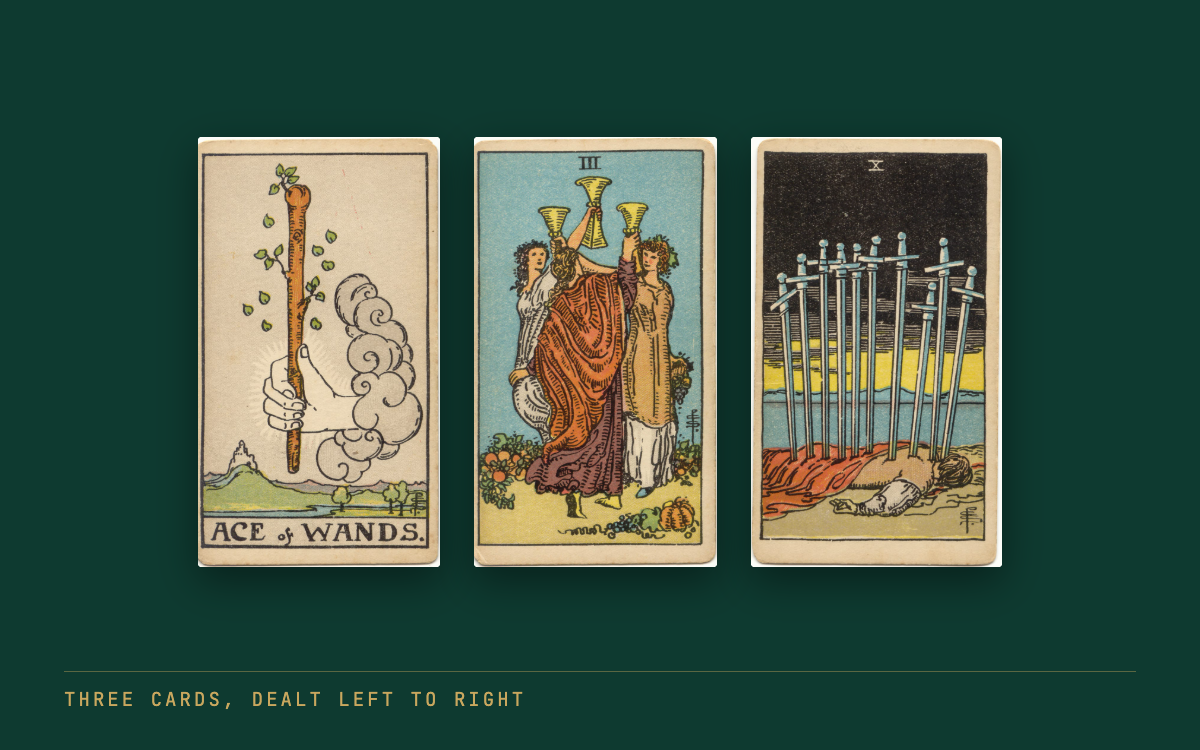
Three cards in a row is the first spread most people learn and the one most often read badly. The mistake is not in the cards. It is in the number: three positions look like three questions, so they get three separate answers, and the reading finishes as a list of unrelated statements about a life.
A three-card line is one sentence. The positions are grammar, not compartments.
The commonest mistake
Open almost any beginner's guide and the three-card spread arrives as past, present, future. That framing is where the trouble starts, because it invites you to treat each card as a self-contained verdict on its own slice of time. What comes out is something like: there was a difficulty, things are unsettled now, it improves later. Three claims, none of them joined, and the middle one usually restates the question it was asked.
The three-card spread on this site names the positions differently, and the wording is doing work: what is behind it, where it stands now, where it is heading. Same three cards. But it is the same it in all three positions. The first card is behind something specific, and the third is where that same specific thing is going. If your reading of the third card does not depend on your reading of the first, you have not finished reading.
Before you deal: the question
Most bad three-card readings are decided before the cards are turned, by the question. Anything phrased as will it or does he or when will asks the spread for information it does not carry, and a reader who answers anyway is inventing. Anything phrased as should I hands over a decision that stays yours whatever the cards say.
Questions that work in three positions are questions about shape. What is this situation actually made of. What am I not looking at. What have I been treating as fixed. Those can be answered by a line of cards because the answer is a description, and descriptions can be checked against a life you already know from the inside.
A real draw
Here is an actual spread, dealt with the tool on this site shortly before this piece was written, with reversals switched on. The link reproduces it exactly: this draw. The shuffle is seeded, the seed sits in the address, and anyone who opens it sees the same three cards in the same order.
- What is behind it: Four of Swords, upright
- Where it stands now: Three of Swords, upright
- Where it is heading: Death, upright
That is a heavy line and it arrived by shuffle rather than by choice. It would have been easy to draw again and write about something more comfortable. Drawing repeatedly until the cards suit the argument is the commonest way a reading gets quietly falsified, and it is worth naming here, at the point where the temptation was real.
The three cards, briefly
Four of Swords is rest, and specifically the imposed kind. Pamela Colman Smith drew a figure lying full length on a tomb, three swords on the wall above and one beneath: recovery pictured as stillness rather than as sleep. Nothing in the card is happening, and that is the card.
Three of Swords is the plainest image in the deck. A heart, three blades through it, rain behind. Grief with its cause visible and named, which is a different condition from unhappiness in general.
Death is the card people reach for first and the one that least often means what they fear. It is the thirteenth trump, and Arthur Edward Waite's own 1910 commentary on it is notably careful. What is drawn is a procession: a figure on a white horse, people of several ranks in its way, a river behind. The card describes a conclusion. It does not name the thing concluding.
Reading them as one sentence
Now put them in a line and let each clause bear on the next.
Behind this is a period of withdrawal, of the kind done lying still. Where it stands now is grief that has become explicit: the thing being rested from has acquired a name, and it hurts in a way that is no longer vague. Where it is heading is an ending.
Read as three separate answers, that is a forecast of doom, and forecasting is not what the spread does. Read as one sentence it describes something ordinary and far more useful: a situation that has moved from numbness, through articulation, toward a conclusion. That is a recognisable order of events. The withdrawal came first; the pain arrived when the withdrawal ended and the thing could finally be looked at; what follows is the end of an arrangement.
Notice what joining them changed. Death alone invites catastrophe. Death as the third term of a sentence that opened in convalescence reads instead as the completion of a process already well advanced by the time the cards were dealt. Same card, different sentence, and the sentence is what the spread is for.
One structural note about the middle position. In a three-card line the second card is the one readers most often skip past, because it is supposed to describe where things stand and the querent already believes they know that. It is worth slowing down there. In this draw the middle card is the only one that names a cause, and a line whose middle term is vague will produce a third term that can mean anything.
What this draw cannot tell you
Worth stating with the cards still on the table, because a good reading is specific about its own limits.
It does not say what ends. Death names a conclusion and specifies nothing whatever about its object. A job, an arrangement, a version of yourself, a habit of thinking about someone: the card is silent, and a reader who tells you which one has supplied it from their own head rather than from the spread.
It does not say when. There is no clock anywhere in a tarot spread. Three positions in a row look like a timeline and are not one; the third position is where something is heading, which is a direction rather than a date.
It does not say whether the ending is chosen. Nothing in this line distinguishes a decision from something that happens to a person, and the difference between those two matters more than anything the cards are being asked.
Reading the line backwards
A discipline worth adopting once the forward reading is done: run the sentence in reverse and see whether it still holds. Ask what the first two cards would have to be for the third to be true of an actual situation.
Here that produces a genuine test. If something is genuinely at the point Death describes, was there a period of enforced stillness behind it, and did that stillness give way to a grief that can be named? If the answer to either is no, the line does not fit, and the honest response is to say so rather than to bend the cards until they cover it. A spread that fits everything describes nothing.
How to practise this
Draw three cards. Before looking anything up, write one sentence with three clauses joined by and or so or but. Never three sentences. Force the grammar and the reading follows it.
Then look the cards up and find where the sentence was wrong. The wrongness is the useful part, because it shows which card you had already decided about before you read it.
One more habit, and it is the one that separates reading from decoration. Say out loud what would have to be true in the situation for your reading to be false. If you cannot answer that, you have not read a spread. You have written a horoscope, and the difference is that a horoscope is safe from evidence.
Three cards are enough for most questions. If you want more positions, the Celtic Cross gives ten, at the cost of ten more chances to explain away a card you did not like.