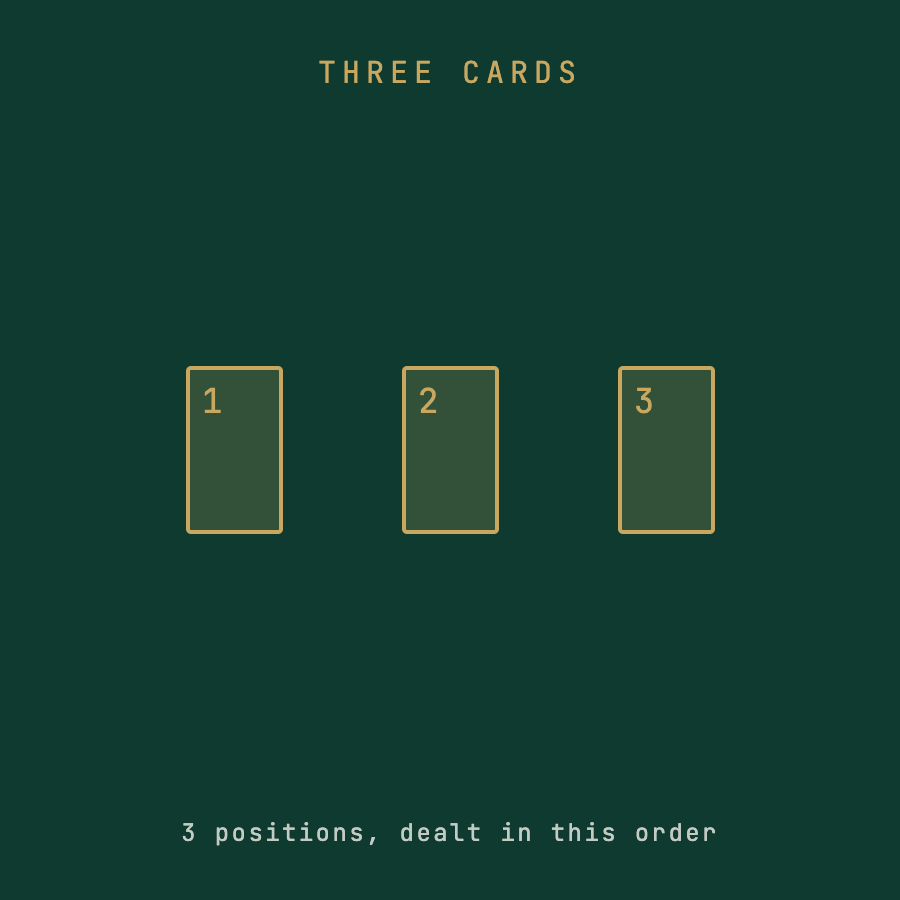
- Number of cards
- 3
- Difficulty
- Beginner
Three-card spread
Three cards in a line, read as one sentence rather than three answers. The most common spread in English-language tarot, and the one where the middle card does most of the work.
- three cards
- past present future
- beginner
- sequence
- context
When this spread is the right one
The three-card line suits a situation with a history and a direction: something that started somewhere, is currently somewhere, and is going somewhere. That covers a great deal of what people actually want to ask about.
It is the right size for a question with one subject. A stalled project, a friendship that has cooled, a decision you have been circling for a month. Three positions are enough to give each card some context and few enough that you cannot quietly cherry-pick.
It does not suit questions with two parties in them. If the question is about you and somebody else, the line has no position for them, and readers end up silently assigning one, usually the middle. Use the relationship spread, which has those positions built in.
It also does not suit a decision between named options. Three cards in a row cannot compare two things; they describe one thing over time. And it is a poor fit for anything you want answered yes or no, which is a separate problem with its own page.
How to read it
Read the three as one statement. That instruction appears on every page about this spread and is almost universally ignored, so it is worth being concrete about what it means.
The wrong method is to read card one, stop, read card two, stop, read card three. You end up with three miniature readings and no reading at all. The positions are not three questions. They are three parts of one description, and the meaning lives in how they relate to each other.
The working method is to find the movement first. Look at all three before interpreting any of them. What changes across the line? A spread running from a Major Arcana card to two Minors describes something losing momentum. One running the other way describes something gathering it. Three cards of the same suit narrow the subject before any individual card has said anything.
Then read the middle. The centre position is the present, and it is the only one you can check against your actual life. If it does not fit, the reading is already in trouble, and no amount of work on the other two will repair it. Readers routinely gloss a wrong middle card and then build an elaborate story around the third, which is how these spreads go astray.
Only then take the first and third in the light of the middle. The first is not a separate account of your past; it is the part of the past this present is made of. The third is not a prediction; it is where the present points if nothing changes, which is a conditional and should be spoken as one.
Finish with a sentence you could say out loud in one breath. If you cannot, you have three readings rather than one.
What each position is asking
What is behind it. Not your past in general, and not the beginning of the story. This position holds the part of what came before that is still operating. A card here describes something with a live effect, which is why an old event that no longer moves you is a poor fit and a small recent thing that still stings is a good one. Readers frequently over-read this position into biography.
Where it stands now. The load-bearing position, and the one to read first. It describes the situation as it actually is, which makes it the only card in the spread you can test. If you cannot recognise your own circumstances in it, stop and say so rather than adjusting the interpretation until it fits. A three-card reading with a wrong middle is not a reading with two good cards. It is a reading that has failed.
Where it is heading. The most misread position in the spread. It is not a prediction and it is not an outcome. It describes the direction the present is pointing, on current terms, with nothing changed. That last clause is the whole position, and it is the part people drop. A difficult card here describes a trajectory rather than a sentence passed on you, and the useful response is to ask what would have to change, not to brace for impact.
The three positions also carry no fixed timescale between them. Nothing in the spread says whether behind means last week or a decade ago, or whether heading means Thursday or next year. Readers supply a scale without noticing, usually one that suits the conclusion they were already drifting toward, and then treat the timing as though the cards had provided it.
It is also worth saying what these three positions do not include. There is no position for another person, none for what something costs, and none for advice. Readers supply all three anyway, usually by promoting the third card into a recommendation. If your question needs those, this is the wrong size of spread.
A worked example
Drawn on this site, three cards, reversals on, seed 20260906, on a question about a piece of work that had stalled.
Behind it: Seven of Wands, reversed. Upright it is holding a position under pressure. Reversed the range runs to overwhelm, giving up, or a siege that was more imagined than real.
Now: Two of Pentacles, upright. Juggling, balance, several things kept moving at once.
Heading: Knight of Cups, reversed. Unreliability, stalling, an offer with less behind it than it appears to have.
Read as three separate cards this is noise. Read as one line it is fairly direct: a defence that was abandoned some time ago, a present spent keeping several things in the air, and a direction pointing at something that arrives with enthusiasm and does not follow through.
Note the structure before the content. No Major Arcana at all, conventionally read as an ordinary situation rather than a turning point, and three different suits, so the spread is not concentrated on one area of life. Both constrain the reading before any single card does.
What it does not say: whether the work is worth continuing, whose fault the stalling is, or when any of it resolves. The third card is a direction rather than an arrival, and reading it as an arrival is the error this spread invites most often.
Where this spread came from
The three-card line is modern and conventional, and there is no lineage to claim for it.
Three-card layouts appear in European cartomancy well before tarot was used for divination at all, for the simple reason that three is a convenient number. Etteilla's late eighteenth-century system and the nineteenth-century French cartomantic tradition both used spreads of various sizes, without anything resembling the past-present-future line being singled out.
The Golden Dawn material of the 1890s, from which most structured English-language tarot practice descends, is concerned with larger and more elaborate layouts. Waite's The Pictorial Key to the Tarot (1910) prints a ten-card method and a second, shorter one, and gives no three-card spread at all.
The past-present-future line as everybody now knows it is a twentieth-century simplification, popularised through mass-market tarot books from the 1970s onward and then by every app and website that needed something quick to put on a screen.
That is not a criticism. It is a good spread, precisely because it is small enough to stay honest. It is simply not old, and a page claiming otherwise is inventing a pedigree it does not need.
The common misreading
The most common misreading is treating three cards as three separate answers. It produces a reading three times as long as it should be, containing less than a single card would, because the relationships between the positions are where the information actually is.
The second is treating the third position as a prediction. It is the position readers most want to be a forecast and the one where the spread is weakest. A card in the third position describes where a situation points if nothing changes. Every part of that sentence matters, and dropping the conditional turns a description into a fortune.
The third is quietly reassigning positions. When the middle card does not match the querent's life, readers move it: perhaps that one is about work rather than the relationship, perhaps it refers to next month instead. Once positions become negotiable the spread has stopped constraining anything and you are simply talking.
And one specific to this spread: using it for two-party questions. With no position for the other person, one of the three gets silently drafted into the role, which produces confident statements about somebody who is not in the room and was never in the spread.
The positions, in order
- What is behind it
- Where it stands now
- Where it is heading
Questions to sit with
- Can you say the whole spread as one sentence, in a single breath?
- Does the middle card actually match your circumstances, honestly?
- What would have to change for the third card not to be where this goes?
- Which card did you spend longest on, and was it the one that fit worst?
Deal this spread with the full deck.