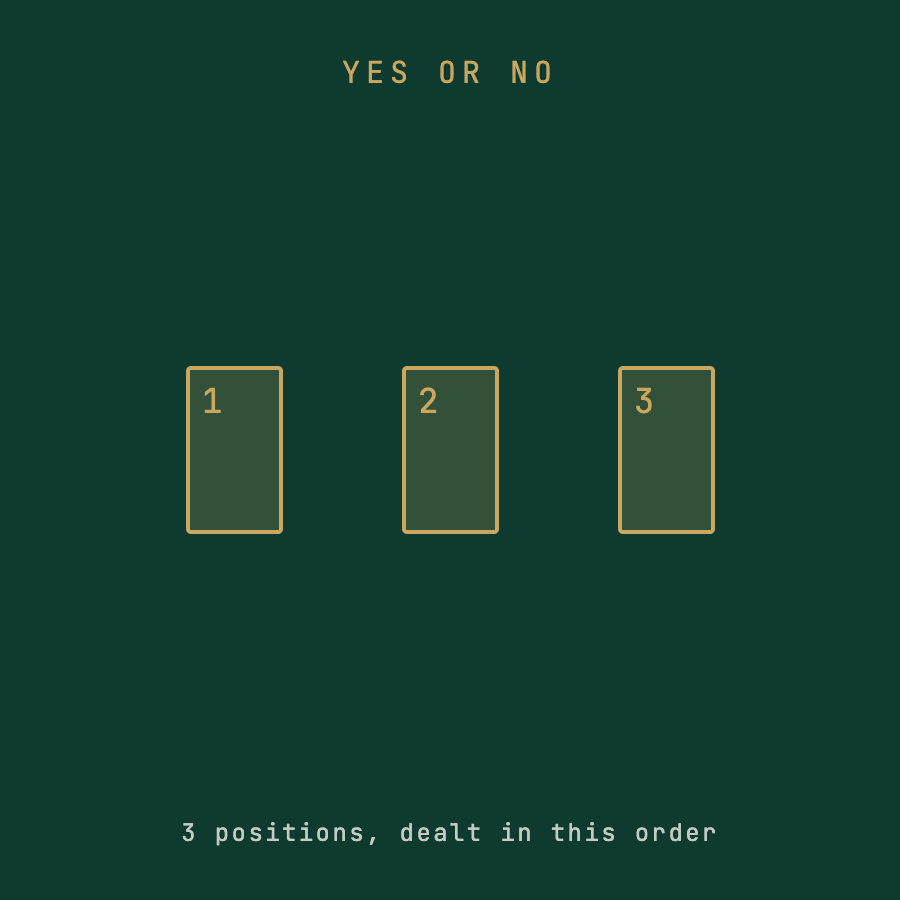
- Number of cards
- 3
- Difficulty
- Beginner
Yes or no spread
This spread exists because people search for it. Three cards counted as votes is not an answer, and on this deck the tally comes out yes about three times as often as it comes out no.
- yes or no
- binary question
- tally
- decision
- beginner
When this spread is the right one
The honest answer is almost never, and the page you are reading is the argument for that.
A yes-or-no question is usually a decision the querent has already framed as binary in order to stop thinking about it. Should I take the job. Should I message them. Should I leave. Those look like closed questions and are not: each one hides a set of conditions a card cannot evaluate and you can.
Where the spread has any use, it is diagnostic rather than oracular. Drawing three cards on a binary question and watching how you react tells you which answer you were hoping for, and that is genuinely useful information about your own position. It is information about you, not about the outcome.
If you have a real question, almost any other spread here is better. The three-card line will describe the situation instead of scoring it. The work spread ends on a concrete step rather than a verdict. Both give you something to do. This one gives you a tally.
How to read it
There is a conventional method and it does not work. It is worth setting out properly before explaining why.
The method: every card in the deck is assigned yes, no, or it depends. You draw three, count them, and the majority wins. In some versions a reversal flips a yes into a no.
Here is why that fails, using this site's own deck. Of the seventy-eight cards, thirty-nine are marked yes, twenty-one it depends, and eighteen no. That is not a balanced instrument. Half the deck says yes and under a quarter says no.
Run the tally across every possible three-card hand and the arithmetic is unambiguous: more yeses than noes in 60.8 per cent of hands, more noes than yeses in 18.1 per cent, and an even split in the remaining 21.1 per cent. The procedure returns yes roughly three times as often as no before your question has even been considered. That is not a coin toss. A coin toss would be fairer.
The bias is not a quirk of this particular deck either. Any list that assigns a verdict to each of the seventy-eight cards will be uneven, because the cards were never designed to divide into two camps, and whoever draws the line decides the odds.
You could rebalance the assignments, and readers do, but then the answer depends entirely on who did the assigning rather than on the draw. There is no version of this that recovers.
So read it the other way round. Draw the three cards, look at what they describe, and ignore the tally completely. Three cards will tell you something about a situation, which is what three cards can do. The moment you start counting, you have swapped a reading for a rigged vote.
What each position is asking
First card. The positions in this spread are deliberately unnamed, and that is the most informative thing about it. In every other spread on this site the position tells the card what to be about. Here the position is a serial number. The first card is not the past, not the strongest factor, and not the primary answer, whatever it feels like when it lands first.
Second card. Also carries no assignment. In practice readers give it one anyway, usually treating it as the tie-breaker or the deciding vote, which is exactly the move this page argues against. If the three positions are interchangeable, and they are, then no single one of them can be the decider.
Third card. The same, with one addition: it is the position most likely to be over-weighted, because it is seen last and leaves the reader with the final impression. Recency ends up doing the work the spread does not do.
It is worth pausing on why the spread is three cards at all. Three is the smallest number that produces a majority, which is the only reason for it. The size was chosen to make the scoring work rather than because three positions illuminate anything, and a spread built around its scoring method rather than around a question is a spread built backwards.
Because the positions are empty, everything has to come from the cards themselves and from what you brought to the question. That is not a defect to be worked around. It is the entire structure of the spread, and being clear-eyed about it is what separates a useful five minutes from a superstitious one.
If you want positions that mean something, every other spread on this site has them. This one has three slots and a scoring system, and the scoring system is the part that does not survive examination.
A worked example
Drawn on this site, yes or no, reversals on, seed 415509, on the question: should I go back and finish the course I abandoned.
First: Eight of Swords, upright. This deck marks it no. Second: The Hierophant, upright, marked it depends. Third: The Sun, reversed. The card itself is marked yes, and it landed reversed, which most tally systems treat as a no.
So the count is one no, one it depends, and one card whose value flips according to whose rule you follow. There is no majority. The scoring method has returned nothing at all, which is the most useful thing it could have done.
Now read the same three cards as a description and they are not silent. Eight of Swords is a situation experienced as a trap where the constraint is largely procedural. The Hierophant is formal instruction, institutions, the accredited way of doing things. The Sun reversed is delay, or something dimmed rather than absent.
That is a fairly clear account: a course of formal study, felt as closed off, with the light on it dimmed rather than gone out. It says nothing whatever about whether to enrol. It says a good deal about what has been assumed.
Where this spread came from
The yes-or-no spread is modern and has no tradition behind it at all, which is unusual even in this field.
Historical cartomancy did produce binary techniques. Nineteenth-century French systems and later Lenormand practice included methods for settling a question by drawing until a significator appeared, and various folk practices used a single cut of the deck for small decisions. Those are not this spread.
Waite's The Pictorial Key to the Tarot (1910) prints two methods and neither is a yes-or-no procedure. The Golden Dawn material behind it is likewise concerned with structured, multi-position layouts.
The card-by-card assignment of yes, no and it depends that this spread depends on is a twentieth-century invention, and different books assign different values to the same cards. There is no authority behind any of the lists, and where two of them disagree there is no way to settle it.
The spread became common online for a straightforward reason: yes-or-no is a high-volume search, and a page promising an answer performs better than a page offering a description. That is publishing rather than divination, and this page exists for the same reason while declining to make the promise.
The common misreading
The whole spread is close to a misreading, so this section is about the specific ways it goes wrong.
The first is treating the tally as an answer. It is not one, and on this deck it is a biased one: the count comes out yes roughly three times as often as it comes out no. Anybody quoting a majority verdict is quoting an artefact of somebody's keyword list rather than a result.
The second is stopping at the count. Three cards were drawn and they describe something. Readers who score them and move on have thrown away the only part with any content in it, in exchange for a single syllable.
The third is drawing again. This spread has the highest redraw rate of any on the site, for obvious reasons, and a second draw is not a second opinion. If you shuffle until the tally comes out yes, you have not consulted anything. You have made the decision and dressed it up.
And one worth being blunt about: using this spread for questions that matter. People ask it about jobs, about pregnancies, about whether to leave somebody. A procedure that returns yes three times out of five regardless of the question has no business near a decision like that.
The positions, in order
- First card
- Second card
- Third card
Questions to sit with
- Before you counted anything, which answer were you hoping for?
- What conditions is your yes-or-no question hiding inside it?
- If the tally had come out the other way, would you have drawn again?
- What do the three cards describe if you never score them at all?
Deal this spread with the full deck.