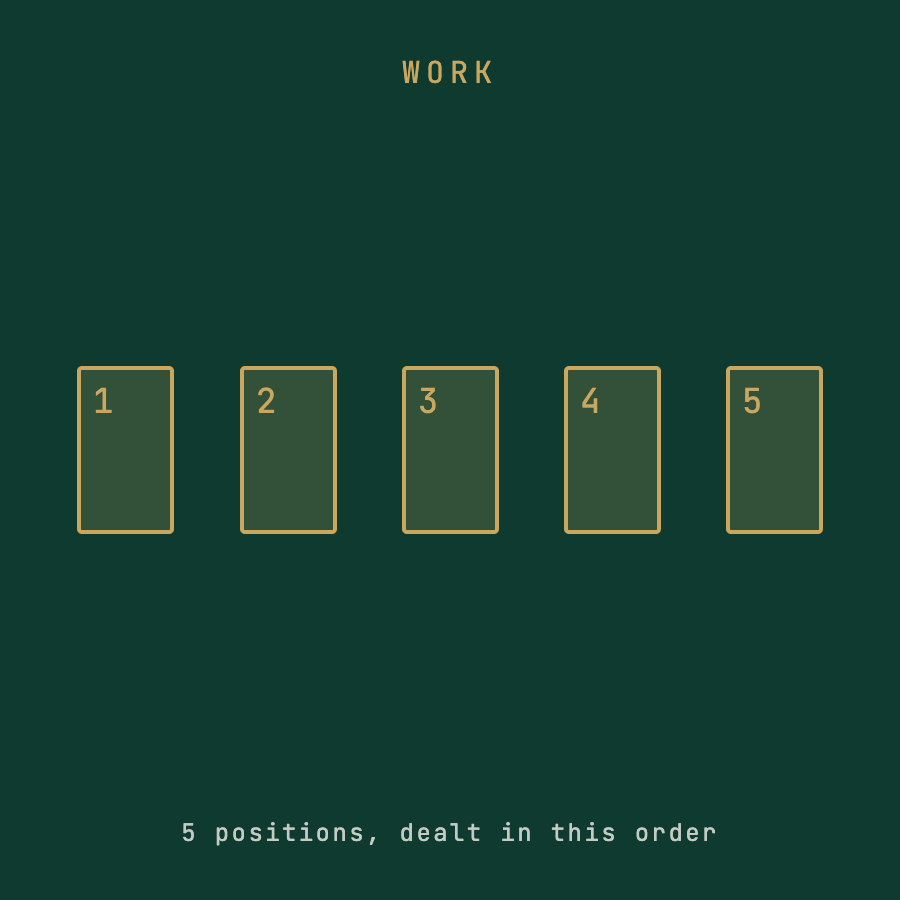
- Number of cards
- 5
- Difficulty
- Intermediate
Work and career spread
Five positions aimed at a decision rather than a forecast. The spread is built so that it ends on something you could actually do this week, and the third position does most of the real work.
- work
- career
- decision
- options
- intermediate
When this spread is the right one
This spread suits a work situation you are stuck inside and want to move. A job you are unsure about, a role that changed underneath you, a decision between staying and going, a stretch where effort has stopped producing anything.
It is built around a decision rather than a prediction, which is why the last position holds a step rather than an outcome. If you want to know whether you will get the promotion, this is the wrong tool, and so is every other one.
It is also usable outside work. The five positions describe any stuck situation with options in it, and readers point it at moves, courses of study and family decisions perfectly successfully.
Where it fits badly is a situation with no options at all. If the redundancy has already happened and the decision is made, the third and fifth positions have nothing to hold. A description suits that better: the three-card line will tell you where you are without pretending you have levers you do not have.
How to read it
Read positions three and four together, first, and treat the rest as context for them.
That is the opposite of the order they are dealt in, and it is deliberate. Position one, where you are, is the position you already know the answer to. You do not need cards to tell you that work is difficult, and reading it first tends to produce twenty minutes of agreeing with yourself.
Position three is the one carrying information you might not already have: what is actually available, as opposed to what you have been assuming is available. Read it early and read it literally. If the card describes something modest, resist the urge to inflate it. Most career decisions are constrained, and a spread that says so is being accurate rather than pessimistic.
Then position four, the cost. Every option in a working life has one, and this position exists because people evaluating a change routinely price the upside and skip the bill. If the cost card is mild, that is worth noting too. Not everything is expensive.
Now go back to one and two. Where you are will usually confirm what you already knew. What you are avoiding is the position most likely to be uncomfortable, and the one people most often misread on purpose, by finding a flattering reading for it.
Finish on five, and hold it to a standard: something you could do inside a week without anybody's permission. If the step you produce is get a new job, you have not read the position, you have restated the problem.
The spread has worked if you end with one sentence about the situation and one action with a date on it.
What each position is asking
Where you are. The current state of the situation, and the position you can check most easily. Its function is calibration: if this card does not describe your working life, stop and say so, because the rest of the spread is built on top of it. It is not a diagnosis of your career and it is not a statement about your worth.
What you are avoiding. The sharpest position in the spread. It does not ask what you are afraid of, which invites a comfortable answer, but what you are not doing. Those are different questions. People are usually well aware of the fear and much less aware of the specific action it has been quietly organising them away from. Read this one slowly and be suspicious of a flattering interpretation.
What is actually available. The word actually is doing the work. This position corrects the two most common distortions in career thinking: assuming the only options are the ones already considered, and assuming the situation is more open than it is. It cuts both ways, and a modest card here is not a failure of the spread.
What it costs. Not whether it is worth it. The position names a price and leaves the judgement with you, because the judgement genuinely is yours and depends on things no card knows: your savings, your obligations, how much risk you can absorb. Nothing on this page is financial advice, and a card cannot assess your circumstances.
The next concrete step. The only position with an instruction in it, and the reason the spread exists. It has to produce something specific, small and soon. Send the email, book the conversation, ask the question, find out the actual number. A step you cannot start this week is not a step, and readers who let this position stay abstract have converted a decision spread back into a description.
A worked example
Drawn on this site, work, reversals on, seed 930277, on whether to stay in a role that had gone wrong.
Where you are: Ten of Swords, upright, an ending that has already happened. What you are avoiding: Temperance, upright, patience and the slow version of things. What is actually available: Eight of Cups, upright, walking away from something that no longer holds. What it costs: Eight of Swords, reversed, release and clear sight. The next step: Six of Wands, upright, recognition.
Read three and four first, as the method says. What is available is departure, and what it costs is the loss of the belief that leaving was impossible. That is a specific and slightly unusual pairing: the price of the option is giving up the story that there was no option.
Position one confirms rather than adds. The situation is already over in some real sense.
Position two is the uncomfortable one. What is being avoided is patience, which cuts against the reading so far, and that tension is worth keeping rather than smoothing away.
The step is not do well. Made concrete it is closer to: write down what you have actually delivered here, in specifics, before the conversation. That is small, it takes an evening, and it needs nobody's permission, which is the test the fifth position has to pass.
Where this spread came from
There is no historical career spread. This one is a modern editorial layout, designed for this site.
Cartomancy has always been asked about money and work. Etteilla's system in the 1780s assigned meanings covering business, employment and financial fortune, and the Victorian penny fortune books did brisk trade in exactly those questions. What did not exist was a dedicated layout: the questions were put to whatever general method the reader already used.
Waite prints no career spread in The Pictorial Key to the Tarot (1910), and the Golden Dawn material behind him is general-purpose. Purpose-built spreads for love, work and the year ahead are a twentieth-century publishing development, and they multiplied in the mass-market tarot books from the 1970s onward.
The five positions here were chosen to resist the two things career readings usually do: predict an outcome, and finish without anything to act on. Positions three and four force a realistic assessment, and position five forces an action. That is a design decision made for this site rather than an inheritance, and it is more useful to say so than to attach it to a lineage it does not have.
The common misreading
The most common misreading is expecting an outcome. People come to a career spread wanting to know whether they will get the job, and no arrangement of cards contains that. The spread describes a position and produces a step. Anything more confident has been invented by the reader.
The second is inflating position three. What is actually available is the position readers most want to be generous, and a modest card there gets read up into a grand opportunity because the alternative is disappointing. A spread telling you your options are narrow has told you something worth knowing, and arguing with it wastes the one position designed to be realistic.
The third is skipping position four. Cost is the least interesting card to talk about and the one that most changes a decision. Readings that race past it produce cheerful conclusions that people cannot actually afford.
And the specific failure of this spread: letting the final position stay vague. Be more confident is not a step. If the fifth card does not convert into something with a verb and a deadline, the reading has not finished, whatever it felt like at the time.
The positions, in order
- Where you are
- What you are avoiding
- What is actually available
- What it costs
- The next concrete step
Questions to sit with
- Does the first card actually describe your working life, or did you adjust it?
- What are you not doing, stated as an action rather than as a fear?
- Is the third card modest, and did you try to read it upward?
- What is the step, with a verb and a day of the week attached to it?
Deal this spread with the full deck.