- Card number
- 2
- Arcana
- Minor Arcana
- Suit
- Pentacles
- Element
- Earth
- Rank
- Two
- Yes or no reading
- It depends
Two of Pentacles
A figure keeps two discs moving while the sea runs behind him. The Two of Pentacles describes juggling, not resolution, and it stays silent on whether the arrangement is sustainable or already slipping.
- balance
- juggling
- adaptability
- priorities
- cash flow
- overcommitment
- disorganisation
- dropped ball
- drift
- stalled decision
What the card shows
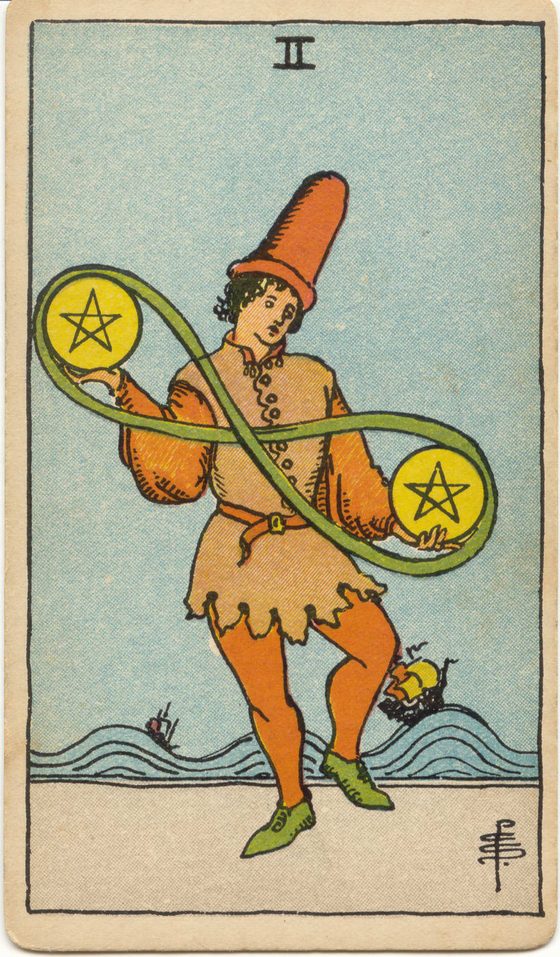
A young man stands with one foot crossed over the other, mid-step or mid-dance. He holds a pentacle in each hand. A green cord loops around both of them in a long figure of eight, so the two discs are tied into one continuous line. His cap is tall and soft, orange-red, and rises well above his head in a rounded cone.
He wears a pale tunic with a scalloped hem over orange sleeves and orange hose, with a belt at the waist and green shoes. Behind him the sea is drawn low in the frame as a few simple bands of wavy line. Two small ships ride it, one on each side, both tipped at an angle. Above the water the background is plain blue, and it takes up most of the card. Nothing in the picture is falling, and nothing is at rest.
Upright meaning
The Two of Pentacles describes a situation being held in balance by continuous effort. Two commitments, two obligations, two sources of income, two people who both need something on the same afternoon. The card does not say the load is too heavy. It says the load is only manageable while the movement continues.
What makes this card specific is the cord. The two pentacles are not independent; they are tied together, so moving one moves the other. That is usually the honest shape of the problem. A querent who thinks they are juggling two separate things is often managing one system with two visible ends, and the tiredness comes from pretending otherwise.
The sea behind the figure is doing the thing he is not: it is moving without being managed. Conditions are unsettled and he is not in charge of them. Read alongside Ten of Wands the card tips toward a load already past sustainable. Next to The Magician it reads as competence, someone genuinely good at keeping things moving. Eight of Pentacles beside it suggests the juggling is a phase before real focus.
Upright in love
In a relationship reading this card usually describes attention divided rather than withheld. Someone is running two demands at once and the relationship is one of them. That is not the same as disinterest, and it is not the same as being fine either.
It can also describe two relationships, or a relationship and something the relationship is competing with: work, family, a move, an illness. The card marks the split without saying which side wins. Where the question is whether the balancing can go on indefinitely, the honest answer is that the card describes a technique, not a settlement, and techniques get tired.
Upright in work
Two roles, two projects, two managers, or one job that has quietly become two. The Two of Pentacles is the card of the person who is coping, and coping well enough that nobody has noticed there is a problem to fix.
It often appears for contract and freelance work, where the balancing is the structure rather than a failure of it. In that context the card is neutral to positive: the arrangement works, and it works because someone keeps working it. Where a spread is asking about a promotion or a new responsibility, this card is a question about capacity, not about ability. Read it with Three of Pentacles, which describes work with other people carrying part of the weight.
Upright in money
Money that moves rather than money that sits. Income from two places, or one income covering two obligations, or a month that works only because the timing works. The card is common in readings where nothing is wrong and nothing is comfortable.
It is worth naming what the card cannot see: it does not know the size of the numbers. A person balancing two salaries and a person balancing two overdrafts draw the same picture. What the card describes is the dependence on timing. If a payment arrives late, the arrangement does not degrade, it stops. That is a structural fact about the situation, not a prediction about it.
Upright as feelings
As someone's feelings, this is interest that is real but scheduled. They are not cold and they are not undecided; they are allocating. The card describes a person who has more calls on them than hours, and who has put this one somewhere in the rotation. Whether that placement is high or low is not something the card can tell you.
Upright as advice
Write down the two things you are holding and the exact point at which one of them fails. Not a feeling about it, a date or a number. The Two of Pentacles is manageable while you know where the edge is, and unmanageable the moment you are balancing by instinct alone.
Reversed meaning
Reversed, the Two of Pentacles splits into two readings that are close to opposites, and the spread has to choose. The first is the balance lost. Too many commitments, taken on one at a time, each reasonable, and now the timing that held them together has slipped. This is the reading most books give, and it is often right.
The second is the balance held too long. Nothing has dropped. The querent has become extremely good at an arrangement that should have been temporary, and the competence is now the obstacle: as long as it works, nobody has to decide anything. That reversal is not about collapse. It is about a situation that will run indefinitely because someone is willing to keep running it.
The difference matters because the responses are opposite. One asks you to put something down. The other asks you to stop being so capable that the real decision never surfaces. Look at what surrounds it, and at what the question was actually about.
Reversed in love
Either the divided attention has stopped working, or it has worked so well that the imbalance has become the shape of the relationship. In the first case something has been dropped and both people know it. In the second, nobody has complained in a long time, which is not the same as nobody minding. The reversal is more often about an unexamined arrangement than about a crisis, and unexamined arrangements are harder to raise than crises are.
Reversed in work
Overcommitment that has tipped, or a workload that only looks sustainable from outside. Deadlines start to collide rather than queue. The other reading is a person whose flexibility has been read as capacity, so more keeps arriving. Both are common and they need different conversations: one about triage, one about the job description. Look at whether the surrounding cards describe the size of the load or the people handing it over; that is what decides which reversal you are in.
Reversed in money
Cash flow that has stopped absorbing shocks, or a juggling act that has quietly become permanent. Money moved to cover money, repeatedly, until the movement is the system. The card does not diagnose which, and it certainly does not tell you what to do with the accounts. What it does mark is that the timing has become load-bearing, and that a small delay now has a large effect. That is worth knowing before it is tested.
Reversed as feelings
Distraction rather than coldness, or a decision being avoided by staying busy. Reversed, the card often describes someone whose feelings are genuine and whose availability is not, and who has not yet had to look at the gap between the two. Ask what they have actually declined, rather than what they have said.
Reversed as advice
Put one thing down on purpose, before circumstances choose for you. Name the item, name the date, and tell the person affected. The reversal punishes drift more than it punishes decisions, and a deliberate drop is recoverable in a way that a dropped one is not.
Symbolism in the 1909 image
The green cord. Looped around both pentacles in a long figure of eight, the shape usually called a lemniscate. Waite's own description calls it an endless cord. Most books read it as infinity, flow, the continuity of exchange. In the drawing it is also plainly a tether: the two discs cannot be moved apart, which is a harder thing to say about a workload than infinity is.
The two ships. Small, low in the frame, each tipped by a wave. They are the only other actors in the picture and neither is in difficulty. Read as trade, commerce, goods in transit, things happening elsewhere that the figure depends on and cannot steer.
The tall cap. Orange-red, soft, rising well above the head in a rounded cone. Readers who make it a cap of liberty are importing meaning; it is closer to stage costume, and Smith drew a great deal of stage costume.
The crossed foot. All the weight is on one leg. Whether he is dancing or recovering his balance is genuinely unsettled in the drawing, and that unsettled quality is the card.
The sea. Drawn as a few bands of simple wavy line along the bottom of the card, not as a storm. Conditions are moving but not violent. It is the part of the picture he has no control over, and the part he is not looking at.
Where this meaning came from
For most of its life this card was a number card with no picture and no meaning. In the Italian trick-taking decks of the fifteenth century the two of coins was simply low-value cardboard, and in many surviving decks it carries the printer's name or a tax stamp rather than a scene.
The interpretive layer arrives with the eighteenth-century French occultists, Court de Gebelin and then Etteilla, who assigned divinatory meanings to a deck that had never had them. Their claims about Egyptian origins were invented and are now known to be so.
The picture English readers actually have in mind was drawn by Pamela Colman Smith in 1909, and Waite's gloss in The Pictorial Key to the Tarot (1910) is unusually thin: a young man in the act of dancing, the endless cord joining the two coins, and a divinatory line about gaiety and recreation, plus news and messages in writing. The modern reading, juggling and multitasking and cash flow, is a twentieth-century overlay on Smith's picture rather than anything Waite wrote.
Behind both sits the Golden Dawn attribution, Jupiter in Capricorn, under the title Lord of Harmonious Change. That title has done more to shape the current meaning than Waite's text did.
The common misreading
The most common misreading is that the Two of Pentacles is a compliment. Books call it adaptability, and readers hand it to people who are exhausted as though it were praise for coping. The card describes a situation that requires constant management. Whether the person should be managing it is exactly what the card does not say.
The second is the opposite error: treating it as a warning that something is about to drop. Nothing in the drawing is falling. Reading collapse into it turns a description of a workable arrangement into a prediction, which is the one thing a card cannot do.
The third is quieter. Because the card looks light, all dancing and bright colours, it is often used to make a heavy spread feel easier. If it appears next to cards about scarcity or exhaustion, the sensible reading is that someone is holding a difficult situation together by effort alone, and that the effort has a cost nobody is currently counting. Compare Seven of Pentacles, where the work has stopped and the waiting has started.
Questions to sit with
- Which two things are you actually holding, and what connects them?
- What is the first thing that would fail if a payment or a deadline slipped by a week?
- Who benefits from your being good at this arrangement?
- If you had to put one of the two down tomorrow, which would it be, and what stops you?
Pull this card in a real spread.