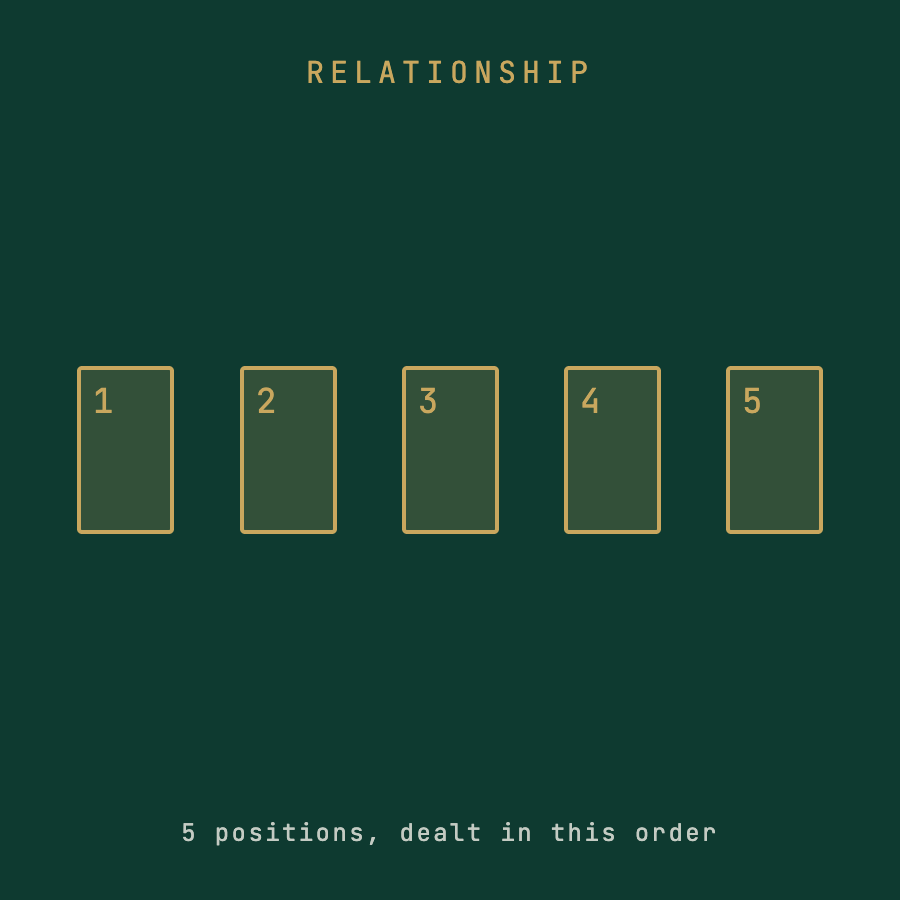
- Number of cards
- 5
- Difficulty
- Intermediate
Relationship spread
Five positions, and only two of them touch the other person. That is deliberate, because a spread cannot report on somebody who is not there, and the ones that claim to are the ones that do harm.
- relationship
- two people
- connection
- strain
- intermediate
When this spread is the right one
This spread suits a relationship you are actually in, or one you have actually left, where you want a clearer account of your own position in it. It works for a romantic relationship and works just as well for a friendship, a sibling, or a difficult colleague.
It does not suit the question people most often bring to it, which is how do they feel about me. No spread can answer that, this one included, and the design of the positions is a refusal rather than an oversight.
It also does not suit a situation with a third party in it. Five positions, two people. If somebody else is involved, the spread has nowhere to put them, and they end up smuggled into whichever card seems to fit.
Where the question is really about a decision, whether to stay or to go, this is still a reasonable choice, but read it as a description rather than a recommendation. If you want a spread that ends on something to do, the work spread has that shape and can be pointed at anything.
How to read it
Read the middle three before the outer two.
The temptation is to start with You and Them, because those are the positions with people in them, and that is precisely the wrong order. They are the two positions readers most contaminate with what they already believe. The connective positions are harder to fake.
So begin with What connects you and What strains it. Together they describe the relationship as a thing in its own right, separate from either party's view of it. If those two cards do not describe something you recognise, the reading has failed at the level where it could still be checked, and continuing will only produce a confident story about two people.
Then read You. It is not a character reference. It describes the posture you are currently holding in this relationship, which is a narrower and more useful claim, and it is the position most likely to be uncomfortable.
Then read Them, with the qualification that matters more than any card in the spread: this position describes your picture of the other person. It is assembled from your experience of them and your expectations of them. It is not a transmission, and there is no mechanism by which it could be. A reader who forgets that produces a diagnosis of somebody who never consented to be diagnosed, and querents act on those.
Finish with What it asks of you, the only position carrying an instruction, and check it against the middle two. If the ask does not address the strain, you have probably read the strain wrong.
The whole spread should resolve into one sentence about the relationship and one thing you could do this week.
What each position is asking
You. Your posture in this relationship now, not your personality. The distinction matters: a card here describes how you have been showing up in this particular connection, which can be very different from how you are elsewhere. It is often the position people skim, because it has the least room in it for flattery.
Them. The only position in the spread that is a description of the other person, and the one this page has to be careful about. What it holds is your image of them, built out of what they have done, what you expect, and what you fear. Nothing in the draw came from them. If the card is unflattering, what you have learned is that your picture of them is currently unflattering. That is real information, and it is not a fact about their character.
What connects you. The thing actually holding it together, which is frequently not what either party would say it was. Worth reading before the personal positions, because it is harder to bend toward a conclusion. Occasionally it is uncomfortable, describing habit or convenience rather than affection, and that is worth sitting with rather than rewriting.
What strains it. Not who is at fault. The position is deliberately impersonal, and readers routinely convert it into an accusation by asking which of us this card is about. Frequently it is neither: circumstances, timing, money, distance, an old pattern that nobody chose.
What it asks of you. The only position addressed to the reader, and the reason the spread carries two positions on your side and one on theirs. That imbalance is the design. You can act on your own behaviour and you cannot act on theirs, so the spread puts the weight where the leverage actually is. A reading that ends in a list of things the other person ought to do has quietly rearranged the positions.
A worked example
Drawn on this site, relationship, reversals on, seed 288164, on a friendship that had gone quiet.
You: King of Wands, upright, conviction and direction. Them: Queen of Swords, reversed, coldness or honesty that has stopped happening. What connects you: Wheel of Fortune, reversed, resistance and bad timing. What strains it: The Chariot, upright, willpower and momentum. What it asks: The Sun, reversed, delay and dimming.
Structure first: three of the five are Major Arcana, conventionally read as a situation with momentum of its own rather than a matter of small choices.
The middle two together describe a connection held by timing and by reluctance to let go, strained by drive. That is coherent and slightly awkward: somebody pushing forward in a friendship that is being sustained mostly by not being ended.
The You card supports that. The Them card, read correctly, says the reader currently experiences the other person as withdrawn and sharper than they were. It does not say the friend is cold.
The ask is not an instruction to fix anything. It reads as a request to stop performing brightness in a connection that has genuinely dimmed.
What the spread does not deliver is the thing the question wanted: whether the friend still cares. Nothing here can reach that, and the reading is more useful for having declined to guess.
Where this spread came from
The relationship spread is modern and conventional. There is no historical layout it descends from, and this page is not going to invent one.
Nineteenth-century cartomancy did concern itself heavily with love questions, and the French tradition produced elaborate methods involving a significator card chosen to stand for the querent or the beloved. That practice is genuinely old, and it is worth knowing that the significator was chosen deliberately, usually by appearance or age, rather than drawn at random.
Waite's The Pictorial Key to the Tarot (1910) prints no relationship spread. Neither does the Golden Dawn material behind it. The layouts that survive from those sources are general-purpose.
Multi-position relationship spreads of this kind date from the second half of the twentieth century, and they proliferated during the paperback tarot boom of the 1970s and 1980s, when a book with a spread for love, a spread for work and a spread for the year outsold a book with one method.
The particular five positions here are a modern editorial choice, made on this site. The reasoning behind the split is set out above, and the honest thing is to present it as reasoning rather than as tradition.
The common misreading
The most damaging misreading is treating the Them position as information about the other person. It is the reason most people open this spread, and the card sitting there is built entirely out of the querent's own material. Reading it as a report produces sentences like they are afraid of commitment, delivered about somebody who was never consulted, and people carry those sentences into real conversations.
The second is converting What strains it into blame. The position names a strain rather than a culprit, and the most common strains in real relationships have no culprit at all.
The third is reading the whole spread as a verdict on whether to stay. It has no position for that and cannot acquire one. A spread describing a difficult connection is describing a difficult connection, which is something that can improve, end, or continue unchanged for years.
And a quieter one: using the spread on somebody you are not in a relationship with. It gets used constantly on unrequited situations and on people who have stopped replying, where four of the five positions have nothing to describe. If there is no relationship, there is nothing here for the spread to be about.
The positions, in order
- You
- Them
- What connects you
- What strains it
- What it asks of you
Questions to sit with
- Did you recognise the two middle cards before you read the personal ones?
- What is your picture of them made of, and when did you last check it?
- Is the strain something either of you actually chose?
- What does the last position ask that you have already decided not to do?
Deal this spread with the full deck.