- Card number
- 14
- Arcana
- Minor Arcana
- Suit
- Wands
- Element
- Fire
- Rank
- King
- Yes or no reading
- Yes
King of Wands
Fire under command. The King of Wands is the card of vision that has learned to give orders, and it is as much about what the certainty costs the people around it as about where it leads.
- vision
- leadership
- conviction
- drive
- authority
- arrogance
- domineering
- impatience
- self-doubt
- indecision
What the card shows
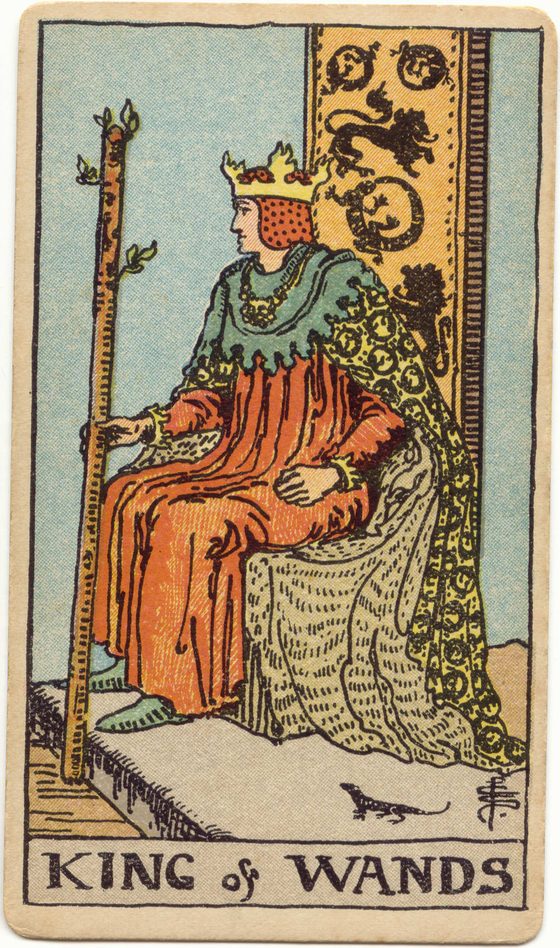
A crowned figure sits on a low stone seat, turned three-quarters to the left, looking away from the viewer. The crown is cut into flame-shaped points. The right hand holds a tall staff, its base on the ground and its tip breaking into green shoots. An orange robe shows beneath a green mantle at the shoulders.
A long patterned cloak falls from the shoulder and pools on the ground to the right, printed with black salamanders on yellow. The throne back rises as a flat panel carrying the same salamanders and a lion. On the ground at the lower right, level with the hem, a small live salamander sits with its head turned toward the king. The ground is bare and the sky is plain.
Upright meaning
The King of Wands is the suit's fire turned into direction. He is not the person with the idea and not the person who runs at it; he is the person who decides which idea the group is having. That is the whole card: conviction that other people organise themselves around. Waite's shorthand for him is a countryman, generally married, honest and conscientious, which reads oddly next to the figure modern books describe.
Read as a situation, it describes leadership that works because someone is willing to be certain in public before certainty is available. This is genuinely useful. Groups stall without it. It is also the mechanism by which confident people take everyone somewhere wrong, and the drawing does not distinguish between the two cases.
Note what Smith did with the pose. The Queen of Wands is seated square to the viewer; this figure is turned away, looking off at something outside the frame. Neighbours settle the reading: beside The Emperor it is authority with a structure under it, beside Seven of Wands it is a man defending a position rather than choosing one.
Upright in love
In a relationship reading the King of Wands describes someone decisive, generous and used to being the one who plans. He is not subtle and he is rarely uncertain, and both of those are the appeal.
The difficulty is that a person who leads by default can be hard to be equal with. The card often turns up where one partner has quietly become the junior one, not through unkindness but through momentum. If the question is about compatibility, this card describes the temperature and the pace and leaves the fit to the cards around it.
Upright in work
This is the founder card, and the senior-operator card. Someone with a picture of where the work is going who can make other people want to build it. Where the Ace of Wands is the idea arriving, the King is the idea with a headcount and a deadline attached.
As advice, it points at taking the decision rather than continuing to consult. There is a stage in most projects where more input stops improving the answer and starts protecting the person who has to make it. The King's competence is knowing when that stage has arrived; his failure is deciding it arrived earlier than it did.
Upright in money
Money treated as fuel rather than as a store. The King of Wands commits at scale and does not agonise: the business funded, the team hired, the property bought because the plan needs it.
The card describes a posture toward risk, not a verdict on it. What it does reliably indicate is that somebody is comfortable enough to move, and comfort is not the same as being right. If the reading concerns a decision large enough to be irreversible, treat this card as a description of the decider and go and find the numbers elsewhere.
Upright as feelings
As feelings, this is settled interest that has already made up its mind and expects to be met rather than persuaded. There is warmth in it and very little doubt. What it rarely contains is uncertainty about its own standing, which can read as arrogance from one angle and as safety from another.
Upright as advice
Decide, and say the decision out loud to the people it affects before you are comfortable. The King's advice is not to gather more; it is to convert what you already believe into something other people can act on. Pick the version you would defend and commit to it this week.
Reversed meaning
Reversed, the King of Wands divides, and the two halves are close to opposites. The first is the certainty gone hard: a person who no longer takes information that contradicts them, who mistakes volume for authority, and whose decisiveness has become the main obstacle to anyone else contributing. Nothing is wrong with the judgement except that it has stopped being checked.
The second is authority that has lost its footing. Someone in the chair who does not believe they should be, deferring, overexplaining, running decisions past people who did not ask to be consulted. From the outside this looks like humility. From inside it is usually fear, and it stalls the same group the first version bulldozes.
Which one you read is not the card's decision. Cards of conflict or pride around it argue for the first; cards of doubt, delay or hidden pressure argue for the second. A useful check: ask whether the situation currently suffers from too much direction or from none.
Reversed in love
Either a partner whose certainty has stopped leaving room for anyone else's, or one who has quietly abdicated and is waiting to be told what the relationship is. Both produce the same complaint from the other side, which is that the conversation never happens.
The reversal is also where the card's most-repeated reading lives: the domineering man. It is one reading. It is worth checking against actual behaviour rather than the reputation of the card, because it is an accusation and it is easy to make.
Reversed in work
A leader who has stopped listening, or a leadership vacuum nobody will name. In the first, good people leave quietly and the reason given at the exit interview is never the real one. In the second, the decision everyone is waiting on has been pending for months and no one will say whose it is.
Read the surrounding cards for which. The correction for the first is a check on the decider; the correction for the second is to make the ownership explicit.
Reversed in money
Commitments made on conviction that the arithmetic never supported, or an opportunity left standing because nobody was willing to own the call. The reversal marks a failure of process rather than a size of number.
There is a specific pattern this card describes well: money spent to keep a story about oneself intact. It is not always a large sum, and it is usually recognisable afterwards. If the reading is about a decision already made, the useful question is who was in a position to say no.
Reversed as feelings
Either feeling asserted rather than offered, so that the other person is informed of it rather than asked, or feeling that has been folded away under a role. Both look composed. Neither tells you much about the person underneath, and the card is not going to.
Reversed as advice
Find out which direction the reversal runs. If you are the one deciding, put one decision in front of somebody who is free to tell you it is wrong, and listen to the answer. If you are the one waiting, name the decision, name whose it is, and ask for it in writing.
Symbolism in the 1909 image
The salamanders. Printed down the cloak and repeated on the throne panel. Several are closed, tail in mouth; several are open. The salamander stood for fire in the occult writing of the period, and the closed loop is usually read as fire completed or mastered. Smith drew both states here, as she did on the Knight's surcoat.
The live salamander. A small one sits on the ground at the lower right, outside the cloth, head turned toward the king. It is the only thing in the frame that is not an emblem, and Waite does not explain it.
The turned head. The king is looking off to the left, out of the picture. He is the only one of the four Wands courts drawn attending to something the viewer cannot see. Read as vision by most books; read as not watching the room by anyone who has worked for one.
The sprouting staff. Held upright with its base on the ground, still leafing. The same living wood as the rest of the suit. Held, not carried and not swung.
The lion on the throne back. Leo again, the fixed sign of fire, sharing the panel with the salamanders. It marks the seat rather than the man; the authority belongs to the chair as much as to whoever is in it.
Where this meaning came from
Kings are the top of a playing-card court and nothing more mysterious than that. The fifteenth-century Italian decks that tarot grew out of were for a trick-taking game; the King of Batons outranked the Queen and the Knight and carried no meaning at all.
The meanings came later and from outside. Antoine Court de Gebelin proposed in the 1780s that the tarot preserved Egyptian priestly wisdom, which it did not, and Etteilla built the first commercial system of card meanings on that foundation. The astrological layer, including the fire attributions that put lions on this throne, is Golden Dawn work from the end of the nineteenth century.
The picture itself is from 1909, drawn by Pamela Colman Smith to Arthur Edward Waite's brief, with Waite's notes published the following year as The Pictorial Key to the Tarot. His King of Wands is domestic and modest: a countryman, honest and conscientious, generally married. The visionary founder of modern readings is not in Waite's text. He was assembled during the twentieth century, and the fact that he is so much more useful than what Waite wrote is worth noticing rather than hiding.
Smith took a flat fee, signed with initials, and is not in the deck's usual name.
The common misreading
The King of Wands is most often misread as an endorsement. Drawn on a question about whether to go ahead, he gets taken as permission, because the figure looks like someone who has been right before. The card describes a manner of deciding. It carries no information about whether this particular decision is sound.
The second misreading is the one the card invites by being flattering. Querents who identify with him tend to read the certainty as the virtue and skip the rest of the picture, which includes a man facing away from everyone in the room. If you are reading this card as yourself, the interesting question is not whether you are decisive. It is who has stopped telling you things.
The third is the habit of turning every court card into a real person, usually a partner or a boss. Sometimes it is. Often the King of Wands is describing a role that nobody in the situation is currently filling, which is a different problem and needs a different response.
Questions to sit with
- Who in this situation is free to tell you that you are wrong, and when did they last do it?
- Is the decision you are avoiding actually yours to make?
- What can you see that the people around you cannot, and have you described it to them?
- If you removed your confidence from the plan, what part of it would still stand up?
Pull this card in a real spread.