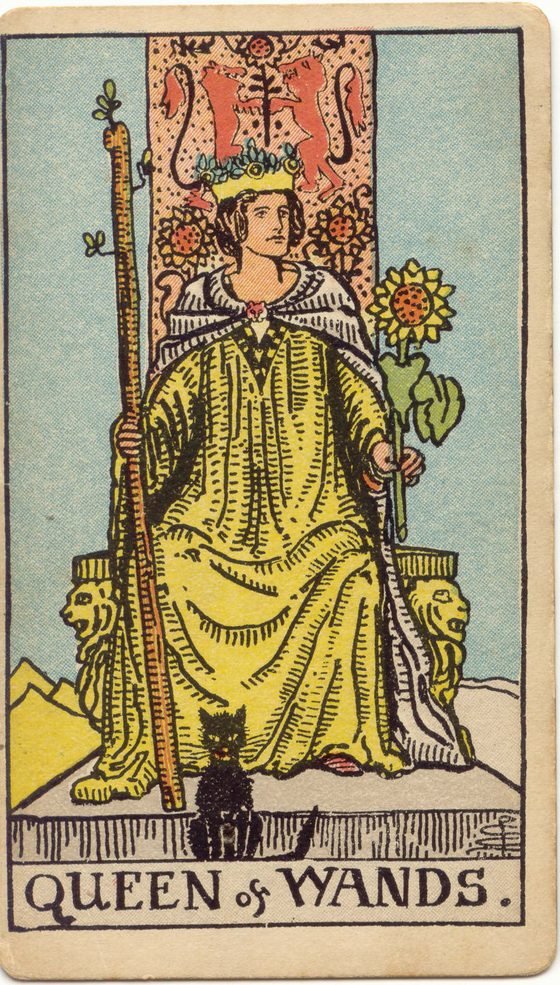
- Card number
- 13
- Arcana
- Minor Arcana
- Suit
- Wands
- Element
- Fire
- Rank
- Queen
- Yes or no reading
- Yes
Queen of Wands
Warmth with authority in it. The Queen of Wands describes someone who holds a room without raising her voice, and the card is about how that presence is used rather than whether it is deserved.
- warmth
- confidence
- magnetism
- courage
- presence
- jealousy
- withdrawn
- controlling
- insecurity
- guarded
What the card shows
A crowned figure sits facing forward on a stone throne, knees apart, both feet on the ground. The right hand holds a tall staff with green shoots at its tip, planted upright beside the throne. The left hand holds a single sunflower, head up, resting against the lap. The robe is yellow; a white mantle covers the shoulders.
The throne is carved. Its arms end in lion heads and its back rises into a panel showing two lions facing each other, with a sunflower above them. More sunflowers run in a band behind the figure's head. A black cat sits upright at the foot of the throne, facing straight out of the picture. Small pale triangles sit low on the left. The ground is bare and the background is flat.
Upright meaning
The Queen of Wands is fire that has learned to sit still. Where the Knight of Wands moves and the King of Wands directs, the Queen holds. She is the court card of personal magnetism: someone whose influence comes from being entirely themselves in public, without apology and without performance. Waite's own entry is a list of adjectives rather than a description: friendly, chaste, loving, honourable.
Read as a situation, it describes a position of informal authority. Nobody appointed her and everybody defers anyway. This is a real form of power and it is unusually fragile, because it depends on the person rather than the role, and it does not survive being faked. In practice she turns up for the person who is consulted before a decision is made, without being in the meeting where it is made.
The card says nothing about whether she is liked. Warmth and intimidation are often the same quality seen from two distances. The neighbours decide which: beside The Sun the reading is generosity and nerve, beside Five of Wands it is someone dominating a room that did not ask her to.
Upright in love
In a relationship reading the Queen of Wands describes someone who is warm without being available on demand. She is affectionate, direct about what she wants and unembarrassed by wanting it, and she does not chase.
That combination is often misread as coolness. It is closer to self-possession: the interest is real and it is not the only thing holding her life together. Where the question is about an existing relationship, the card tends to describe the partner who keeps their own centre of gravity, which is either the reason it works or the reason someone feels shut out, and the surrounding cards decide which.
Upright in work
At work the Queen of Wands is the person everyone actually asks. Not necessarily senior; often the one with the longest institutional memory and the shortest patience for pretence. She is good in a crisis, better with people than with process, and completely uninterested in politics she did not start.
As advice for the querent, the card points toward visibility rather than effort. The work is already good enough. What is missing is that the right people have not seen it, and the Queen's method is not self-promotion but presence: turning up, speaking plainly, letting the competence be witnessed rather than described.
Upright in money
Money handled with confidence and without much anxiety. The Queen of Wands is not careful in the accountant's sense; she is decisive, spends on what she has decided matters, and does not renegotiate with herself afterwards.
That works when the underlying picture is sound and fails quietly when it is not, because the same confidence covers both. The card describes a relationship to money rather than a state of it. If the question is whether there is enough, this card is not answering it. Look for a card that counts.
Upright as feelings
As feelings, this is interest that is not hiding and not pleading. Somebody has decided they like you and would say so if asked, and has no intention of asking first. It reads as steady heat rather than urgency, and it is easily mistaken for indifference by anyone waiting to be pursued.
Upright as advice
Take up the space you have already earned. Say the thing you were going to soften, in the room where it matters, once and without a preamble. The Queen's instruction is not to become louder but to stop shrinking the parts of yourself that were never the problem.
Reversed meaning
Reversed, the Queen of Wands is usually read one of two ways, and they are not compatible. The first is the warmth turned outward as heat: jealousy, a sharp tongue used accurately, control exercised through personality rather than authority. The magnetism is intact and it has stopped being generous.
The second is the same figure with the fire pulled inward. Confidence that has quietly gone, presence withdrawn from rooms she used to hold, a person managing how she is perceived instead of simply being present. From outside this often looks like modesty. It is more often exhaustion, or a knock that was never named. Nothing in the drawing changes when the card turns; only the reading does.
The spread decides. Conflict cards around it argue for the first; cards of retreat, secrecy or depletion argue for the second. There is also a third possibility worth holding: that the reversal is describing the reader's discomfort with a woman who takes up space, rather than anything wrong with her.
Reversed in love
Either possessiveness, or a partner who has gone quiet inside the relationship. The first version tests loyalty it already has and calls the testing love. The second stopped asking for anything some time ago and has not mentioned it.
Both are readable from behaviour: one produces friction, the other produces an unnatural absence of it. What the card cannot do is tell you which one the other person would say they are in. That is a conversation, not a reading.
Reversed in work
A workplace where personality has replaced structure, and the person holding it together by force of character is starting to resent it. Or the reverse: someone competent who has stopped speaking up, whose absence from the conversation is being read as agreement.
The reversed Queen is also the card of being talked about rather than talked to. If that is the situation, the surrounding cards usually show whether it is worth addressing or worth leaving.
Reversed in money
Spending used to manage a feeling rather than to buy a thing, or a grip on money so tight that it has become the main relationship in the room. Both are the same card and they need opposite corrections.
There is a plainer reading that gets skipped: sometimes the reversal simply means the confidence in the upright card was not backed by the numbers, and somebody has been managing appearances. That is worth looking at directly rather than symbolically.
Reversed as feelings
Feeling that has curdled slightly, or feeling withheld on purpose while the person decides whether it is safe. Both read as distance. Neither is indifference, which is why this position is so often misjudged. The card describes a guard being kept up; it does not say what is behind it.
Reversed as advice
Work out whether you are burning or banked. If you are burning, take the sharpest sentence you have prepared and do not send it today. If you are banked, pick one room this week and be fully present in it, without explaining yourself first. The card is about presence, not volume.
Symbolism in the 1909 image
The sunflower. Held in the left hand and repeated across the throne back. It is the only flower in the deck that tracks the sun, and it is usually read as loyalty and open regard. Note that in the drawing hers is turned toward the viewer rather than toward any light source.
The black cat. Sitting upright at her feet, facing straight out. Waite does not mention it. Modern books read it as intuition, as a familiar, as the private self beneath the public one; all of that was added later. What the drawing gives you is that it is the only figure looking directly at you.
The lions. Two on the panel behind the throne, facing each other, and two more carved as the arms of the seat. Leo is the standard Golden Dawn attribution here, and the lion doubles as the fixed fire sign and as a plain emblem of nerve.
The staff. Sprouting, planted on the ground, held loosely upright. Unlike the Knight's, it is not being carried anywhere. It is being kept.
The open posture. Knees apart, both feet planted, facing forward. Almost every other queen in the deck is drawn in three-quarter view. Smith seated this one square to the viewer, and that is most of the card.
Where this meaning came from
Queens are the oldest part of this card and the least mystical. Fifteenth-century Italian tarot decks used a four-rank court, page, knight, queen, king, for a trick-taking game, and the Queen of Batons was a card you played, not a person you were.
Meaning was grafted on in eighteenth-century France by Court de Gebelin and then systematised commercially by Etteilla, whose Egyptian pedigree for the tarot was fabricated and is still repeated. The Golden Dawn, late in the nineteenth century, added the astrological scaffolding that puts the fire courts under Aries, Leo and Sagittarius; the lions on this throne belong to that layer, not to the Italian one.
The image English readers know is the 1909 deck drawn by Pamela Colman Smith under Arthur Edward Waite's direction, with Waite's commentary published as The Pictorial Key to the Tarot in 1910. His entry for the Queen of Wands is a short string of adjectives, friendly and chaste and loving and honourable, with a note that reversed she may be read as opposition or jealousy. The confident modern portrait of her as charismatic, independent and socially formidable is a twentieth-century elaboration.
Smith was paid once, credited by initials, and left out of the deck's name.
The common misreading
The most common misreading of the Queen of Wands is as a compliment. Drawn in a self-reflective spread she gets taken as confirmation that the querent is magnetic and admired. The card is not an assessment. It describes a way of occupying a situation, and it is perfectly capable of describing someone whose presence is currently costing them something.
The second is reading her as a specific woman. Court cards are read as people far more often than the drawing supports, and this one attracts it most because the portrait is vivid. Before deciding the card is a particular relative, check whether the spread has any other reason to introduce a new person.
The third is the jealousy reading. Waite's one-line reversal gave later books permission to make this the card's signature, and it is now reached for automatically whenever the Queen appears reversed in a love spread. It is one option among several, and it makes an accusation about somebody who is not in the room. Do not make it without evidence in the other cards.
Questions to sit with
- Where do people already defer to you without being asked, and are you using it?
- What do you soften before you say it, and who taught you to soften it?
- If your confidence about this were removed, what would the facts alone support?
- Whose room are you in, and did anyone actually invite you to run it?
Pull this card in a real spread.