- Number of cards
- 10
- Difficulty
- Advanced
The Celtic Cross
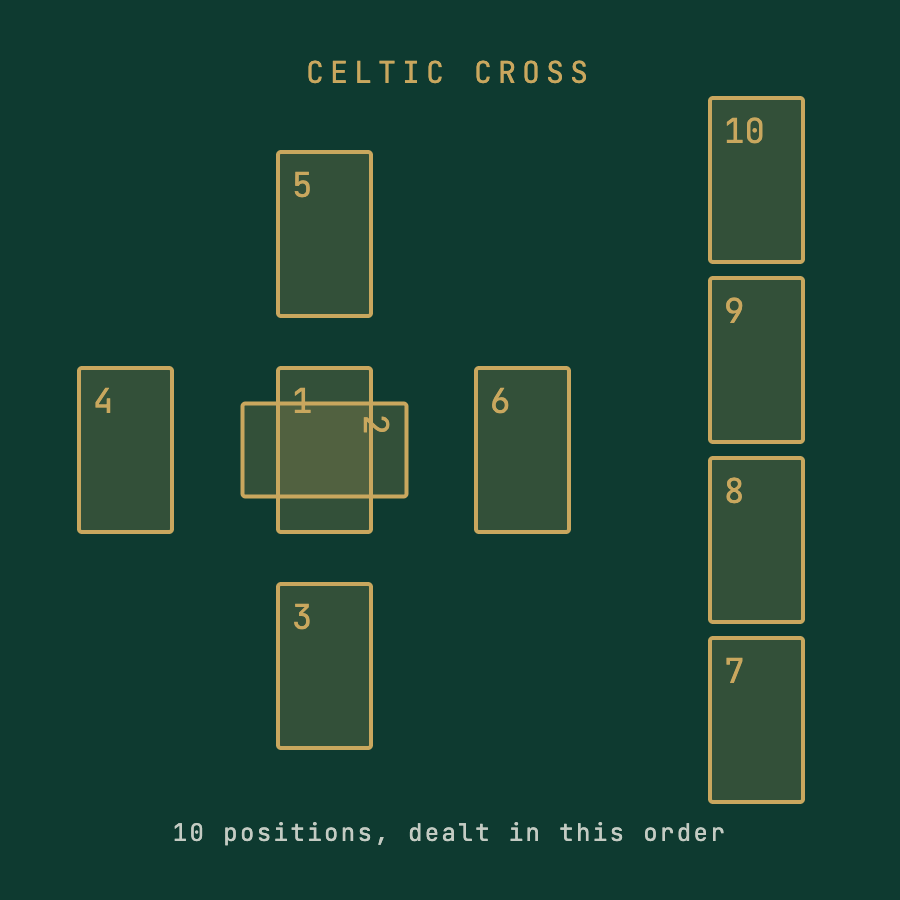
Ten positions, the oldest documented spread in English tarot, and the easiest one on this site to over-read. Position nine is where readers most often park a card they did not want to draw.
- celtic cross
- ten cards
- golden dawn
- advanced
- over-reading
When this spread is the right one
The Celtic Cross suits a situation you cannot summarise. Something with several parties, a history, and no obvious framing, where a smaller spread keeps forcing you to choose which part of the problem to ask about.
It is the wrong choice for anything simple. Ten cards on a question a single card would answer produces ten cards of interpretation, and the extra nine are mostly the reader talking. If you can state your question in one sentence and it has one subject, use the three-card line.
It is also demanding in a way the other spreads are not. Ten cards is enough material that a determined reader can assemble almost any conclusion from it, and the spread offers no resistance at all. That is its real difficulty, and it is why this one is marked advanced. Nothing about the individual cards is harder. The discipline required not to over-read is.
Give it time. A Celtic Cross read in five minutes has not been read.
How to read it
The instruction is the same as for every spread here, and it matters more: read the shape before the cards.
Start with the tally. How many Major Arcana, how many reversals, which suit repeats. Ten cards is enough for those counts to mean something, and this is the one spread where they carry real weight. Five cards of one suit narrows the subject before any individual card has spoken. Two Majors in ten says the situation is more ordinary than a ten-card layout makes it feel.
Then read the cross, positions one and two, as a pair and as a single statement. That pair is the spread. Everything else is context for it, and a reader who cannot say what the cross means in one sentence should stop rather than proceed to card three.
Then take positions three to six as the timeline: four cards describing where this came from and where it points. Read them in sequence, fairly quickly, and do not stop to elaborate on any one of them.
Then the staff, positions seven to ten, which move from the querent outward to the surroundings and back to an ending.
The specific danger here is volume. With ten cards you will always find something that fits whatever you already believed, and the spread will not stop you. Two disciplines help. First, decide what the spread says before you read position ten, then see whether ten agrees; if it does not, that disagreement is information rather than a problem to be solved. Second, note which cards you passed over quickly. Those are usually the ones that did not fit the story you were building.
What each position is asking
The situation. What is actually happening, rather than what you feel about it. The card to check against reality first, before anything else is interpreted.
What crosses it. The obstacle, and the second most abused position in the spread. A card the reader did not like gets quietly demoted to here, and thereby dismissed as merely the difficulty.
The root. What the situation grew out of. Older than the recent past, and frequently not an event at all.
The recent past. What has just finished or just changed. It should be recognisable, and if it is not, say so rather than adjusting it.
What is above it. Traditionally the conscious aim: what the querent believes they want. Read it against position seven, which often disagrees.
The near future. Where the present points on current terms. Not a prediction, and readers convert it into one constantly.
You in it. Your posture, not your character. The position most likely to be uncomfortable and the one worth the most attention.
The setting. Other people, circumstances, the environment the situation is happening inside. Frequently the most useful card in the spread and the least discussed.
Hopes and fears. The position this page has to warn about. It is ambiguous by construction, because the same card reads as either a hope or a fear, which means it can never be wrong. That makes it the standard escape hatch: a card contradicting the reading gets moved here and neutralised as merely something you fear. Watch for yourself doing it. If a card only makes sense in position nine, you have probably not read it.
Where it lands. The outcome position, and the one people skip to. It describes where the situation goes on present terms, which is a conditional. It is not the answer, and the other nine positions are not preamble to it.
A worked example
Drawn on this site, Celtic Cross, reversals on, seed 604418, on a family situation that had become complicated.
Shape first, and it does most of the work. Five of the ten cards are Cups, which narrows the subject sharply before any individual card is read. Only two Majors, so this is an ordinary situation rather than a turning point, whatever a ten-card layout implies.
The cross: Queen of Cups reversed, crossed by Queen of Pentacles upright. Depletion from over-caring, crossed by practical competence. In one sentence: somebody emotionally emptied out, running into a situation that needs doing rather than feeling.
The timeline runs from an Ace of Wands root through Two of Cups recently, with Seven of Swords above and Three of Cups reversed just ahead. Something that began with enthusiasm and closeness, currently involving concealment, heading toward isolation.
Then position nine, The Sun upright, and position ten, Six of Cups. This is where the over-reading starts. A reader hoping for reconciliation takes Six of Cups as reunion and The Sun as a hope about to be realised. Both readings are available and neither is supported. Six of Cups is nostalgia at least as often as reunion, and position nine is the one card in the spread that cannot be wrong, which is exactly why it should carry the least weight.
Where this spread came from
This is the only spread on the site with a documented lineage.
The layout comes out of the Hermetic Order of the Golden Dawn in the 1890s, and it reached print through Arthur Edward Waite, who published it in The Pictorial Key to the Tarot in 1910 as an ancient Celtic method. The attribution to anything Celtic is decorative. There is no evidence of Celtic origin, and the name appears to be Waite's framing rather than a description of where it came from.
What is genuine is the transmission. Waite was a Golden Dawn initiate, the order had developed structured methods of divination, and the ten-position layout he printed is recognisably the one still in use, with some variation in the order and naming of positions between later authors.
Because the deck Pamela Colman Smith drew in 1909 and this spread arrived in the same book, the two travelled together, and the Celtic Cross became the default English-language tarot spread across the twentieth century.
So it is older than everything else here, and it is a little over a century old rather than ancient. The distinction is worth keeping, because pages calling it ancient are repeating a piece of Edwardian branding.
The common misreading
The Celtic Cross is the easiest spread on this site to over-read, and most of its failures are the same failure at different scales.
The first is position nine. Hopes and fears is unfalsifiable by design, because any card reads as either one, and it therefore becomes the place readers put anything inconvenient. A card that contradicts the story gets moved there and defused as merely a fear. If you notice yourself doing that, the honest move is to take the card at face value in the position it actually landed in.
The second is position two, which does the same job more subtly. A card you did not want becomes the obstacle, and an obstacle is something to be overcome rather than something to be believed.
The third is starting at position ten. It is the outcome position, everybody wants it, and reading it first turns the other nine cards into an argument for a conclusion you already hold.
And the general one: ten cards will support almost any reading a determined person wants to build. The spread has no defence against that, which is why the discipline has to come from the reader. A Celtic Cross that confirms everything you already believed has probably not told you anything.
The positions, in order
- The situation
- What crosses it
- The root
- The recent past
- What is above it
- The near future
- You in it
- The setting
- Hopes and fears
- Where it lands
Questions to sit with
- Can you say the cross, positions one and two, in a single sentence?
- Which card did you move to hopes and fears rather than take at face value?
- Did you read position ten before you had read the rest of it?
- Which cards did you pass over quickly, and what did they have in common?
Deal this spread with the full deck.