Ten cards is a lot of cards. That is the Celtic Cross's advantage and its characteristic failure: with ten positions on the table there is almost always somewhere to put a card you did not want, and the reading will still look coherent afterwards.
Where it actually comes from
The version everyone uses was printed by Arthur Edward Waite in The Pictorial Key to the Tarot in 1910, the same book that accompanied the deck Pamela Colman Smith had drawn the year before. Waite presented it as an ancient Celtic method, long used privately in England, Scotland and Ireland.
There is no evidence for the antiquity and none for the Celtic part. What is documented is that Waite belonged to the Hermetic Order of the Golden Dawn, that the order had its own divinatory procedures, and that his book is the point at which this particular arrangement entered general circulation in English. The spread is real, widely used, and about a hundred and fifteen years old. The pedigree attached to it in 1910 is decoration, and most modern books repeat it without checking.
That is worth knowing before you sit down with it, because it changes how much authority the ten positions carry. They are a useful frame devised by identifiable people at a datable moment. They are not an inheritance, and nothing obliges you to use all ten.
There is a practical reason to know the date as well. A frame that is a hundred and fifteen years old has been shaped by a hundred and fifteen years of use, and the labels have drifted. Waite's own names for the positions are not quite the ones in general circulation now; his sixth position is what will come, his ninth is hopes and fears, and several modern layouts have quietly swapped positions three and five. If two readers give you different readings of the same ten cards, the disagreement is often about the layout rather than about the cards.
The ten positions
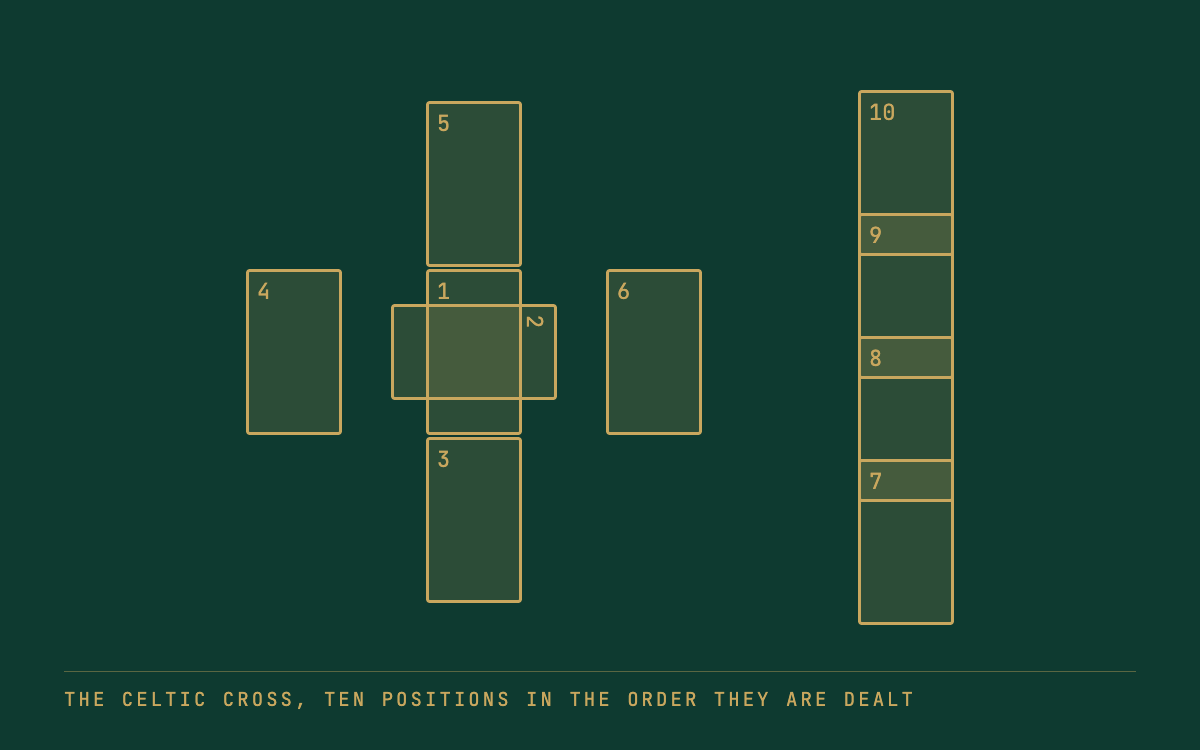
The Celtic Cross as this site lays it out: the situation, what crosses it, the root, the recent past, what is above it, the near future, you in it, the setting, hopes and fears, and where it lands.
The first six make the cross and describe the situation. The last four make the staff up the right-hand side and describe the person and their surroundings. That division matters more than the individual labels: cards one to six are about the thing, cards seven to ten are about you and the room you are standing in.
A real ten-card draw
Dealt with the tool on this site, reversals on, before this piece was written. The link reproduces it exactly, because the shuffle is seeded and the seed is in the address: this spread.
- The situation: The Magician, upright
- What crosses it: Nine of Pentacles, upright
- The root: Knight of Wands, upright
- The recent past: Nine of Swords, upright
- What is above it: The High Priestess, upright
- The near future: The Hanged Man, upright
- You in it: Knight of Pentacles, upright
- The setting: Ace of Cups, reversed
- Hopes and fears: Ace of Swords, upright
- Where it lands: Five of Wands, reversed
Reading the cross
The situation is The Magician: someone who has the tools and the competence, with everything laid out on the table in front of them. What crosses it is the Nine of Pentacles, which is an unusual obstacle, because on its own that card is comfortable. Self-sufficiency, an earned and pleasant independence. As the crossing card it reads as the thing in the way being the fact that you do not have to. Nothing is forcing the issue.
The root is the Knight of Wands, which is speed and impulse: whatever this is began as a fast decision rather than a slow one. The recent past is the Nine of Swords, the sleepless card, which places a stretch of private anxiety immediately behind the present. Above it, in the position for what is consciously aimed at, sits The High Priestess: waiting, and specifically not saying. The near future is The Hanged Man, which is suspension. Nothing resolves in the next stretch; something hangs.
That is a coherent six. Capacity, unforced by comfort, begun in haste, recently anxious, currently committed to silence, and about to be suspended.
The other thing the cross gives you is a sequence to check. Root, recent past, present, near future is a rough order in time, and a reading that cannot say how the root produced the present is usually a reading that has treated the ten cards as ten unrelated observations. Here the line runs from an impulsive start, through a bad stretch of nights, to a person now moving carefully and saying nothing, which hangs together well enough to be worth testing against an actual situation.
Reading the staff
You in it: the Knight of Pentacles, the methodical one. The person is plodding, reliably and without drama, through something that began impulsively. The setting is the Ace of Cups reversed, which describes surroundings in which feeling is withheld or blocked, and that is an environment card rather than a claim about anybody in particular.
Then the two positions where this spread earns its reputation.
The three positions that let you cheat
Hopes and fears is the worst offender in the deck's most popular spread, and this draw demonstrates why with unusual clarity. The card is the Ace of Swords: clarity, a decision, the truth said outright. Is that the hope or the fear?
The spread does not say. It cannot. The position is defined as two opposite things at once, which means any card landing there can be assigned to whichever half makes the rest of the reading work. Here you could say the person hopes for a clean decision, or that they dread someone finally saying the plain thing. Both are legitimate readings of the same card in the same position, and the honest move is to hold them both open and tell the querent that the position is ambiguous by construction rather than picking the flattering one.
The setting is the second offender, for the opposite reason. It is the dustbin position. When a card contradicts the reading you have already built, it is remarkably easy to say that this one is merely the environment and does not really belong to the querent. Ace of Cups reversed is exactly the sort of card that gets treated that way: uncomfortable, so it becomes background. It is not background. Position eight describes the conditions the other nine cards are operating in, and a withheld emotional setting changes what the Hanged Man's suspension is likely to consist of.
The near future is the third, and the cheat there is postponement. A card that does not fit gets read as something that has not arrived yet, which conveniently removes it from anything checkable. The Hanged Man is a gift to this habit, because suspension can always be described as not yet.
Where it lands
The tenth card is Five of Wands reversed, and it is worth being straight about it: that reversal reads two contradictory ways. Conflict avoided, with the disagreement pushed underground, or conflict genuinely subsiding. The card does not decide between them and neither does the position.
What the rest of the spread can do is weight it. With The High Priestess above, a person committed to not saying, and a setting where feeling is withheld, the avoided reading has more of the spread behind it than the resolving one. That is an argument, not a verdict, and it should be offered as an argument. Anyone who reports the tenth position as an outcome has misunderstood what the position is: where it lands describes the shape a situation is settling into, not a result you can be told in advance.
What ten positions are actually for
Not more accuracy. The Celtic Cross does not know more than a three-card line; it simply gives more places to stand while looking at the same situation. Its real use is that it separates things people habitually conflate: what a situation is from what crosses it, what you consciously want from what you are actually doing, your own posture from the room you are in.
If you use it, use two disciplines. Read positions one to six before you look at seven to ten, and write down your reading of the cross before the staff can influence it. Then, for every position where you had to choose between two readings, say so out loud rather than resolving it silently. In this draw that is at least two positions, and probably three.
A ten-card spread with every ambiguity quietly resolved in the querent's favour is not a reading. It is a compliment with pictures. If ten positions feel like too much room to hide, three cards give you nowhere to put the card you did not like.