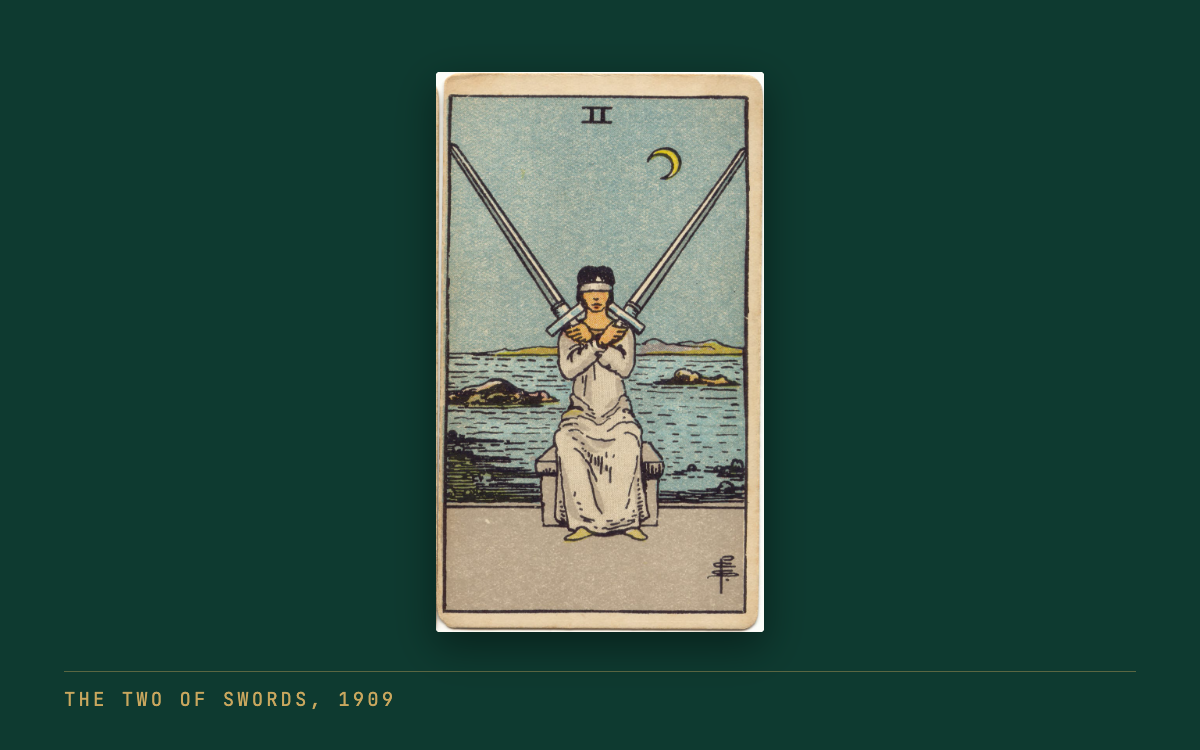
The strongest thing anybody ever says in defence of a reading is that it came true. It is offered as the end of the argument, and it usually ends it. This piece is about why that sentence is much weaker evidence than it feels, and about the one practice that would make it stronger, which almost nobody has ever done.
None of this is an argument that you should stop. It is an argument that you should keep a record, because the alternative is that you will remember your readings inaccurately and in a direction that flatters them.
Why it came true is weak evidence
Three things go wrong between a reading and the memory of it, and they compound.
The first is that the outcome is recorded after the fact. In almost every case, the reading is remembered once something has happened, and the something supplies the interpretation. Nobody writes down in March what they took the Tower to mean and then opens the envelope in July. They have a difficult July and remember that the Tower had come up.
The second is ambiguity, and it is structural rather than accidental. Most cards read two or more ways. That is not a flaw in the deck, it is the whole design, and this site says so on every card page: the The Tower can describe a collapse that happens to you, a structure you finally pull down yourself, or a shock that turns out to be a relief. All three are legitimate readings. Which means that whatever happened in July, one of them will fit it.
The third is selective memory. Readings that landed are memorable. Readings that came to nothing are not memorable, because nothing happened, and nothing is very hard to remember. Nobody tells the story of the spread that turned out to be about nothing in particular.
Put those together and you have a system that is close to unfalsifiable in practice. Not because anyone is being dishonest. Because the record is being written by the outcome.
The two biases doing most of the work
Both of these have names and neither is a moral failing. They are ordinary features of how people reason, and they are strongest in exactly the situation a reading creates.
Confirmation bias was named by Peter Wason, who demonstrated it in 1960 with a task that is worth knowing about. He gave people the number sequence 2, 4, 6 and told them it followed a rule he had in mind. They could propose further sequences and he would say whether each one fitted. Almost everybody proposed sequences designed to confirm the rule they had guessed: 8, 10, 12, then 20, 22, 24. Very few proposed a sequence they expected to fail, which is the only kind of test that could have told them anything. The actual rule was simply any three ascending numbers, and most participants never found it because they never tried to break their own hypothesis.
That is what happens with a reading. You form an interpretation, and then you notice the things that fit it. You are not lying. You are running the search that human beings run by default.
Hindsight bias is the second, demonstrated by Baruch Fischhoff in 1975. Once people know how something turned out, they consistently overestimate how predictable it was, and they misremember their own earlier estimates as having been closer to the outcome than they were. Fischhoff called it creeping determinism. The past rearranges itself into a story that was always going to end this way.
A reading is an ideal substrate for this, because it is a set of images rather than a set of claims, and images accept a story more readily than sentences do.
The remedy, which is not complicated
There is one practice that addresses all of this, and it is unglamorous. Write down what you take the reading to mean before you know what happened.
Not the cards. Anybody can note the cards. Write the interpretation, in advance, in terms specific enough to be wrong.
Concretely, five lines:
- The question, in one sentence, as you actually asked it.
- The cards and their positions, exactly as they fell.
- What you take it to mean, stated as a claim about the world rather than as a mood.
- What would count as a miss. This is the line people skip and it is the line that does the work.
- A date to check.
Then leave it alone. Do not edit it as things develop, which will be tempting, because the interpretation will want to update itself quietly as the situation clarifies.
Line four is the whole exercise. A prediction that cannot fail is not a prediction, and if you cannot write down what would count as a miss, you have not made a claim. That is the same test as the one in the Barnum effect piece, applied forwards in time instead of sideways.
An example of a claim you can check: I think this spread says the conversation with my manager will be worse than I expect and that I will be the one to raise it. A miss would be the conversation going smoothly, or somebody else raising it first. Check in three weeks.
An example of a claim you cannot check: I think this spread says a transition is coming and I need to trust the process. There is no version of the next three weeks that falsifies that.
What you will probably find
Here is a prediction of my own, offered honestly as a prediction rather than as a result.
If you do this for twenty readings, the most common outcome will not be hits and it will not be misses. It will be a third category: readings that were too vague to score at all. You will look at what you wrote and find you cannot tell whether it happened, because the claim you recorded was not a claim.
That is genuinely useful, and it is not a defeat. It tells you that most of what you were doing was interpretation rather than prediction, and interpretation is a legitimate activity. It just cannot be validated by outcomes, and it was never going to be.
Of the readings that are scoreable, expect a mix. Some will be right in ways that feel uncanny, and the correct response to those is to note the base rate: if you predict that a difficult situation will get worse before it improves, you will be right a great deal of the time without any assistance from the cards. Some will be wrong, and the correct response to those is to record them, because a practice that never records a miss is not learning anything.
What this changes about how to read
Keeping this record has a side effect that is more valuable than the scoring, and it is the reason to do it even if you never tally anything.
Writing an interpretation down before the outcome forces you to commit, and committing forces you to notice how much of your reading was actually about the cards and how much was your own existing view of the situation wearing the cards as a costume. Most readers discover, uncomfortably, that they had already reached the conclusion. The spread was a way of arriving at it with more ceremony.
That discovery is worth more than any number of confirmed predictions. It tells you what you actually think, which is the thing a reading is genuinely good at surfacing, and it is available whether or not any of the rest of it is true.
It also improves the reading itself. A reader who knows they will check will state things more precisely, and precision is the difference between a spread that tells you something and a spread that tells you what you wanted. If you use the three-card line, the discipline is to say what the third position actually claims, on current terms, and then find out. If you use the I Ching, the text is old and specific and rewards the same treatment.
None of this requires believing in a mechanism, and none of it requires disbelieving in one. It requires a notebook and the willingness to be wrong in writing, which is a smaller ask than it sounds and a rarer practice than it should be.