No. Not in the way the question usually means.
No mechanism has been demonstrated for any of the five systems on this site. Not for tarot, not for astrology, not for the I Ching, not for numerology, and not for dream symbolism. There is no known process by which a shuffled deck could carry information about your situation, and nobody has produced one. Where the claims have been tested directly, they have not held up. That is the honest state of the evidence and it is the first thing this page should say, rather than the thing it works around.
What follows is the more interesting half: what is actually being claimed here instead, and why it does not require the mechanism.
What has actually been tested
Most of these systems have never been tested properly, because most of them do not make a claim you could design a trial around. Astrology is the exception. It makes specific, checkable claims about people, and it has been examined.
The best-known controlled test is Shawn Carlson's, published in Nature in 1985. Astrologers, who had agreed the protocol beforehand as a fair test of their practice, were given a natal chart and three personality profiles, and asked which profile belonged to the person whose chart it was. They performed at chance. The study has been argued over since, as good studies are, and it remains the most serious attempt made.
The second is the time twins work by Geoffrey Dean and Ivan Kelly, published in 2003. They followed a group of around two thousand people born in London within minutes of each other in early 1958, on whom a great deal of subsequent data existed, and looked for the similarities astrology would predict across more than a hundred measured characteristics. They did not find them.
These are not the only studies and the field is not tidy, but the direction is consistent, and a site that publishes astrological interpretation has an obligation to say so on its own pages rather than leaving readers to discover it elsewhere.
The systems that cannot be tested that way
Tarot and the I Ching are different, and the difference is worth being precise about rather than hiding behind.
They are not making a claim that could fail a trial, because what they produce is an interpretation rather than a prediction. That is not a defence. A claim that cannot fail is weaker than one that can, and this site has an entire article arguing that point about statements that cannot be wrong. It applies here too.
What can be said precisely is what the machinery does. The reading tool on this site uses a seeded pseudorandom number generator to shuffle an array of seventy-eight entries in your browser. That is the whole process. It is a good shuffle and it is only a shuffle: it knows nothing about you, receives nothing about you, and would produce exactly the same cards for anybody who arrived with the same seed. No claim is being made about it and none should be inferred.
Numerology deserves a harder look, because it is the one system on the site whose internal logic can be checked without any experiment at all. A life path number is derived from a birth date in the Gregorian calendar, a convention introduced by papal reform in 1582 and adopted in Britain only in 1752. The letter-to-number correspondences used for a name are attributed to Pythagoras and in their modern Western form date from the early twentieth century. Change the spelling of your name, or move the analysis to an alphabet with a different number of letters, and the result changes. Those are facts about a scheme of assignment, not about a person, and the numerology pages here say so.
The I Ching is the oldest thing here by a wide margin, and its situation is different again. The core text dates to the Zhou dynasty, roughly three thousand years ago, and it has been continuously read, annotated and argued with ever since by people including some of the most serious thinkers in Chinese intellectual history. Nothing about the coin toss is demonstrated. The text is a genuine and remarkable object regardless.
So what is actually being claimed
Three things, and none of them needs a mechanism.
That a fixed set of positions is a useful thing to think a question against. This is the strongest claim on the list and it is fairly ordinary once stated plainly. When you lay out five positions and one of them is what you are avoiding, you have to answer that, in a way you would not have if left to your own devices. The prompts are not chosen by you, they do not flatter, and they arrive in an order you did not select. That is a structured interruption of habitual thinking, which is a real thing that helps, and it works identically whether the shuffle is meaningful or not.
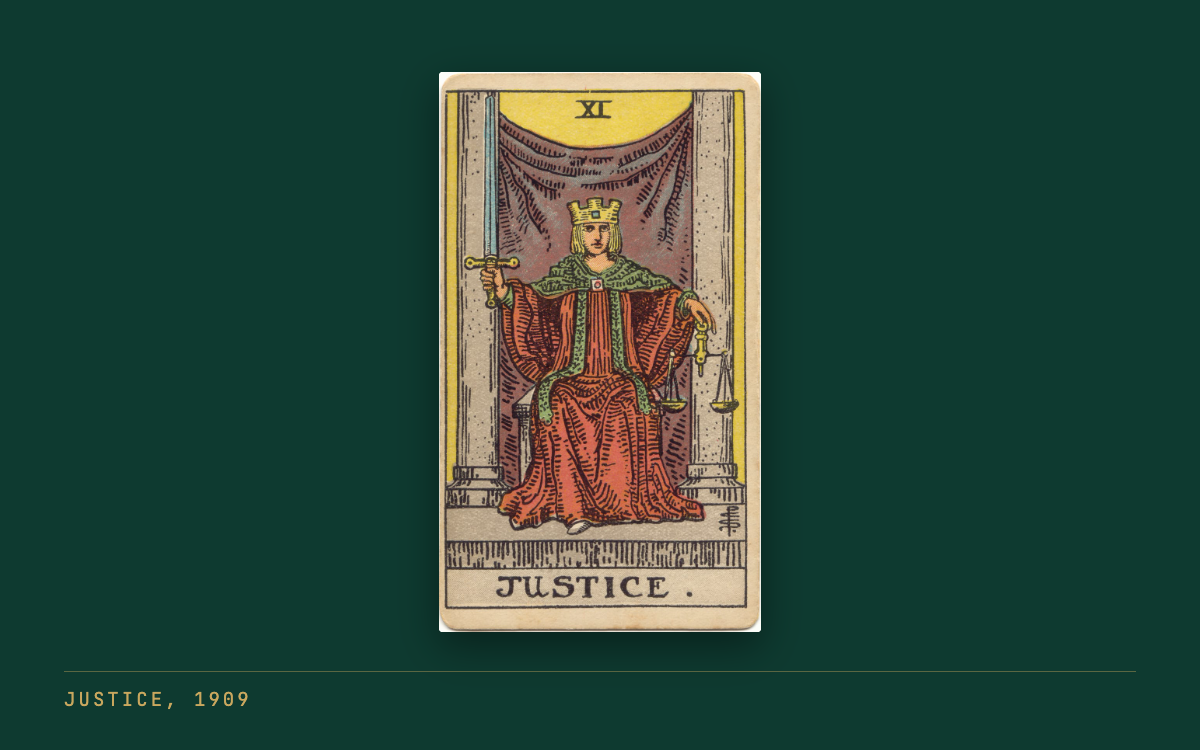
That the images carry accumulated thought. The tarot's pictures were fixed in 1909 by Pamela Colman Smith, working to Arthur Edward Waite's brief, drawing on several centuries of European symbolic material. The I Ching hexagram texts have three thousand years of commentary attached. Artemidorus was writing carefully about dreams in the second century and distinguishing what an image meant for a merchant from what it meant for a farmer. This is a genuine cultural inheritance about fortune, character and obligation, and reading it is a legitimate thing to do for exactly the reasons reading any old and serious body of thought is.
That the underlying computation is real, where there is one. A birth chart is a correct astronomical calculation. The planetary positions are where the planets were. What is unsupported is the interpretive layer on top, and keeping those two apart is most of what honest writing about astrology consists of.
What this site will not claim
It is easier to trust a boundary that is stated than one that is implied, so here is the boundary.
Nothing here predicts events. No card, hexagram, number or dream image on this site is presented as information about what will happen, because none of it is.
Nothing here reports on another person's private thoughts. This is the request that arrives most often and it is the one that does the most damage when it is granted. A spread cannot tell you whether somebody loves you, is lying to you, or is coming back, and pages that answer those questions are inventing an answer and handing it to somebody who will act on it.
Nothing here is medical, legal or financial advice, and where a page brushes against those subjects it says so and stops.
And no page here will tell you that a difficult result means something good is coming. The material is allowed to be uncomfortable. That is most of what makes it worth reading.
Why publish it at all
The obvious objection is that a site convinced there is no mechanism should not be publishing several hundred thousand words of interpretation.
The answer is that the interpretation is worth having on its own terms, and that this material is going to be read by an enormous number of people whatever anybody thinks about it. The realistic choice is not between people reading tarot pages and people reading nothing. It is between a version that names its sources, states its limits and tells you which of its claims descend from a Victorian pamphlet, and a version that does not.
Most of what is published in this field is the second kind. It is confident, it is unsourced, it predicts, and it is frequently written to be sold something on the back of. A version that treats the reader as capable of holding two ideas at once seems worth making.
Those two ideas are these. There is no evidence that a shuffled deck knows anything about your life. And the seventy-eight pictures are a serious body of accumulated thought about how human situations go, arranged so that you encounter one you did not choose. Neither of those cancels the other. The disclaimer on this site is not a legal formality bolted on at the end; it is the same position, stated more briefly.
If that reads as a hedge, test it against the pages themselves. A hedge is vague everywhere. What you should find here is the opposite: specific claims, attributed, with the misreadings listed and the limits named. Whether that is worth your time is a fair question. Whether it is honest about what it is should not be.