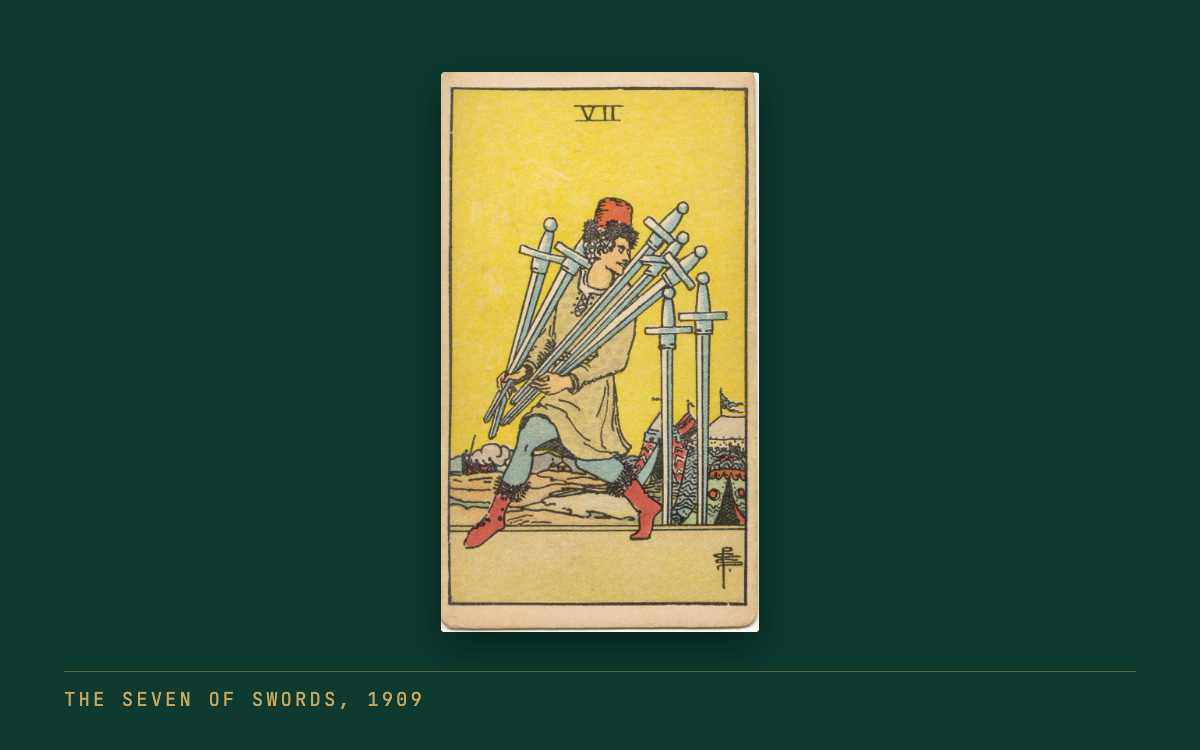
Cold reading is the set of conversational techniques that let somebody produce an accurate-sounding account of a stranger while knowing nothing about them. It is not a theory about whether tarot works. It is a description of what a skilled person can do in a room with somebody who wants to be understood, and it works whether or not there is anything behind the cards.
This site publishes card meanings, dream material and birth chart interpretation. It would rather its readers knew how these techniques operate than be protected from knowing. A person who can name them is much harder to take money from.
What it actually is
The canonical account is Ray Hyman's, a psychologist who worked as a palm reader while putting himself through university and later wrote the technique up. His 1977 article on convincing strangers you know all about them is still the clearest description, and much of the vocabulary now in use was systematised by the mentalist Ian Rowland in the 1990s.
The first thing worth understanding is that cold reading is a collaboration. The sitter does most of the work and does not notice doing it, because the work feels like recognition rather than like supplying information. The reader makes an open statement, the sitter privately fills in a specific meaning, and the specific meaning is then remembered as having come from the reader.
It is worth distinguishing this from hot reading, which is simply research: looking somebody up beforehand, or using information collected at the door. Hot reading is fraud in the ordinary sense. Cold reading does not require any prior information at all, which is what makes it impressive and what makes it hard to detect.
The techniques, named
The Barnum opener. Begin with statements true of almost everybody, delivered as though they were specific. You are harder on yourself than you are on other people. You have had to be the strong one more often than you would have chosen. These establish accuracy early, and accuracy early buys credibility for everything after it. This is the effect described in the Barnum effect piece, deployed deliberately rather than accidentally.
The rainbow ruse. Rowland's term for a statement that covers a trait and its opposite in one sentence. You are a very considerate person, but when something matters enough you can be quite ruthless about it. Both halves are available, the sitter takes whichever fits, and the sentence cannot be wrong. Listen for the word but in the middle of a character description; it is doing structural work.
The shotgun. Produce a rapid spray of names, initials, ailments, objects and dates, and let the sitter catch one. I am getting a J name, a John or a Joan, or possibly a James. Somebody with a problem in the chest or the lungs. A watch, or something worn on the wrist. In a room of any size, several of these will hit. The hits are remembered and the misses evaporate, which is not the sitter being credulous; it is ordinary memory doing what it always does.
Fishing. A question shaped as a statement. I am sensing something about a hospital. Said with a slight rise at the end, this is a question, and whatever the sitter offers in reply becomes material the reader can hand back a few minutes later as though they had produced it.
The vanishing negative. You do not drive much any more, do you? If the sitter says no, the reader was right. If the sitter says they drive constantly, the reader says yes, that is what I am picking up, that is a lot of time on the road. The sentence is constructed so that either answer confirms it.
The out. Any phrase that keeps a miss from counting. This may not make sense to you yet. Put it aside and it will come to you. Does that mean anything to anybody else in your family? An out converts a wrong statement into a pending one, and a reading with enough outs in it cannot fail at all.
Reading the reaction rather than the cards
This is the part that most distinguishes a practised reader, and it is the hardest to see while it is happening to you.
The reader is watching. Not in a mystical sense: watching your face, your posture, whether you lean in, whether you go still, how long you pause before answering. A statement that lands produces a visible response, and the reader expands on it. A statement that misses produces a flatter response, and the reader moves on without marking it, often mid-sentence, so that the miss never becomes a discrete event you could count.
This is also where a live reading differs most sharply from anything written down, and it is why the practice recommended in the piece on the honest reading matters here too: a record made at the time is the only defence against a conversation that reshapes itself as it goes.
Run this test the next time you watch a reading, on video or in person. Count who is talking. If the sitter is supplying names, relationships, circumstances and dates, and the reader is reflecting them back in a more resonant register, you have watched a collaboration in which one party did the knowing and the other did the phrasing.
The other tell is direction of travel. Cold reading moves from general to specific. It starts wide and narrows as the sitter feeds it. A genuine piece of information, if such a thing were on offer, would not need to start wide.
Most people using these are not frauds
This is the part that gets left out, and leaving it out is what makes debunking pieces feel dishonest to anybody who has actually sat with a reader.
These techniques are absorbed rather than studied. A person who reads cards for friends over several years learns, without ever deciding to, that certain openings land, that a statement with a but in the middle rarely misses, that if you pause after an ambiguous line the sitter will fill it in helpfully. They are not running a script. They have been trained by feedback, in the same way anybody gets better at conversation, and they will tell you sincerely that they had no idea where that came from.
So sincerity is not the test, and it is not the thing to look for. A completely sincere reader and a deliberate operator produce the same transcript, because the techniques work regardless of intent. The test is structural: what kind of statements are being made, who is supplying the content, and whether anything said could have been wrong.
How to tell it from a reading
Four questions, and you can ask all of them silently while it is going on.
Could any of this have been false? Not false in hindsight. False at the moment it was said. If nothing in twenty minutes could have been contradicted, nothing in twenty minutes was information.
Who supplied the specifics? Names, dates, relationships, illnesses. Track where each one entered the conversation. Most sitters are astonished, on reflection, by how much of the reading they said first.
Did the reading change direction after my reaction? A reader working from the cards should be able to say the same thing to a blank face. A reader working from you cannot.
Would this have worked on the person before me? This is the most useful of the four, and the hardest to answer generously. Imagine the reading given verbatim to a stranger. If it would have landed for them too, it was not about you.
None of those four require you to conclude anything about whether divination is real. They separate a reading that engaged with a fixed set of images from a performance that engaged with your face, and those are different activities whatever you believe about the first one.
Where the actual harm is
The techniques above are, on their own, mostly a parlour matter. People pay for an hour of being attended to and get an hour of being attended to, and that transaction is not the scandal.
The harm sits one step further on, and it follows a recognisable shape. A reading identifies a problem the sitter did not arrive with: a blockage, a curse, an attachment, a negative energy around the family. The problem is grave, the reader can address it, and addressing it requires further sessions and further payment. Escalation is the tell. A reading that ends with a larger problem than it started with, and a fee attached to the solution, is not a reading of any kind, and there are prosecutions every year that follow exactly this pattern.
The defence is not scepticism about tarot. It is the ordinary rule that applies to any transaction: a service that generates its own emergency and then sells the remedy is a scam whatever it is wearing.
Which is why this article exists on a site that publishes card meanings rather than in spite of that. The material here is fixed and public. The Seven of Swords page says the same thing to everybody who opens it, and you can read it without anybody watching your face. When you use the reading tool, nothing about you is collected, and nothing adapts to your reaction, because there is nobody in the room. That is a narrower offer than a live reading. It is also one that cannot be turned against you.