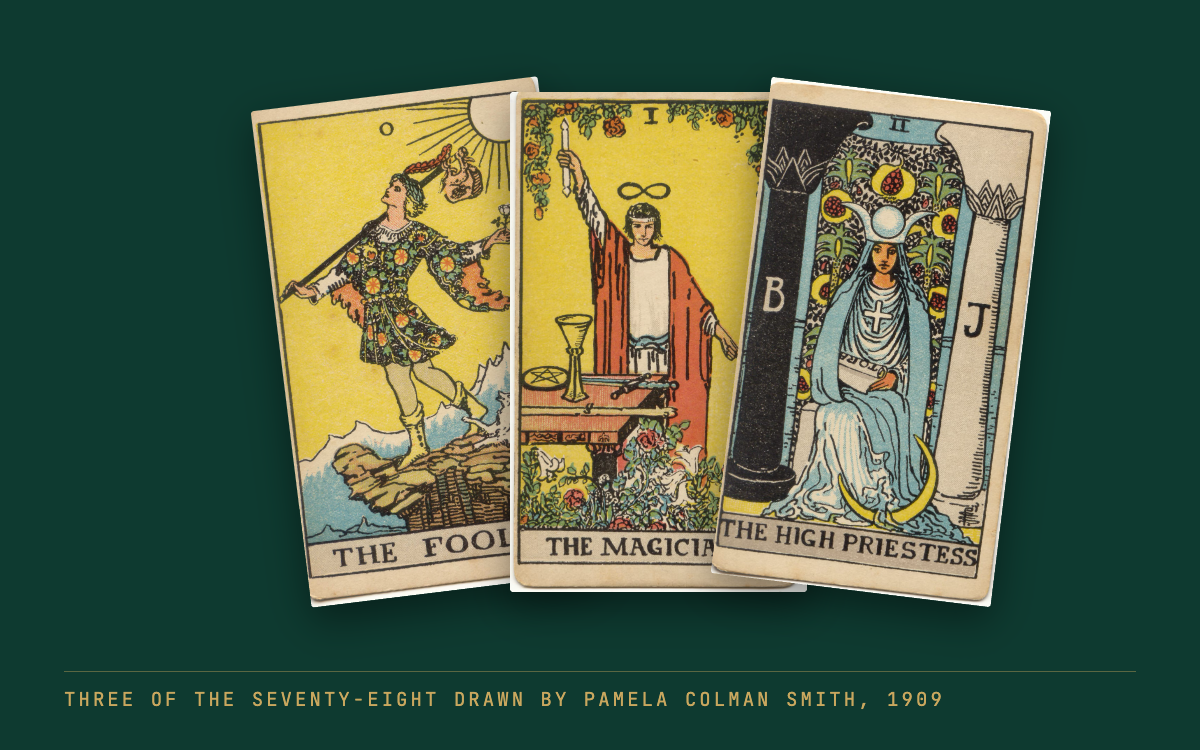
The deck most English-speaking readers use was drawn in 1909 by an artist whose name is not on the box. That sentence is the whole of this article, and everything below is the detail behind it.
Who she was
Pamela Colman Smith was born in London in February 1878 to American parents, and spent a scattered childhood between England, Jamaica and Brooklyn. She studied at the Pratt Institute in Brooklyn in the mid 1890s under Arthur Wesley Dow, whose teaching emphasised flat colour, bold outline and the compositional principles of Japanese printmaking. Anyone who has looked closely at the cards will recognise all three.
She was a working illustrator and a theatre person before she was a tarot artist. She toured with Ellen Terry and Henry Irving's Lyceum company, produced stage designs, illustrated books, told Jamaican folk tales to audiences, and between 1903 and 1904 edited and published her own small magazine. Her friends called her Pixie. In 1901 she joined the Hermetic Order of the Golden Dawn, which is where she met Arthur Edward Waite.
What happened in 1909
Waite, then in his early fifties, was a scholar of esoteric texts with a long publishing record and firm views about what tarot was for. He commissioned Smith to produce a complete deck, and she drew all seventy-eight cards during 1909, apparently in something like six months. The deck was published in London by William Rider and Son at the end of that year, and Waite's companion volume, The Pictorial Key to the Tarot, followed in 1910.
The division of labour is the part worth getting right. Waite gave detailed direction on the twenty-two trumps, which carry the symbolic apparatus he cared about. On the fifty-six minor cards the evidence suggests he gave far less, and what Smith did with that latitude is the reason the deck displaced every competitor.
It is worth being precise about what Waite contributed, because the correction can overshoot. He was not a bystander. The trump sequence carries his decisions, including the swap of Justice and Strength to fit an astrological correspondence, and the reading tradition that grew up around the deck is largely his. The complaint is not that he is credited. It is that he is credited alone.
The thing she actually invented
Before 1909, the minor arcana of a standard European tarot deck looked like playing cards. The five of cups showed five cups. There was no scene, no figure, no situation: the pips were pips, arranged decoratively, and a reader supplied the meaning from a memorised list.
Smith gave all fifty-six of them full illustrated scenes. That is the single most consequential thing anyone has done to this deck, and it is why a beginner can pick up a modern pack and read Three of Swords without knowing anything at all: a heart, three blades, rain. The picture does the work the list used to do.
She was not working from nothing. The Sola Busca deck, an Italian pack from the late fifteenth century, is the one surviving early deck with fully illustrated pip cards, and photographic reproductions of it entered the British Museum in 1907, two years before Smith started. Several of her minor cards bear close compositional resemblance to Sola Busca designs; the Three of Swords and Ten of Wands are the examples most often cited. Resemblance is not proof of copying, but the access is documented and the timing is exact, and any honest account of the deck mentions it.
What she did with the idea is still hers. The Sola Busca pips are illustrated; they are not psychologically legible in the way Smith's are. Her scenes describe recognisable human situations, which is a different achievement from decorating a number.
What she was paid
A flat fee, once, for the whole commission. No royalties, then or ever. The exact sum is not reliably documented and was, by every account, small.
She signed the cards with a monogram rather than a name, which is why the initials in the corner of every card go unnoticed by most people who use them. The deck has sold in the tens of millions. She saw none of it.
How she died
Smith converted to Catholicism in 1911. She spent her later years in Cornwall, at one point running a holiday house for priests, and by the end she was in serious financial difficulty. She died at Bude in September 1951, aged seventy-three. Her possessions were sold to settle her debts. She was buried in an unmarked grave, and there is no reliable record of what became of her original artwork.
She died the year before the deck's popularity began its long climb, and about twenty years before the edition that made it ubiquitous.
Her later years are poorly documented, which is itself part of the story. Most of what is known comes from a small number of letters and from the recollections of people who knew her before 1920. There is no biography written from her own papers, because there are almost no papers. An artist whose work is recognised on sight by millions of people left a paper trail thin enough to fit in an afternoon's reading.
The name, and who owns it
Here is where the story gets uncomfortable.
The name this deck is usually sold and discussed under is a registered trademark. It belongs to U.S. Games Systems, Inc., a Connecticut company founded in 1968 by Stuart Kaplan, which acquired rights to the deck and from 1971 turned it into the standard pack it is today. The company's role in that revival is real and considerable. It also had nothing whatever to do with 1909: it was founded seventeen years after Smith died and twenty-six years after Waite did, and neither of them ever saw a penny from it.
The commonly used name also credits Waite and the publisher, and not the artist. A deck whose distinguishing feature is its pictures is known by the names of the man who briefed them and the firm that printed them.
Because of the trademark, this site does not print that name anywhere, and you will not find it on any card page here. That is a legal constraint rather than a stylistic one. It happens to point in the same direction as the historical case.
What to call it instead
Waite-Smith, or Smith-Waite. Both are in scholarly use, both are accurate, and neither is anyone's trademark. Where a specific edition matters, the 1909 deck or the 1909 illustrations does the job precisely. U.S. Games itself issued a centennial edition in 2009 under a Smith-first name, which suggests the point has been taken.
The copyright position is separate from the trademark and worth stating clearly, because the two get confused. The original 1909 artwork has passed into the public domain: in the United Kingdom that happened at the end of 2021, seventy years after Smith's death in 1951, and it happened earlier in the United States. The images on the card pages here are those 1909 scans. A trademark on a name is not a copyright on a picture, and no amount of the former revives the latter.
Why any of this matters to a reading
It changes what you think you are holding.
A deck presented as ancient wisdom invites you to defer to it. A deck correctly described as the work of a named illustrator in 1909, briefed by a named occultist, drawing partly on a fifteenth-century Italian pack she had seen photographs of two years earlier, invites something better: attention to what is actually drawn. When The Fool shows a figure looking away from a cliff edge, that is a compositional decision Smith made, and reading it as a decision is more productive than reading it as a revelation.
It also settles a question that comes up constantly. If a modern book tells you what a card means and the picture does not support it, the picture wins, because the picture is the primary document and the book is somebody's commentary on it. Every card page on this site tries to keep those two apart, and the reading tool deals from the 1909 images for the same reason.
Give Smith her name. She did the part you are actually looking at.