Put the same birth date into two numerology calculators and you can get two different Life Paths. Not because one is broken. Because there are two standard ways to do the arithmetic, both have been in print for the better part of a century, and nobody ever settled which is correct.
Most sites do not mention this. The ones that do tend to say the methods "sometimes" differ, which is true and useless. So we counted.
The number
Across 20,496 birth dates, every date from the first to the twenty-eighth of each month from 1950 to 2010, the two methods returned different Life Paths for 2,756 of them.
That is 13.4 per cent, or roughly one birth date in seven. Widen the test to every calendar date in those years rather than the first twenty-eight of each month and the figure moves by less than a tenth of a percentage point.
It is a count, not an estimate. Run both procedures over the same range and you get the same 2,756 every time.
The two methods
The all-digits method writes the whole date out as a run of digits and adds them in one go. For 14 March 1988 that is 1+9+8+8+0+3+1+4, giving 34, and 34 reduces to 3+4, which is 7.
The component method reduces the parts first and then adds. March is 3. The 14th reduces to 5. The year 1988 gives 26 and then 8. Add the three: 3+5+8 = 16, and 1+6 = 7.
Same answer. That is the usual case, and it is why the discrepancy went unnoticed for so long: most of the time the two procedures are indistinguishable.
A date that splits
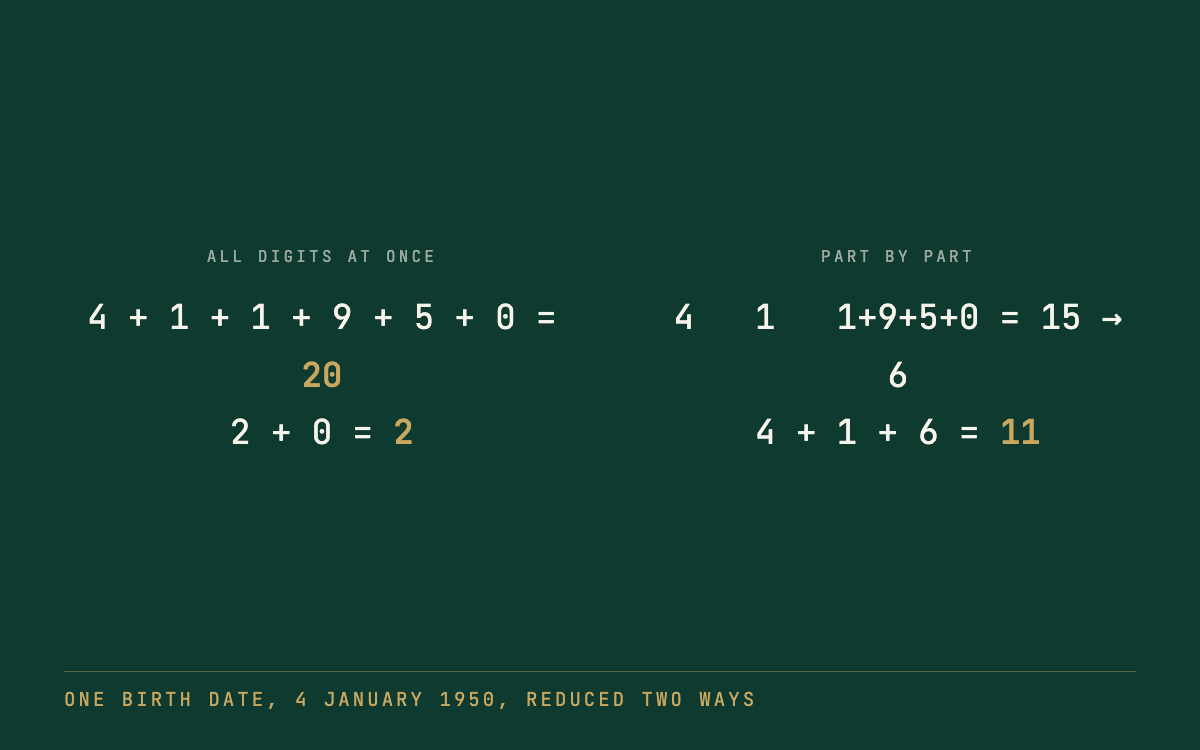
Take 4 January 1950.
By all digits: 1+9+5+0+0+1+0+4 = 20. Twenty is not a master number, so it reduces: 2+0 = 2. The Life Path is 2.
By components: January is 1, already a single digit. The day is 4, likewise. The year 1950 gives 1+9+5+0 = 15, and 15 gives 6. Add them: 1+4+6 = 11. And 11 is a master number, so under the standard rule the reduction stops there. The Life Path is 11.
Two and eleven. Same date, same rulebook, two answers, and the difference is not marginal: one of them is an ordinary number and the other is one of the three numbers the entire tradition treats as exceptional.
The mechanism
Here is what is actually going on, and it is tidier than the practice deserves.
Repeated digit-summing has a property arithmetic calls the digital root, and the digital root of a sum is the same as the digital root of the sum of the parts' digital roots. In plain terms: it does not matter whether you add all the digits of a date at once or reduce the month, day and year first and then add. Reduce everything all the way to a single digit and the two methods agree on every date. Not usually. Always.
We checked that computationally over every date from 1900 to 2100 with the master-number rule switched off, and the number of disagreements is zero.
So the split is caused entirely by master numbers — the rule that says a reduction reaching 11, 22 or 33 stops there rather than continuing. Stopping early leaves a value nine, eighteen or twenty-seven larger than the fully reduced one, and multiples of nine are invisible to a digital root. That is why the two methods can only ever differ over whether the final total lands exactly on a master, never over which ordinary digit it reduces to.
The prediction that follows is checkable, and it holds: every one of the 2,756 disagreements involves a master number on one side or the other. Not most of them. All of them. The two methods have never once disagreed about an ordinary digit.
In the 4 January 1950 case you can see it happen. Reducing the year 1950 down to 6 before adding destroys nothing, but reducing the whole date at once never lets the running total pass through 11, so the master never appears. The component method builds a total of exactly 11 and stops. Two procedures, one arithmetic, one rule about when to stop, and a fork.
Where the splits cluster
The 13.4 per cent is not spread evenly, and the pattern is legible once you know the mechanism.
Birth month matters. November births split 20.0 per cent of the time, the highest of any month, for a reason that follows directly from the rule: November is month 11, itself a master, so the component method holds an 11 in the month slot that the all-digits method never sees. February is lowest at 9.1 per cent.
Birth year matters more, and swings wider. Dates in 1961, 1962, 1970, 1971 and 1980 disagree about 22 per cent of the time. Dates in 1957, 1966 and 1975 disagree about 3 per cent, the lowest in the range, and those three years have something in common: the digits of each sum to 22. A year that is itself a master gets held at 22 by the component method, which adds eighteen to the running total, and eighteen is two nines, so it almost never changes where the sum lands.
Day of birth has a smaller effect, running from 19 per cent for the 11th down to 7 per cent for the 22nd. If you were born in November of an ordinary year, you are considerably more likely than average to be one of the ambiguous cases.
Which way the splits fall
They are lopsided. The commonest is 33 by the all-digits method against 6 by components, 1,053 times in the test range. Then 11 against 2, 758 times. Then 4 against 22, 496 times, 22 against 4, 285 times, 2 against 11, 140 times, and 6 against 33 just 24 times.
That produces a result worth stating because the received wisdom runs the other way. The component method is routinely described as the one that preserves master numbers. It preserves them mid-calculation, which is true and is where the description comes from. But over the same test range it produced a master Life Path for 10.5 per cent of dates, while the all-digits method produced one for 17.5 per cent.
The method with the reputation for guarding master numbers yields fewer of them. The reason is the same multiple-of-nine arithmetic: holding 11 back rather than reducing it to 2 adds nine to the running total, which raises the sum without moving where it settles, so the preserved master usually disappears at the final step anyway.
What to do about it
Nothing dramatic. But three things follow.
First, a Life Path quoted without its method is ambiguous for about one person in seven, and the ambiguity is invisible unless someone shows the working. If you have been given a number by a book, an app or a reader, there is a one in seven chance a different but equally standard procedure would have handed you a different one.
Second, if you are one of the 13.4 per cent, you do not have a fact to look up. You have a choice to make, and no authority exists that could settle it, because two conventions were both in circulation before anyone noticed they conflicted. Read both entries. Notice that they will not feel equally like you, and notice that this reaction is about you rather than about the arithmetic.
Third, and most usefully: be suspicious of any calculator that does not print its intermediate steps. Not because it is dishonest, but because without them you cannot tell which of two legitimate procedures you were handed. That is why the calculator here runs both and shows both, rather than picking one and looking confident.
A system that disagrees with itself for one date in seven, and has done quietly for a hundred years, is telling you something about how much weight the number will bear. That is worth more than the number.