- What it is worked out from
- A birth date
The all-digits method
Write the birth date out as one long string of digits, add them all together, and reduce until a single digit remains. It is the method most modern books give, and it is not the only one.
- all digits
- reduction
- life path
- birth date
- digit sum
How the number is worked out
Take the date in full, with a four-digit year, and treat it as a run of eight digits. A date of 14 March 1988 becomes 1, 9, 8, 8, 0, 3, 1, 4. Add all eight together. That gives a first total, and the total is almost always larger than nine.
Now reduce. Add the digits of the total to each other, then the digits of that result, and keep going until one digit is left. Fourteen becomes one plus four, which is five. Twenty-nine becomes two plus nine, which is eleven.
There is one exception, and it is the whole reason two methods exist. If a total at any stage is 11, 22 or 33, most practitioners stop there and keep it as a master number rather than reducing it further. This tool applies that rule, so 29 reduces to 11 and stops.
That is the entire calculation. The order of the digits does not matter, because addition does not care; whether you write the date as year first or day first, the sum is the same. What does matter, and it matters more than anything else on this page, is whether you reduce the date all at once or reduce its parts first. Those are two different methods and they do not always agree.
A worked example
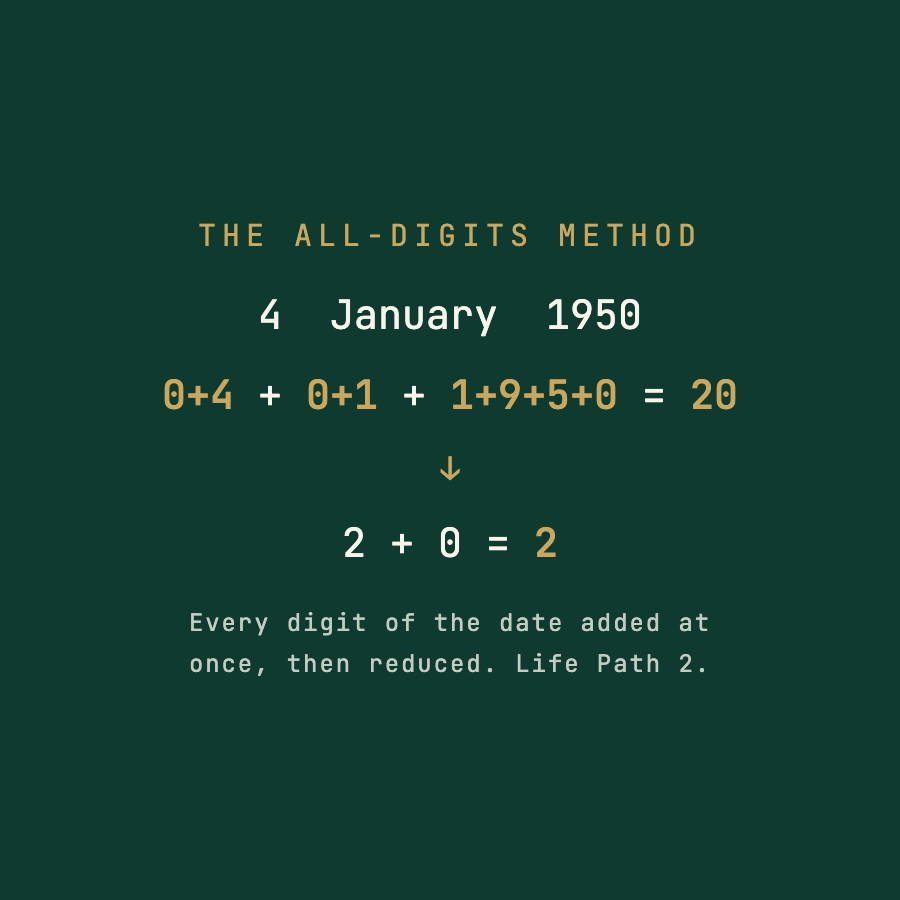
Take 4 January 1950, which is the tool's own example and the clearest case of the two methods parting company.
Written out, the digits are 1, 9, 5, 0 for the year, 0, 1 for the month and 0, 4 for the day. Added together: 1 + 9 + 5 + 0 + 0 + 1 + 0 + 4 = 20.
Twenty is larger than nine and is not a master number, so it reduces: 2 + 0 = 2. The all-digits Life Path for that date is 2.
Now do the same date by the component method, which reduces each part before adding. January is month 1, which is already a single digit. The day is 4, likewise. The year 1950 gives 1 + 9 + 5 + 0 = 15, and 15 gives 1 + 5 = 6. Add the three reduced parts: 1 + 4 + 6 = 11. Eleven is a master number, so it stops there. The component Life Path is 11.
Same date, same rules about master numbers, two different answers: 2 and 11. Neither is a mistake. They are the outputs of two procedures that most books present as though they were one.
Try a date where they agree, and the reason for the split becomes visible. 14 March 1988: all digits gives 34, and 34 reduces to 7. By components, the month is 3, the day 14 reduces to 5, and the year 1988 gives 26 and then 8. Adding those: 3 + 5 + 8 = 16, and 1 + 6 = 7. Both give 7, because no master number appeared at any stage to interrupt the reduction.
Where the schools disagree
The two methods do not always agree, and the size of the gap is measurable. Across the 20,496 dates from 1950 to 2010 that this tool was tested against, they returned different Life Paths for 2,756 of them. That is 13.4 per cent, or roughly one birth date in seven.
That figure is not an estimate. It is a count, and it is reproducible: run both procedures over the same range and you get the same 2,756. Widening the test to every calendar date in those years, rather than the first twenty-eight of each month, moves the figure by less than a tenth of a percentage point.
More striking is where the disagreements sit. Every single one of them involves a master number. Not most, not nearly all: all 2,756. The two methods never disagree about which ordinary digit a date reduces to. They disagree only about whether a master number survives the reduction, and if you removed 11, 22 and 33 from the system entirely, the two procedures would agree on every date ever.
The specific splits are lopsided. The commonest is 33 by all digits against 6 by components, 1,053 times. Then 11 against 2, 758 times. Then 4 against 22, 496 times; 22 against 4, 285; 2 against 11, 140; and 6 against 33, just 24.
One consequence is worth stating because the usual claim runs the other way. Over the same test range, the all-digits method produced a master number for 17.5 per cent of dates and the component method for 10.5 per cent. It is the all-digits method that yields masters more often, not the component one, whatever the received wisdom says. Compare Life Path 33, which is where the largest single block of the disagreement lands.
What the number is said to describe
Use one method and say which one you used. That is the only real rule, and almost nobody follows it. A Life Path quoted without its method is ambiguous for about one person in seven, and the ambiguity is invisible unless someone checks.
If the two methods agree on your date, which they will roughly six times in seven, the question is moot and you can stop worrying about it. If they disagree, you have a choice to make rather than a fact to look up. Read both entries, and notice that they will not feel equally like you; that reaction is data about you, though not the kind numerology claims to supply.
The practical convention on this site is to report both and let the reader decide. Where a date splits between an ordinary number and a master, as most splits do, the honest description is that the date is one of the ambiguous ones, not that one answer is correct. Compare Life Path 22, which exists on this reading and vanishes on the other for several hundred dates in the tested range.
Where this method came from
The system this belongs to is usually sold as Pythagorean, and the attribution does not survive examination. Nothing in the surviving record connects Pythagoras or his school to the practice of reducing a birth date to a digit. The Pythagoreans were interested in number as the structure of reality, which is a different claim entirely, and no text from that tradition assigns meanings to birth dates.
The actual origin is recent and American. L. Dow Balliett published a series of books from around 1903 that assembled the modern letter-and-number correspondences and their meanings, drawing on a mixture of vibration theory and biblical numerology. Her pupil Juno Jordan systematised the material over the following decades, and the tidy nine-number scheme that appears in every bookshop today is largely her arrangement, consolidated in mid-century publications.
The reduction procedure itself is arithmetically trivial and was not invented by anyone in particular. What Balliett and Jordan supplied was the interpretive apparatus and the confident presentation, and the Pythagoras attribution was applied afterwards as a pedigree.
The two competing reduction methods appear to have separated during that consolidation, without an argument anyone recorded. The component method is the older in print. The all-digits method spread later and is now the more common in popular books, which is why it is the default here rather than because it has any better claim.
The common misreading
The first misreading is that there is one correct Life Path and the other method is simply wrong. There is no authority that could settle it. Two procedures were both in circulation before anyone noticed they conflicted, and neither has a claim on the other.
The second is quoting a Life Path without the method attached, which is what nearly every site and app does. For six dates in seven it makes no difference and the omission is harmless. For the seventh it produces a confident wrong answer, and the reader has no way of knowing which case they are in unless the calculation is shown. That is why this tool prints both.
The third is the belief that the disagreement is rare or marginal. Thirteen per cent is not marginal. If you have been given a Life Path by a book, an app or a reader, there is roughly a one in seven chance that a different but equally standard procedure would have given you a different number, and a decent chance it would have been a master number rather than an ordinary one. Compare Life Path 11.
Questions to sit with
- Do the two methods agree on your date, and did you check rather than assume?
- If they disagree, which number were you given before you knew there was a choice?
- Which of the two answers would you rather be, and what does that preference tell you?
- When you next quote a Life Path, will you say which method produced it?
Run your own date through both methods.