- Entry type
- Master Number
- Number
- 11
- Written form
- 11
- Planetary correspondence
- Uranus
- Element
- Air
- Matching tarot card
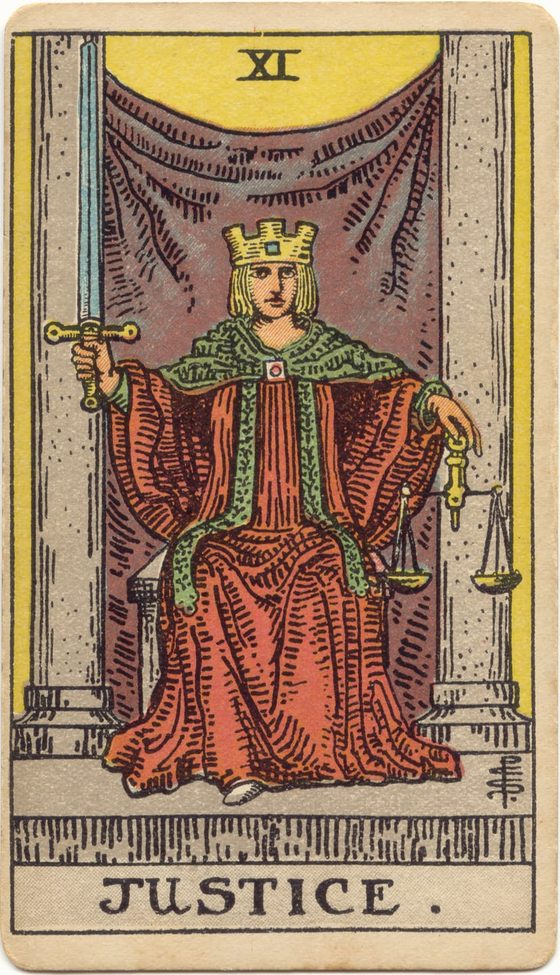
- Justice
Life Path 11
Life Path 11 is the number that may not be yours. It is read as heightened intuition, and it depends entirely on a reduction rule that practitioners do not agree about, which is the first thing worth knowing.
- intuition
- sensitivity
- master number
- vision
- nervous energy
How the number is worked out
Add every digit of the birth date. For 1 January 1989 that is 1 + 1 + 1 + 9 + 8 + 9 = 29, then 2 + 9 = 11. Reducing each part first gives the same answer: January is 1, the day is 1, and 1989 is 1 + 9 + 8 + 9 = 27, then 9. Then 1 + 1 + 9 = 11.
Here the two schools separate. One stops at 11 and calls it a master number. The other keeps going, 1 + 1 = 2, and reads a Life Path 2 carrying some of 11's character. Same date, two answers, and nothing settles it.
A second disagreement sits underneath that one. For 13 September 1978 the whole-date route totals 38, then 11. Reduce the parts first and it is 9 + 4 + 7 = 20, then 2. That date is an 11 or a 2 on grouping alone, before anybody reaches the question of whether to stop.
What the number describes
Life Path 11 is read as the intuitive master number: heightened sensitivity, a pull toward teaching or some form of public message, and nervous energy that has to go somewhere. Structurally it is 2 with the volume raised, and everything the reading says about it is a more intense version of what it says about pairing, receptivity and standing beside rather than in front.
The honest description is that 11 is a status marker as much as a character sketch. Master numbers were added to the system in the twentieth century, they are given the vocabulary of vocation and heightened purpose, and being told you have one is a materially different experience from being told you are a 2. That difference is doing work the arithmetic cannot support.
What the reading describes, once the flattery is set aside, is a person who runs at a higher baseline than those around them and is often uncomfortable in rooms they can read too well. Beside Life Path 7 the sensitivity turns analytical. Beside Life Path 22 it is the visionary end of a pair whose other half is expected to build something. The description is of a temperament, and the tier it sits in was somebody's editorial decision.
What it does well
Reading a room before anybody speaks, which 11 shares with 2 and is described as running further and faster. The number is associated with people who register the mood of a group as a physical fact and can act on it while a meeting is still forming.
The second, and where the reading is at its most defensible, is a tolerance for holding two incompatible things at once. Eleven is a doubled one, and the description that survives contact with actual people is of somebody who can keep a contradiction open instead of collapsing it early. That is a genuine capability. It is not evidence of a mission, and the number cannot distinguish between a person who has it and a person who was told they have it and is now performing the part.
Where it goes wrong
The failure mode is the weight. Somebody told at nineteen that they carry a master number and a purpose will frequently spend their twenties waiting for the purpose to identify itself, and will read ordinary work as beneath the assignment. The reading produces more paralysis than achievement, and the literature almost never says so.
The second is nervous overrun. The same sensitivity that reads a room accurately has no off switch, and the description shades quickly into anxiety without ever using the word. Practitioners tend to call this the high-voltage problem, which is a flattering way of describing being unable to sleep. Naming it plainly is more use than the metaphor is.
In relationships
The reading describes intensity early and difficulty with the ordinary middle. An 11 is said to connect quickly and deeply, and to want a relationship that means something, which is a fine thing to want and an exhausting standard to apply to a Tuesday.
The specific trouble is that heightened sensitivity to a partner's state can become surveillance without either person naming it. Reading somebody accurately is not the same as being told, and acting on the reading rather than asking is where this goes wrong. Where the question is what another person feels, the number offers nothing about them. It describes somebody who believes they already know, which is a different and riskier position.
In work
Teaching, counselling, performance, ministry, anything where the work is transmitting something to other people. The reading leans hard on vocation, and that is the part to hold loosely, because a pull toward meaningful work is extremely common and the number adds no information about aptitude.
The practical difficulty is that this description makes ordinary jobs feel like a betrayal. Somebody carrying it can turn down solid work while waiting for the significant thing, and the significant thing has no arrival date. Worth saying plainly: none of this is career advice. A birth date knows nothing about your training, your obligations or what is being hired, and treating it as a signal about vocation is how people spend a decade underemployed.
In money
The reading associates 11 with money handled inattentively, on the grounds that the number's concerns are elsewhere. That framing is convenient and should be resisted, because it makes financial vagueness sound like a spiritual credential rather than a habit with consequences.
Nothing here is financial advice. The observation worth keeping is that somebody told their purpose is not material will often defer money decisions indefinitely, and deferral compounds quietly. If that fits, the correction is unglamorous: look at the actual numbers once a month, on a set date, whatever else the reading says about you.
The lesson it keeps setting
The lesson 11 is said to keep setting is the difference between sensitivity and knowledge. Reading a situation accurately most of the time produces a confidence that is not always earned, and the failures stay invisible, because nobody comes back to correct an inference you never said out loud.
Concretely, the recurring test is whether you can check a reading against the person it is about, in words, and accept being wrong. Most people who identify with this number can recall a conclusion they reached about somebody and acted on without ever asking. The system frames it as a lesson because it recurs, which is how habits behave and not evidence that anything is arranging the recurrence.
The part people leave out
The popular reading sells 11 as a calling, and that is the part doing damage. Telling somebody they are here for a heightened purpose is a heavy thing to hand a person, particularly a young one, and it gets dispensed casually by people who will not be around for the consequences.
The plainer version is that a special-status number is flattering, unfalsifiable and slightly isolating. It supplies a reason to feel apart from other people that requires no evidence and cannot be tested. Nothing here diagnoses anybody. It names the shape, because this is the one number whose main effect on a life is usually the effect of having been told about it.
How it meets other numbers
Because 11 reduces to 2, the pairings described for it are the pairings described for 2 with more intensity attached, and most practitioners simply reuse them. That is worth knowing before treating any of it as specific to this number.
With 2 the system reads deep mutual understanding and a shared inability to state a need early. With 4 the pairing is the classic vision-and-structure arrangement, which works where the 4 is respected rather than treated as the practical one. With 8 there is friction about what counts as worth doing. With 22, described as the other half of the master pair, the reading is high expectation on both sides and a real risk that neither does anything ordinary. These are tendencies, and the system cannot see whether either person listens.
In a personal year
Personal years come from your birth month and day, each reduced, plus the reduced current year. For somebody born on 4 June, in 2026: June is 6, the day is 4, and 2026 is 2 + 0 + 2 + 6 = 10, so 1. Then 6 + 4 + 1 = 11.
Here the same argument reappears in miniature. Most writers reduce that 11 to 2 and call it a Personal Year 2. A minority stop and call it an 11 year, described as intense and significant. The arithmetic is identical either way. Only the stopping rule differs, and it is the same unsettled convention that decides whether your Life Path is an 11 at all.
Where the symbol comes from
Eleven is the first number past ten, which in a base-ten system makes it the first repetition: one, written again. That is the whole of its geometry, and it is why the doubling language attaches to it so readily.
The planet given is Uranus, which is worth pausing on for the same reason Neptune is on the 7 page. Uranus was identified in 1781, so a correspondence table using it is at most two and a half centuries old and cannot be part of anything ancient. The tarot pairing is Justice, trump XI in the 1909 deck and only there. Waite swapped Justice and Strength to fit the Golden Dawn's zodiacal order, so in a Marseille pack the eleventh trump is Strength instead. The correspondence is an artefact of one deck's renumbering rather than a meaning anybody discovered.
Where this meaning came from
Master numbers are not ancient. Pythagoras left no writings, no ancient source describes a birth-date system, and Greek arithmology, recorded by Nicomachus of Gerasa around 100 CE, deals with the numbers one to ten and has nothing corresponding to a doubled eleven with elevated status.
The system in use was assembled in the early 1900s by L. Dow Balliett and systematised by Juno Jordan, who studied with her. Eleven and twenty-two are the older pair within that modern tradition, appearing in the mid-century literature as the recognised master numbers, while 33 was added later and a substantial number of practitioners still decline to accept it.
It is worth stating plainly what that means. The category that makes this number special is roughly a century old, was created by working numerologists, and has never had a rule about when to stop reducing that all of them agree on. That is not a scandal. It is simply what the thing is, and knowing it changes how much weight the label can reasonably carry.
The common misreading
The first misreading is rank. Master numbers get delivered as a higher tier, and people who have one hear that they are more significant than the people who do not. Nothing in the arithmetic supports a hierarchy. Across every date from 1950 to 2009, the whole-date method produces a master number for roughly one birth date in six, which is not a rare distinction and is almost never mentioned.
The second is certainty about which number you have. A great many people have been told they are an 11 by one calculator and a 2 by another, and both were following a standard method. If a reading rests on the label rather than on the description, it is resting on a coin toss.
The third is the purpose framing. Heightened intuition, spiritual mission and being here to teach get handed over as facts about a person, and there is no version of this system that could establish any of them. The 111 sequence attracts the same treatment for the same reason.
Questions to sit with
- Which calculation gave you this number, and what does the other method give?
- What have you turned down or postponed while waiting for something more significant?
- When did you last check a conclusion about somebody by actually asking them?
- If you were told tomorrow that you are a 2, what would change about how you live?
Work out your own number, both ways.