- Entry type
- Life Path
- Number
- 2
- Written form
- 2
- Planetary correspondence
- Moon
- Element
- Water
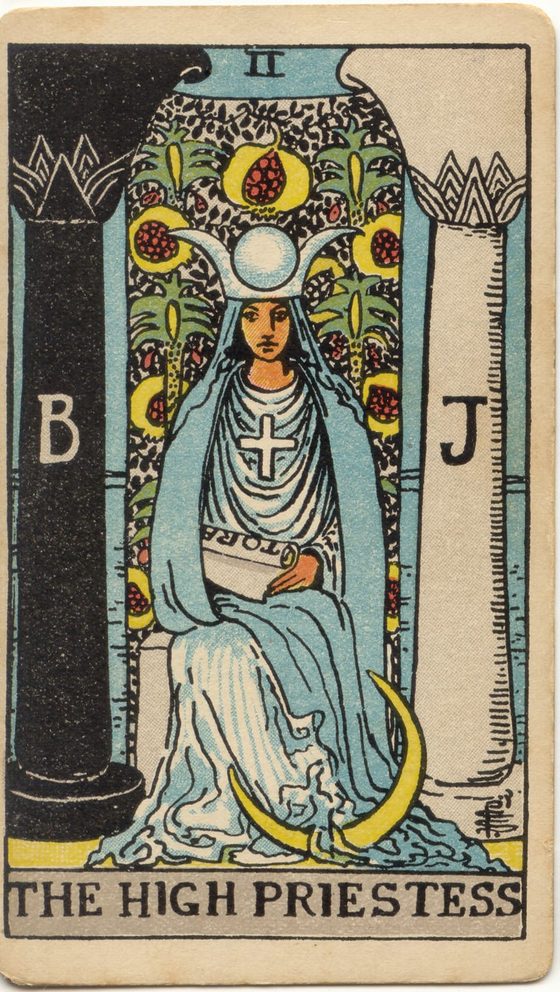
- Matching tarot card
- The High Priestess
Life Path 2
Life Path 2 is the number of the second person in the room. It describes someone who reads a situation before entering it, and it is honest that keeping the peace and disappearing can be the same act.
- cooperation
- sensitivity
- diplomacy
- partnership
- patience
How the number is worked out
Add every digit of the birth date and reduce. For 9 September 2000 that is 9 + 9 + 2 + 0 + 0 + 0 = 20, then 2 + 0 = 2.
Reducing each part first gives the same answer here. September is the ninth month, so 9. The day 9 stays 9. The year 2000 is 2 + 0 + 0 + 0 = 2. Then 9 + 9 + 2 = 20, then 2.
The two methods agree on most dates, because changing the order in which you add digits cannot change the final single figure. They diverge only where one route lands on 11, 22 or 33 and stops there by convention. 13 September 1978 totals 38, then 11, and is usually kept as a master number; reduce the parts first and it gives 9 + 4 + 7 = 20, then 2. This is the number where that argument bites hardest, because Life Path 11 reduces to 2 and no authority settles which of the two readings applies.
What the number describes
Life Path 2 is read as the number of pairing: the person who works in relation to somebody else rather than out in front. Where 1 is described by initiative, 2 is described by response. The system gives it sensitivity as an instrument rather than a temperament, which is a useful distinction, because sensitivity used well is a skill and sensitivity left unmanaged is only a cost.
In practice the number describes somebody who registers the state of a room quickly and adjusts before deciding whether to. That produces good mediators, good seconds, and people who are very hard to read because they have spent a lifetime reading everybody else. The system frames this as cooperation. What it describes more precisely is a habit of positioning, learned early and rarely examined once it starts working.
The card given is The High Priestess, trump II, seated between two pillars with a book half concealed. It is a fair pairing: the figure is present, informed, and not saying. Beside Life Path 1 the reading becomes a well-known complement that can also collapse into deference. Beside Life Path 6 the caretaking doubles and nobody in the situation is asking for anything directly. The number describes a stance toward other people, not a level of strength.
What it does well
Reading a situation. The number describes a person who can tell that a meeting has gone wrong before anybody has said anything wrong, and who can usually name what happened afterwards. That is a real and undervalued capability, and it is why 2 turns up in descriptions of good negotiators, editors and clinicians.
The second is patience with process. A 2 will sit with something unresolved for far longer than most people can stand, which is exactly the trait that lets long collaborations survive. Alongside it comes an unusual tolerance for other people's inconsistency. None of this is a promise about how a life goes. It describes what the number is said to make easier, offered as a tendency rather than an endowment.
Where it goes wrong
The failure mode is not weakness, which is the version the older keyword lists print. It is the slow substitution of other people's preferences for your own, carried out so gradually that there is no moment at which it happened. A 2 can go years without stating a position and then find there is no longer one available to state.
The second is the ledger. Peace gets bought repeatedly, the cost is recorded privately, and the account is never presented to anybody who could settle it. What eventually comes out is not a request but a grievance, delivered at a moment that makes it easy to dismiss. The system calls this the shadow side of harmony. It is more accurately the arithmetic of unspoken bargains.
In relationships
The reading describes a person who is good at relationships and prone to disappearing inside them. Attentive, accommodating, quick to notice what the other person needs, and correspondingly slow to say what they need themselves, on the reasoning that asking might cost something.
The trouble that follows is specific. A partner who is never asked for anything eventually stops offering, not out of indifference but because they have been given no signal, and the 2 reads that as confirmation. Where the question is what somebody else feels, this number has nothing to say. It describes a way of being in a relationship, and being easy to be with is not the same as being known.
In work
Roles built around other people: mediation, partnership, support functions, anything where the work is holding several parties in a workable relation. The reading is good at describing deputies who are better than the person above them and have arranged for nobody to notice.
The practical difficulty is credit. A 2 will do the coordination that makes a project succeed and then be unable to describe their contribution afterwards, because it does not decompose into deliverables. Worth saying plainly: this is not advice to leave or to stay. It describes a pattern, and the useful response is administrative rather than spiritual, which is to write down what you actually did while you can still remember it.
In money
The reading associates 2 with shared finances rather than solo ones: joint accounts, family money, arrangements where somebody else's decisions weigh as much as yours. It is associated with neither abundance nor scarcity, which is a rare piece of restraint in this material.
Nothing here is financial advice. The observation worth keeping is that the described tendency, deferring on any decision that involves another person, is expensive specifically in money, where deferral compounds quietly. If the pattern sounds familiar, the correction is to state a number out loud before the conversation rather than in the middle of it.
The lesson it keeps setting
The lesson 2 is said to keep setting is the difference between being needed and being known. The two feel similar from inside and arrive by very different routes, and the first is considerably easier to arrange.
Concretely, the recurring test is whether you can state a preference before finding out what everybody else wants. Not a large preference, an ordinary one, about a restaurant or a weekend. Most people who read themselves as a 2 can feel the resistance to that as something almost physical. The system calls it a lesson because the situation keeps returning, which is a fair account of how a habit behaves and not evidence that the returns are arranged by anything.
The part people leave out
The popular reading sells 2 as gentleness. What gets left out is that never stating a preference is itself a strategy, and not always a passive one. Somebody who has arranged never to be the one who asked keeps the right to be disappointed, and that is a position with real power in it.
Said plainly: the martyr and the diplomat use the same technique, and the difference is whether the cost is being tracked. Nothing here suggests any particular person is doing this. It names the shape the number's shadow takes, so that a reader can check whether it fits rather than simply accept the flattering half.
How it meets other numbers
With 1 the system reads the textbook complement, and it works where the 2 holds a position of their own. Where they do not, the pairing produces one person who is agreeable and one who is lonely, and neither can locate when that started.
With 8 the reading is a support arrangement that suits both until the 2 wants something, at which point the machinery has no channel for it. With 9 it is the gentlest pairing in the system and also the vaguest, since neither number is inclined to name a problem early. With 6 there is genuine warmth and a shared blind spot about who is allowed to need things. These are described tendencies. Whether two people can actually talk to each other decides more than all of them together.
In a personal year
Take your birth month and day, reduce each, and add the reduced current year. For somebody born on 4 June, in 2026: June is 6, the day is 4, and 2026 is 2 + 0 + 2 + 6 = 10, so 1. Then 6 + 4 + 1 = 11, and 1 + 1 = 2. That is a Personal Year 2.
Notice that the total passed through 11 on the way. Some writers stop there and call it a master year; most reduce it. That inconsistency is not a detail. It is the same unsettled convention that makes the Life Path calculation disputed. A 2 year is read as slow: partnership, waiting, things developing rather than launching.
Where the symbol comes from
Two is where counting starts to be interesting. One mark is a tally. Two is the first relation, and the first thing that can be compared. Greek arithmology treated the dyad as the entry of difference and therefore of division, which is why 2 carries an older association with conflict that the modern gentle reading has almost entirely dropped.
The line is its geometric form: two points and the shortest thing joining them, without enough information yet to enclose anything. The planet given is the Moon, which comes from a modern correspondence table rather than an ancient source and brings the reflection idea with it. The tarot pairing is The High Priestess, trump II, seated between a black pillar and a white one. Those pillars do the same work the number does: two things, and a figure positioned between them.
Where this meaning came from
The pedigree usually claimed for this material does not hold up. Pythagoras wrote nothing that survives, and no ancient source attributes a birth-date system to him. What did exist was Greek arithmology, set out by Nicomachus of Gerasa around 100 CE and in the later Theology of Arithmetic, which does treat the dyad as a principle. That is a philosophy of number, not a method for reading a person.
The method is early twentieth century. L. Dow Balliett published from 1903 onward, connecting numbers, letters and vibration, and Juno Jordan, who studied under her, turned that into the standard chart still in use: Life Path, Expression, Soul Urge and the rest. Jordan's work through the middle of the century is where the modern keyword sets were fixed.
It is worth being exact about what all of that means. When a site tells you 2 is the ancient number of harmony, the harmony reading is roughly a century old, and the older reading it displaced was closer to the number of division.
The common misreading
The first misreading is treating 2 as a weak number. Older lists print passive and dependent, and the reading gets delivered as a deficit to be corrected. What the number describes is a strategy, and strategies are chosen, maintained and occasionally very effective. Telling somebody they are passive while they are managing a room is a failure of observation dressed as insight.
The second is turning sensitivity into psychic ability. Because 2 is given the Moon and The High Priestess, the reading slides quickly into intuition and from there into knowing things about other people. Noticing that a colleague is upset is a social skill with an ordinary explanation, and dressing it up costs the person the ability to be wrong about it.
The third is prescriptive. This number gets used to tell someone they should compromise more, usually by whoever benefits from the compromise. Nothing in a birth date establishes that any particular person owes more accommodation than they are already giving.
Questions to sit with
- When did you last state a preference before finding out what everybody else wanted?
- What are you keeping a private tally of, and who has never been shown it?
- Who in your life knows what you want without you having to hint at it?
- If you stopped smoothing this situation over, what would actually happen?
Work out your own number, both ways.