- Entry type
- Life Path
- Number
- 1
- Written form
- 1
- Planetary correspondence
- Sun
- Element
- Fire
- Matching tarot card
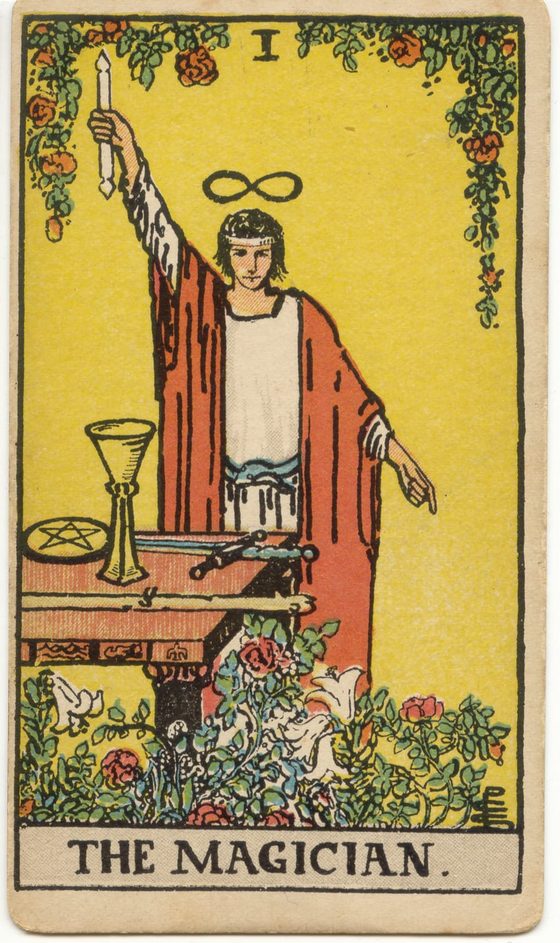
- The Magician
Life Path 1
Life Path 1 is the number of going first. It describes a person who would rather decide badly than be managed well, and it is honest that self-reliance and isolation are the same trait seen from different sides.
- initiative
- independence
- leadership
- self-reliance
- beginnings
How the number is worked out
Add every digit of the birth date and reduce to one figure. For 6 October 1983 that is 1 + 0 + 6 + 1 + 9 + 8 + 3 = 28, then 2 + 8 = 10, then 1 + 0 = 1.
The other common method reduces each part first. October is 10, so 1. The day 6 stays 6. The year 1983 is 1 + 9 + 8 + 3 = 21, so 3. Then 1 + 6 + 3 = 10, so 1.
Both give 1, and for most dates they always will, because the order you add digits in does not change the final single figure. The two methods part company only when one route passes through 11, 22 or 33 and stops there by convention. 13 September 1978 adds to 38, then 11, and is kept as a Life Path 11; reduce the parts first and you get 9 + 4 + 7 = 20, then 2. No authority settles which of those is correct.
What the number describes
Life Path 1 is read as the number of initiative: the person who starts the thing, takes the decision and carries the consequence. In the modern system every number is given a posture rather than a fate, and this one's posture is toward authority. A 1 is usually uncomfortable being managed, and reasonably good at managing themselves.
What the reading actually describes is a preference for acting on incomplete information rather than waiting for consensus. That is a real capability and it is not the same as being right. People who read themselves this way tend to accumulate a track record of decisions taken early, some of which worked, along with a habit of not asking, which is much harder to audit.
The card paired with it is The Magician, trump I in the 1909 Waite-Smith deck: tools laid out, nothing yet made. That is the honest version of 1, because it describes capacity and starting position rather than achievement. Beside Life Path 8 the drive reads as appetite for scale. Beside Life Path 2 it reads as an inability to share the wheel. The number does not say which of those you are, and nothing in the arithmetic could be made to.
What it does well
Starting. A 1 will begin something that has no precedent and nobody's permission, and a first version will exist while other people are still scoping it. That is rarer than it sounds, and most organisations are short of it.
Deciding under uncertainty is the other real one. The reading describes somebody who can hold a call they cannot fully justify, take responsibility for it in public, and revise it later without treating the revision as a defeat. Alongside that sits a tolerance for being disliked, which is not a virtue by itself but is the price of most useful decisions. None of this is a prediction of success. It is a description of what the number is said to make easier, and easier is the whole of the claim.
Where it goes wrong
The failure mode of 1 is not arrogance, which is the version the keyword lists sell. It is the quiet conversion of every disagreement into an obstacle. Someone reading themselves as a 1 can stop hearing objections as information and start hearing them as friction to route around, and the routing works often enough to become a habit.
The second is not delegating. Usually not from ego, but because explaining takes longer than doing, which is true in the short run and ruinous across years. The result is a person whose projects are all slightly smaller than they could have been, and who is permanently the bottleneck. The achievements accumulate. The people who might have carried part of it do not.
In relationships
The reading describes someone who needs a partner rather than an ally and finds the distinction hard to hold. A relationship with a 1 tends to work where the other person has their own centre of gravity, and to fail where they do not, because agreement offered too readily stops being useful and starts being invisible.
The common trouble is not conflict but its absence. A 1 who has arranged their life so that nobody contradicts them has usually done it without noticing, and the relationship goes quiet a long time before it goes wrong. None of this predicts anything about a particular person. It describes a pattern the number is said to make likelier, and a pattern is not a person.
In work
Founding, leading, or working in a role with a defined territory and few people above them inside it. The reading favours situations where the boundary of the job is drawn by results rather than by process, and it is consistently poor at describing anyone content inside a well-run hierarchy.
The practical difficulty is being second. A 1 in a deputy role often performs it well for about two years and then either leaves or quietly begins running a parallel version of the job. Worth saying plainly: this describes a tendency, it does not recommend quitting anything. Whether a particular role suits you is a question about the role, the money and the people in it, and a birth date has no access to any of the three.
In money
The reading associates 1 with income arriving in steps rather than along a curve: stretches of very little, then something that works. It also associates it with a willingness to carry personal risk, which is a temperament rather than a strategy.
Nothing here is financial advice and this page will not offer any. The one observation worth keeping is that the trait the number describes, deciding fast and alone, is the trait that makes financial decisions worse rather than better. If you recognise yourself in this reading, the useful correction is to slow money decisions down specifically, whatever you do with everything else.
The lesson it keeps setting
The lesson 1 is said to keep setting is the difference between leading and being alone. From the inside they look identical, and a person can spend decades choosing the second while describing it as the first.
Put concretely, the recurring test is whether you can let something be done a way you did not choose, by somebody you did not have to persuade, and then leave it alone. Most people who read themselves as a 1 can tell you precisely when they last failed that test. The system frames it as a lesson because the situation keeps coming back, which is a fair description of how habits behave, and not evidence that anything is arranging them.
The part people leave out
The popular reading sells 1 as confidence. What gets left out is that self-reliance is usually learned, and usually learned early, by somebody who found that relying on other people went badly. That is a history rather than a personality, and the number has no way of telling the two apart.
The practical shape of it is that asking for help registers as losing. Not as embarrassing, as losing, which is why the person concerned will do three days of avoidable work rather than send a two-line message. None of this is fated. It is a described pattern, and the point of naming it is that a pattern can be examined instead of admired.
How it meets other numbers
Against 2 the system reads 1 as the classic complement: one initiates, one mediates. That pairing gets called ideal by some writers and disastrous by others, and both are right, because it depends entirely on whether the 2 holds a position of their own.
With 8 it reads as two people who both want the final call, producing either a formidable partnership or a very long argument about scope. With 5 the pairing is fast and unstable, two people accelerating at once. With 4 the friction is about method rather than direction: the 1 wants it started, the 4 wants it specified. The system offers these as tendencies. It has no way to account for whether either person is kind, which matters more than the whole of it.
In a personal year
A Personal Year is worked out from your birth month and day plus the current calendar year, each reduced and then added together. For somebody born on 5 April, in 2026: April is 4, the day is 5, and 2026 is 2 + 0 + 2 + 6 = 10, so 1. Then 4 + 5 + 1 = 10, so 1. That is a Personal Year 1.
A 1 year is read as the opening of a nine-year cycle, the year to start rather than finish, on the claim that whatever begins now sets the shape of the eight that follow. Read plainly it is a scheduling convention, not a forecast. It tells you very little about the year and a good deal about how the system is organised.
Where the symbol comes from
The associations attached to 1 are older than the numerology using them. Greek arithmology treated the unit as the source of number rather than a number itself, and the idea that one is not properly countable survives in Nicomachus of Gerasa's Introduction to Arithmetic, written around 100 CE. The tally stroke is older still and is the plainest version of the same thing: one mark, cut by somebody standing at the beginning of a count.
The planet given is the Sun, which a modern correspondence table supplies rather than an ancient source. The tarot pairing is The Magician, trump I, and it holds up by number and by picture both: a figure with the four suits laid out in front of him and nothing yet done with any of them. Where these correspondences fit well, it is usually because somebody chose them to fit.
Where this meaning came from
Modern numerology is not Pythagorean, whatever the introduction to nearly every book on it says. Pythagoras left no writings, and nothing survives that attributes this system to him. Greek arithmology did exist and did assign qualities to numbers, but a Life Path calculated from a birth date appears nowhere in it.
What is documented is far more recent. The system in current use was assembled in the early 1900s by L. Dow Balliett, an American writer who tied numbers, letters and musical vibration together across a series of books from 1903 onward. Juno Jordan, who studied with her, systematised it into the chart readers use now, standardising Life Path, Expression, Soul Urge and the rest through the middle of the century.
There is a further wrinkle almost nobody mentions. A Life Path depends on the Gregorian calendar, which dates from 1582 and was not adopted in Britain and its colonies until 1752. The number is stable, but what it is calculated from is an administrative decision rather than a fact about the sky. The same pattern of a recent invention given an ancient pedigree repeats with angel numbers, popularised by Doreen Virtue from the late 1990s and publicly renounced by her in 2017.
The common misreading
The first misreading is treating the number as a verdict on ability. Life Path 1 gets delivered as leadership, and the querent hears a promise that they will lead something. The system does not claim that and could not support it. It describes a disposition, and dispositions are distributed across people who succeed and people who do not in roughly the proportions you would expect.
The second is using it as a permission slip. This is the commonest damage the number does: I am a 1, so I do not compromise, so the thing I did to you was structural rather than chosen. A description of a tendency is not an exemption from it, and the people around somebody quoting their Life Path at them can generally tell the difference.
The third is reading it as the whole chart. The Life Path is one number among several in a standard reading, sitting beside the Expression Number and the others taken from the name, and even inside the system it was never meant to carry a personality alone.
Questions to sit with
- When did you last change your mind because somebody else was right, and did you say so out loud?
- What are you doing yourself this week that another person could do at eighty per cent?
- Is there anyone in your life who reliably tells you no, and do you still ask them?
- Which of your recent decisions were fast because they were urgent, and which because waiting felt worse?
Work out your own number, both ways.