- Entry type
- Core Number
Expression Number
The Expression Number is calculated from every letter of the full birth name. It claims to describe capacity: what a person is equipped to do, as distinct from what they want or how they come across.
- capacity
- equipment
- expression
- aptitude
- operating style
How the number is worked out
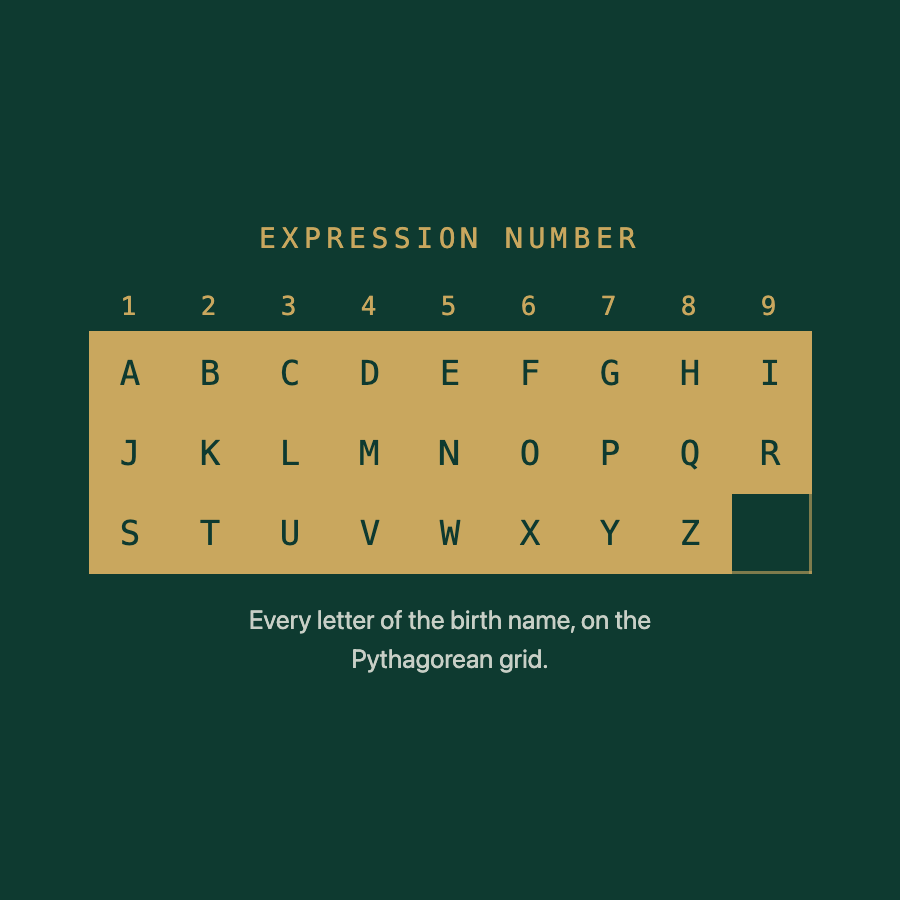
Every letter is assigned a number from one to nine in alphabetical order, restarting after each nine. Set out as columns: 1 is A, J, S; 2 is B, K, T; 3 is C, L, U; 4 is D, M, V; 5 is E, N, W; 6 is F, O, X; 7 is G, P, Y; 8 is H, Q, Z; 9 is I, R.
Take the full name exactly as given at birth. For John Smith: J is 1, O is 6, H is 8 and N is 5, totalling 20. S is 1, M is 4, I is 9, T is 2 and H is 8, totalling 24. Twenty plus twenty-four is 44.
Reduce: 4 + 4 = 8. John Smith has an Expression Number of 8.
One caveat the calculators rarely state. Some practitioners stop at 44 and keep it as a master number, on the same grounds that 11, 22 and 33 are kept unreduced. There is no agreement about whether 44 qualifies, and the two treatments give different answers for the same name. Life Path 11 covers how master numbers are handled.
What the number describes
The Expression Number, also called the Destiny Number, is calculated from the full name given at birth. What it claims to measure is capacity: the abilities a person has to work with, the way they tend to operate, and what they are equipped to do rather than what they would like to do.
That distinction is the entire reason for having four core numbers instead of one. The Expression is the outward equipment. The Soul Urge is what a person wants. The Personality is what other people meet first, and the Birthday Number is a single additional detail drawn from the date rather than the name. A Life Path, calculated from the whole birth date, is read as the terrain rather than the equipment. Practitioners describe conflict between these as ordinary rather than as a fault.
The obvious objection is that a name is assigned rather than intrinsic, and the tradition's answer is that the birth name is treated as given in the same way a birth date is. Whether that answer satisfies anybody is a separate matter, and it is worth stating plainly that the method has never been shown to measure anything. What it reliably does is produce a structured prompt to describe your own capacities in specific terms, which is a real use and a much smaller claim.
What it does well
As a method the Expression Number does one thing well: it forces a person to describe their capacities in a fixed vocabulary rather than in whatever terms happen to come to hand. Nine categories, each with a defined character, and you have to place yourself in one of them.
That constraint is the value. Self-description is usually vague and quietly flattering, and a system that assigns a category before you have argued for one produces something more useful to push back against.
It is also the most complete of the core numbers, since it uses every letter of the name rather than a subset. Where the Soul Urge and the Personality each use half the letters, the Expression uses all of them, which is why practitioners treat it as the summary figure of the three.
Where it goes wrong
The method's central weakness is the name itself. It requires the full name exactly as recorded at birth, and that requirement collapses on contact with ordinary life: adoption, immigration and transliteration, names recorded with errors, people who have never used the name on the certificate, anybody whose name changed young.
Practitioners disagree about all of those cases, and the disagreements are not minor, because a single letter changes the total and can change the reduced digit. There is no authority to appeal to.
The second weakness is that the reading is supplied after the fact. Nine descriptions, each broad enough to fit most people, and the reader finds the match. That is not a reason to discard the exercise. It is a reason not to treat the output as a measurement.
In relationships
In relationships the Expression is read as what a person actually brings: the capacities they contribute, the way they handle things, the register they operate in. It is the most external of the core numbers and correspondingly the least private.
Practitioners compare Expression Numbers between two people and describe the pairing as easy or difficult, and it is worth being clear that this is the system arranging itself rather than a finding about anybody. Two names produce two numbers, and the relationship between those numbers is a fact about arithmetic. Whether two people suit each other is not something a name can establish, and no page should imply otherwise.
In work
The Expression is the core number most often used for work questions, since capacity sits closer to a working life than desire does. The reading describes an operating style: a 4 as somebody who builds systems, an 8 as somebody who handles the material machinery, a 3 as somebody whose contribution is expression.
Its practical use is comparative rather than predictive. Setting the Expression against the Soul Urge produces the genuinely interesting question, which is whether what a person is equipped for and what they want are the same thing. Where they are not, that gap usually describes a career difficulty better than anything either number says on its own.
In money
The Expression describes an approach to money rather than an amount: whether somebody is comfortable handling it, careless about it, or inclined to treat it as somebody else's department.
That reading is only as good as the self-description it prompts, and it indicates nothing about earnings or outcomes. Nothing calculated from a name bears on a financial decision, and this page gives no guidance on money, which numerology is not equipped to provide. What the exercise can usefully do is make somebody state their actual approach out loud, which most people have never done.
The lesson it keeps setting
The lesson the method sets is a specific one: use what you have. The Expression describes equipment, and the tradition's consistent claim is that the difficulty is rarely a lack of capacity and usually a refusal to work in the register a person actually operates in.
The recurring pattern practitioners describe is somebody attempting to succeed as a different number: a 4 trying to be a 3, or a 7 trying to be an 8, generally because the other number looks better from outside.
Stated without the numerology, the lesson is that most people know what they are good at and would rather be good at something else. Whether a name can establish this is doubtful. Whether the question is worth asking is not.
The part people leave out
The part popular writing leaves out is how much depends on decisions the reader is never told about. Whether to reduce 44, which name to use for somebody who changed theirs, whether to include a middle name that appears on the certificate and nowhere else: every calculator makes these choices silently, and two sites will hand the same person different numbers without either of them explaining why.
The second omission is the direction of fit. Because the descriptions are broad, a person will find themselves in whichever number they are given, and the sense of recognition that produces is not evidence that the calculation was correct.
Where the symbol comes from
The letter-to-number scheme is the part of numerology most often given an ancient pedigree and the least entitled to one. It maps the twenty-six letters of the modern English alphabet onto the numbers one to nine in order, which is a system that can only exist once that alphabet does.
Older gematria traditions work differently. Hebrew and Greek letters carried numerical values as part of the writing system itself, with letters standing for tens and hundreds as well as units, and those values were not assigned by counting along the alphabet in nines. The two systems produce different numbers for the same word and rest on different logic.
What the modern scheme has is convenience. Nine columns, twenty-six letters, and an arrangement anybody can reproduce from memory, which is a considerable part of why it spread as fast as it did.
Where this meaning came from
The Expression Number, along with the rest of the modern core-number scheme, was assembled in the early twentieth century. L. Dow Balliett published the founding books between about 1903 and 1917, setting out the letter-to-number correspondence and linking it to musical tones and colours. Juno Jordan, who came out of Balliett's circle, systematised the material over the following decades, and her work is the direct source of the four core numbers as they are calculated today.
The attribution to Pythagoras is a later claim and it does not survive examination. No Pythagorean source sets out this letter-to-number system, and none could have: the scheme maps the modern English alphabet. The claim appears to have been attached as the practice commercialised, and it is now repeated by essentially every numerology site, which is a reasonable illustration of how a pedigree can be manufactured by repetition alone.
What is genuinely old is the broader idea that letters carry numerical value, which is real and well documented in Hebrew and Greek gematria. That is a different practice with different values, and modern numerology's debt to it is one of inspiration rather than descent.
The common misreading
The commonest misreading of the Expression Number is treating the output as a measurement. It is a category assignment produced by arithmetic on a string of letters, and while the arithmetic is exact, the mapping from letters to numbers is arbitrary. Precision in the calculation does not transfer to the result.
The second is the birth-name rule taken as settled doctrine. It is presented everywhere as a requirement, and practitioners disagree substantially about what to do when the birth name is unknown, was recorded wrongly, or belongs to a life somebody has deliberately left behind. Anybody handing you a number without saying which convention produced it is concealing a choice.
The third is reading the Expression on its own. It is one of four core numbers, and the tradition is emphatic that they are read together. The interesting material is almost always in the disagreements between them, particularly between what somebody can do and what they want. A single number read in isolation produces a flattering paragraph and very little else.
Questions to sit with
- What are you actually equipped to do, described without modesty and without exaggeration?
- Which number would you rather have been, and what does that tell you?
- Where are you working in a register that is not yours?
- If the calculation had given a different answer, would you have recognised yourself in that one too?
Work out your own number, both ways.