- Entry type
- Core Number
Personality Number
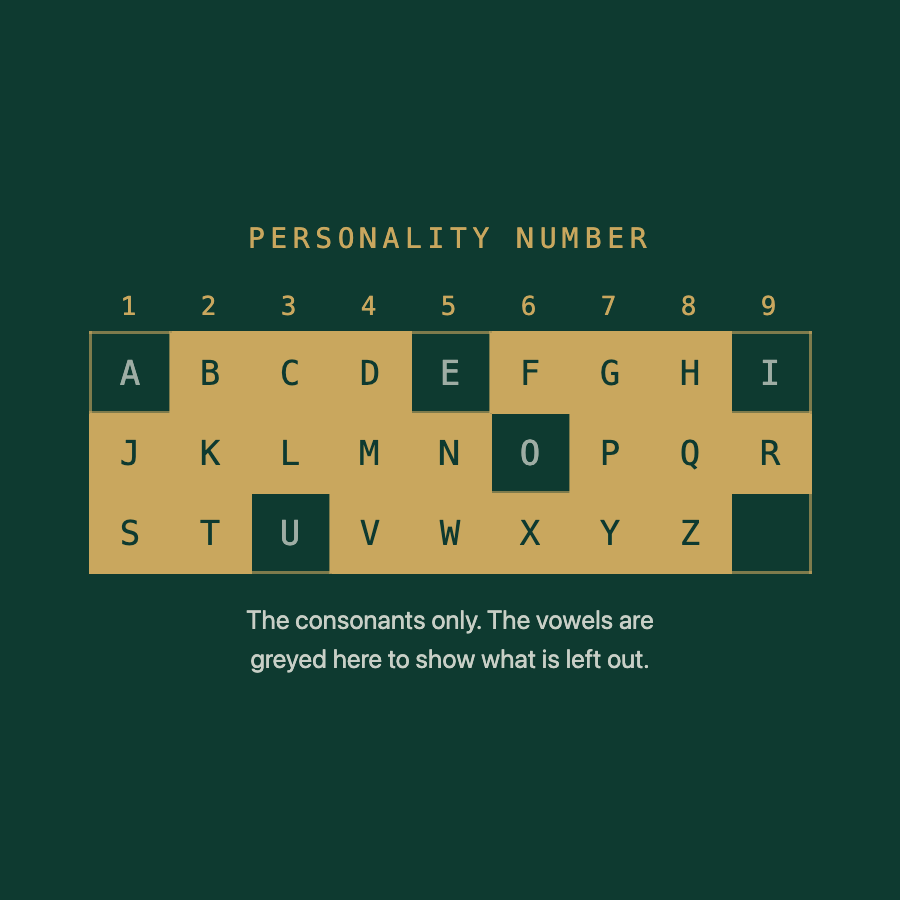
The Personality Number is calculated from the consonants of the birth name. It claims to describe what other people meet first: the manner, the impression, the part of somebody that arrives before they do.
- manner
- impression
- outward self
- presentation
- first contact
How the number is worked out
Use the standard letter values and take the consonants only, leaving out whatever you counted as a vowel.
For John Smith: J is 1, H is 8 and N is 5, which totals 14. S is 1, M is 4, T is 2 and H is 8, which totals 15. Fourteen plus fifteen is 29.
Reduce: 2 + 9 = 11. Eleven is a master number and is conventionally left unreduced, so John Smith has a Personality Number of 11 rather than 2. Life Path 11 sets out how master numbers are handled.
There is a check worth running. The vowel total and the consonant total should add up to the Expression total, because between them they use every letter of the name: 15 plus 29 is 44, which is John Smith's Expression. The check works on the raw totals rather than on the reduced digits. If yours do not reconcile, you have either made an arithmetic slip or used two different rules about Y.
What the number describes
The Personality Number is calculated from the consonants of the birth name and read as the outward manner: the impression a person makes before anybody knows them, the version of them that arrives in a room first. The tradition sometimes calls it the outer self, and one older description has it as the clothing of the name.
It is the deliberate counterpart of the Soul Urge. Vowels are assigned to what is inward and wanted, consonants to what is outward and shown, and the two together account for every letter the Expression uses. The Birthday Number stands outside that group, since it comes from the date rather than the name. The three name-based numbers are meant to be read as a set, and the tradition's most useful claim concerns the distance between them rather than any one on its own.
A gap between Personality and Soul Urge is the standard reading here, and it is not treated as dishonesty. What it describes is the ordinary situation of somebody whose manner does not advertise their motives, which is most people most of the time. Practitioners differ on whether the number describes how a person intends to come across or how they actually do, and those two readings diverge sharply for anybody whose self-image is inaccurate. The method has never been shown to measure anything. What it does is make a person describe how they think they come across, which is a question almost nobody answers accurately without being made to.
What it does well
The method is at its best on the question it forces: how do you actually come across, as opposed to how you intend to. Those two are reliably different, and the gap is invisible from the inside, which is why the exercise has some value even where the arithmetic has none.
It is also the core number most easily checked against reality. You can ask people. The Soul Urge and the Expression are difficult to test against anything, whereas a Personality reading can be handed to three colleagues who will say whether it sounds like you inside a minute. It is the only one of the four whose subject other people have direct evidence about.
That testability cuts both ways, and it is the honest reason this is the most interesting of the four.
Where it goes wrong
The Y convention affects this number in the opposite direction to the Soul Urge. Whatever rule excludes Y from the vowels includes it here, so a reader who calculates the two using different conventions ends up with a pair that will not reconcile against the Expression, and most calculators do not expose the rule they used.
The second weakness is the birth name requirement, which fails for the same ordinary cases as the rest of the scheme: adoption, transliteration, misrecorded certificates, early name changes.
Third, the descriptions are broad enough that any of the nine could be recognised as a first impression, and being recognisable is not the same thing as being right.
In relationships
In relationships the Personality is what did the introducing. It describes the manner somebody meets people with, which is the part a new acquaintance is responding to and is not necessarily the part that stays.
The specific reading practitioners give is the mismatch case: somebody whose Personality is warm and whose Soul Urge is private, or the reverse, and the disappointment that can follow when a relationship moves from the first to the second. The related pattern is somebody whose manner does the work of introducing them and then has very little to hand over to. Both are real and entirely ordinary. The number does not predict either, and calculating a partner's Personality tells you about the arithmetic of their name rather than about how they will behave.
In work
At work the Personality is the interview number. It describes the impression a person makes in the first ten minutes, which is a genuine professional variable and one people are routinely wrong about in their own case.
The practical use is the comparison with the Expression. Where the two agree, the tradition reads somebody whose manner advertises their actual capacities, which makes working life easier in an ordinary and unremarkable way. Where they diverge, it reads somebody consistently underestimated or consistently overestimated on first contact, and both are real professional problems with real costs.
The number describes a position rather than an outcome, and it forecasts nothing about a career.
In money
The Personality has the thinnest money signification of the core numbers, and the honest answer is that it barely has one. What it can describe is how somebody is read in a financial conversation: whether they come across as confident about money, careless about it, or uncomfortable discussing it at all.
That perception does have consequences in a negotiation, which is the only place this number touches money at all. There is also the reverse case, in which somebody read as confident about money is assumed not to need any, which is a specific and costly form of being misread. None of it says anything about anybody's circumstances, and it is not financial advice, which numerology is not equipped to give.
The lesson it keeps setting
The lesson the method sets is closing the gap deliberately rather than accidentally. A difference between how somebody comes across and what they want is normal, and it becomes a problem only when it goes unexamined, because then a person keeps being met on terms they did not choose and cannot work out why.
The tradition's version is that the Personality should be worn rather than mistaken for the self. That is a reasonable thing to say and it requires none of the arithmetic.
The second half is accepting the report. If several people describe your manner the same way and it does not match your intention, the description is the more reliable of the two.
The part people leave out
The part popular writing leaves out is that this number is often used as an excuse. Somebody reads that their Personality is reserved or blunt or intimidating and treats it as a fixed property, rather than as a description of a habit other people are actually experiencing.
The second omission is the check nobody runs. The vowel and consonant totals must sum to the Expression total, and a site returning all three without them reconciling has an error in it. That failure stays invisible unless a reader adds the numbers up, and it is one of the very few things in numerology that can be straightforwardly right or wrong.
Where the symbol comes from
Consonants are what shape a sound rather than carry it. They stop, release and direct the breath that vowels sustain, and the tradition takes that as its rationale: the consonants of a name are its structure, the part giving a word its recognisable outline.
It is a genuinely good image. A name spoken with only its vowels is unrecognisable; with only its consonants it is usually still readable, which is why written Hebrew works and why abbreviated text does.
That observation is also the closest the modern scheme comes to a real link with older letter-number traditions, since Hebrew gematria operates on a consonantal alphabet. The link is thematic rather than genealogical and the values used are entirely different, but the emphasis on consonants as the carrying structure of a name is at least a point the two have in common.
Where this meaning came from
The Personality Number arrived with the rest of the modern core-number scheme in the early twentieth century. L. Dow Balliett published the founding material from about 1903, and Juno Jordan organised it into the standard four over the following decades. The vowel and consonant division, which produces the Soul Urge and the Personality as a matched pair, belongs to that period and to no earlier one. Jordan's books are the route by which most of this reached general practice, and they are the practical source of the four-number set as it is taught now.
The Pythagorean attribution is a later marketing claim with no textual support, and the scheme could not predate the modern English alphabet it maps.
What is older is the practice of assigning numbers to letters, which is well documented in Hebrew and Greek gematria and in the Arabic abjad system. Those traditions used the letters of their own alphabets with values running into the hundreds, applied them chiefly to sacred texts rather than to personal names, and produced results that do not correspond to anything modern numerology calculates. The modern system borrowed the idea and none of the apparatus, which is the honest description of the relationship.
The common misreading
The commonest misreading of the Personality Number is treating it as a mask. Popular writing frames it as the face somebody puts on over their real self, which imports a moral judgement the tradition does not make. A manner is not a deception, and the gap between how a person comes across and what they want is the ordinary condition of being a person.
The second is calculating it for other people and treating the result as an assessment. It is the core number most often used this way, because a first impression feels like public information. What the calculation actually produces is a fact about the spelling of somebody's name.
The third is the unreconciled set. The vowel total and the consonant total have to add to the Expression total, and a great many sites return three numbers that do not, usually because of an inconsistent rule about Y. Readers assume the numbers are simply what they are. They are the output of a calculation that can be checked, and checking it is the single most useful thing anybody can do with this material.
Questions to sit with
- How do you come across in the first ten minutes, according to somebody who would actually tell you?
- Where are you consistently met on terms you did not choose?
- What do people assume about you that is not true, and what invites the assumption?
- Is the gap between how you seem and what you want a gap you have chosen?
Work out your own number, both ways.