- Entry type
- Core Number
Birthday Number
The Birthday Number is the day of the month a person was born on. It is the simplest of the core numbers, the only one that needs no name, and the one practitioners disagree about most.
- aptitude
- given talent
- ease
- specificity
- day
How the number is worked out
Take the day of the month and nothing else. Not the month, not the year, and not the name: this is the one core number that cannot be worked out from a name at all, so the John Smith example used on the other three pages does not carry over. A date is all it needs.
Somebody born on the 23rd has a Birthday Number of 23, or of 5, depending on which convention is being followed.
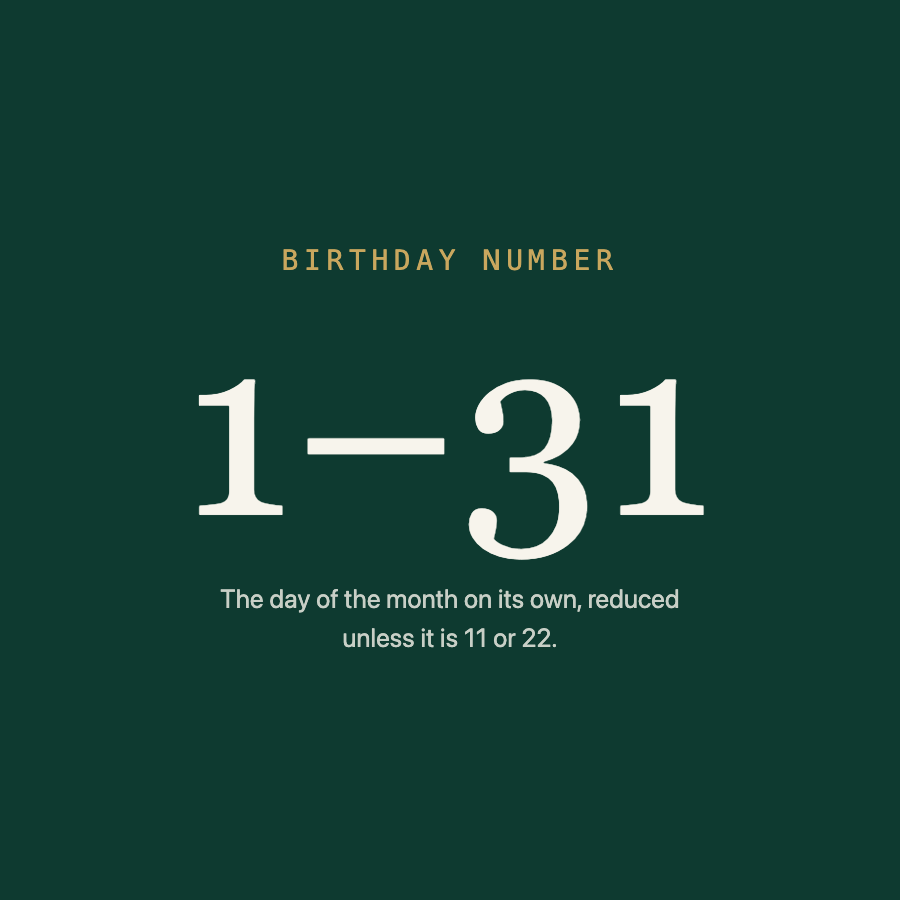
That is the disagreement. One school reduces the day to a single digit: 2 + 3 = 5, which points at Life Path 5 for the meaning of the digit. The other school keeps the day as it stands, treating all thirty-one as distinct, so a 23 is read differently from a 5 and from a 14, even though all three reduce to the same figure.
Both are in current use. The reducing school treats 11 and 22 as master numbers and leaves them alone, which means a 29 becomes 11 rather than 2. Life Path 22 covers that convention.
What the number describes
The Birthday Number is the day of the month somebody was born on, and it is read as a specific talent or marking: not the shape of a life, which the Life Path covers, and not what a person is equipped with in general, which is the Expression, but one particular capacity the tradition treats as given rather than developed.
Practitioners describe it as the smallest of the core numbers in scope and the most concrete. A Life Path describes terrain across decades. A Birthday Number is meant to describe something a person has been able to do since they were young, and which they are likely to underrate precisely because it has always been available to them.
Its structural distinction is more interesting than its readings. Because it uses only a date, it is the one core number immune to every problem afflicting the other three: no birth name to establish, no transliteration, no argument about Y, no question of which certificate to use. The tradition treats it as the natural starting point for anybody whose birth name is contested or unknown, and whatever one makes of the method, this is the only part of it that produces the same answer everywhere, provided the two schools agree on whether to reduce.
What it does well
The method's real strength is robustness. Every other core number depends on a name being recoverable, spelled consistently and transliterated the same way, and those conditions fail often. A date does not have that problem, and for adopted people, for anybody whose name changed, and for anybody working across two alphabets, this is the only core number that can be calculated at all without an argument first.
The second strength is scale. Because the claim is small, a specific capacity rather than a whole life, it is easier to test against somebody's actual history than the grander numbers are.
Third, it is quick, which matters more than it sounds. A method nobody has to look up is a method that gets used.
Where it goes wrong
The reduce-or-not disagreement is the main weakness and it is unresolved. Two schools, two answers, and a reader consulting two sources will be given different numbers with no indication that a choice was made anywhere. The unreduced school gives thirty-one distinct readings and the reducing school gives nine, and they are not the same thing at different resolutions. They are different systems sharing a name.
The second weakness is that a day of the month carries no information about anybody in particular. Roughly one person in thirty shares any given birthday number, and the descriptions have to be broad enough to fit all of them.
Third, the readings are the thinnest in the scheme, which follows directly from the claim being the smallest.
In relationships
The Birthday Number is the least used of the core numbers in relationship readings, and the reason is straightforward: a single capacity is not much to build a compatibility claim on. It is also the number least likely to be weaponised in a reading, simply because there is not enough in it to build an accusation from.
Where practitioners do use it, they read it as what somebody brings that is easy for them and not for their partner, which is a more useful frame than most compatibility material manages. The thing you do without effort is generally the thing you cannot explain, and it can look like carelessness to somebody for whom it is difficult.
Nothing here indicates whether two people suit each other. A date cannot establish that, and pairing two dates produces arithmetic rather than a finding.
In work
At work the Birthday Number is read as an aptitude rather than a direction. It describes something a person can do easily, and the tradition's consistent advice is to look for it in the parts of a job nobody ever had to teach them.
That is more practical than it sounds. Most people are poor at identifying their own easy competencies, precisely because ease makes a skill invisible from the inside, and a prompt asking specifically what you never had to learn is a reasonable way in.
The number does not indicate a profession, and readings that convert a day of the month into a career recommendation have travelled a very long way past anything the material supports.
In money
The Birthday Number has essentially no financial signification, and the honest thing is to say so rather than manufacture one. It describes a single aptitude, and aptitudes relate to money only through whatever use somebody makes of them.
Where it has any bearing at all, it is the same observation as in the career reading: a capacity that comes easily is habitually undercharged for, because the person providing it does not experience it as work. The related pattern is somebody who has built a working life around the harder of their capacities, because that one felt as though it counted. Both are worth noticing. Neither is financial advice, and no calculation from a birth date can offer any.
The lesson it keeps setting
The lesson attached to this number is valuing what came free. The tradition's claim is that a Birthday Number describes something a person has always been able to do, and that the characteristic error is discounting it for exactly that reason: if it was never difficult, it does not feel like an achievement.
The practical form of the lesson is simple enough. Ask what other people come to you for, particularly the requests that strike you as trivially easy, and take that answer more seriously than your own account of your abilities.
None of the arithmetic is required for any of this. The question stands on its own, which is true of most of the useful material in numerology and is worth saying plainly.
The part people leave out
The part popular writing leaves out is how little this number is claiming. It sits alongside the Life Path, the Expression and the Soul Urge in every core-number set, presented as an equal member of the four, and it is doing a fraction of the work: one day of the month against a full name and a full date.
The second omission is that the two schools are almost never named. A site that reduces and a site that does not are running incompatible systems, and neither will tell you which one you are reading. That is not a subtlety. It changes the answer for twenty of the thirty-one possible days.
Where the symbol comes from
There is less symbolism here than on any other page in this pillar, and the honest reason is that the Birthday Number is a piece of bookkeeping rather than a symbol. A day of the month is an artefact of a calendar, and the calendar it is an artefact of has been revised.
That is worth a moment. The Gregorian reform of 1582 removed ten days from the calendar outright, and Britain and its colonies did not adopt it until 1752, dropping eleven days that September. Anybody living through a changeover had a dating system shift under them, and a method reading meaning into the day of the month has no account of what happens to those dates.
Where the individual digits do carry symbolism, it is borrowed wholesale from the single-digit meanings used everywhere else in the system, and this page adds nothing to them.
Where this meaning came from
The Birthday Number belongs to the same early twentieth-century construction as the rest of modern numerology. L. Dow Balliett's books from about 1903 established the letter-to-number scheme, and Juno Jordan systematised the core numbers over the decades that followed, with the Birthday Number as the smallest of the four.
The Pythagorean attribution attached to the whole system has no textual support. No surviving Pythagorean source contains this material, and the letter scheme it depends on maps an alphabet that did not yet exist.
The reduce-or-not disagreement appears to have developed inside the modern literature rather than being inherited from anywhere, which is unusual. Most of numerology's internal disagreements can at least be traced to two older sources saying different things. Here both positions are twentieth-century and neither has a claim to priority. What is documented is that the four-number set stabilised through Jordan's teaching rather than through any single decisive publication, which is part of why its internal disagreements were never adjudicated. Practitioners tend to present whichever position they were taught as the standard, and readers have no way of telling which they have been handed unless the site says so, which is rare.
The common misreading
The commonest misreading of the Birthday Number is treating it as equal in weight to the other core numbers. It is presented as one of four, and it is much the smallest claim: a single day set against a full name and a full date. A reading that gives it the same emphasis as a Life Path is over-reading the arithmetic.
The second is the undeclared convention. Two schools disagree about whether to reduce the day, and the disagreement changes the answer for twenty of the thirty-one possible birthdays. Anybody given a Birthday Number without being told which school produced it has been handed a result with a hidden decision inside it.
The third is the leap into vocation. Because the number is read as an aptitude, it gets converted into career advice with startling confidence, and there is nothing behind the conversion. A day of the month is a calendar fact. What somebody is good at is a question worth asking carefully, and this number is at best a prompt to ask it rather than an answer.
Questions to sit with
- What do people come to you for that you find trivially easy?
- Which of your abilities have you discounted because you never had to learn it?
- What have you never charged properly for, because it does not feel like work?
- If your answer differs under the two conventions, which of the two readings actually describes you?
Work out your own number, both ways.