- Entry type
- Life Path
- Number
- 5
- Written form
- 5
- Planetary correspondence
- Mercury
- Element
- Air
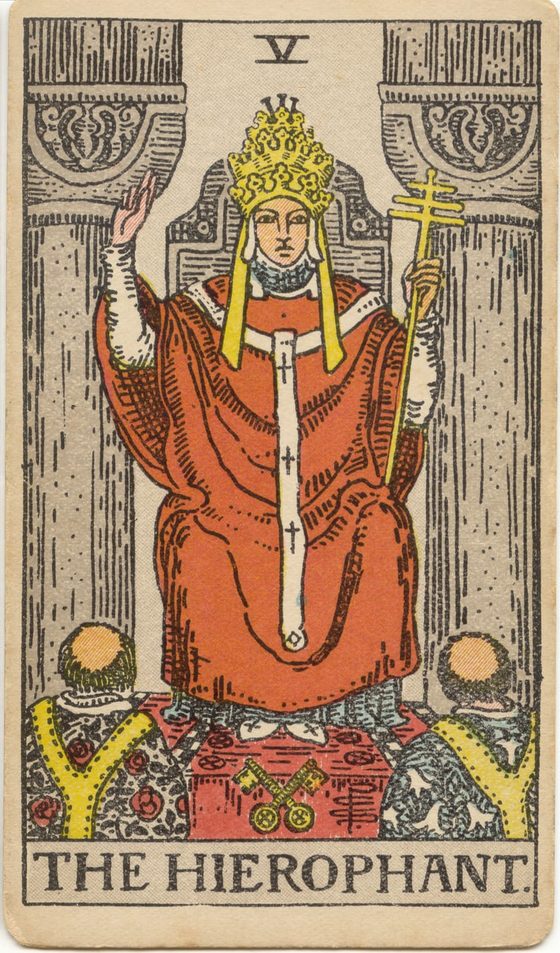
- Matching tarot card
- The Hierophant
Life Path 5
Life Path 5 is the number of the visible exit. It describes someone who needs to know they could leave, and it is honest that this is sometimes courage and sometimes an inability to sit still.
- change
- freedom
- curiosity
- restlessness
- adaptability
How the number is worked out
Add every digit of the birth date and reduce. For 8 April 1973 that is 4 + 8 + 1 + 9 + 7 + 3 = 32, then 3 + 2 = 5.
The other method reduces each part first. April is the fourth month, so 4. The day 8 stays 8. The year 1973 is 1 + 9 + 7 + 3 = 20, so 2. Then 4 + 8 + 2 = 14, and 1 + 4 = 5.
Both give 5, and for the great majority of dates they always will, because the order digits are added in cannot change the final single figure. The methods only come apart where one route lands on 11, 22 or 33 and is stopped there by convention. 13 September 1978 adds to 38, then 11, and is usually kept as a master number; reduce the parts first and the same date gives 9 + 4 + 7 = 20, then 2. Eleven or two, from one birth date, and nothing in the tradition settles it.
What the number describes
Life Path 5 is read as the number of change: the person who arranges their life so that the exit stays visible. Travel, variety, new work, new cities, a low tolerance for arrangements that cannot be altered. Where 4 is described by structure, 5 is described by motion.
What the reading points at more precisely is not a love of novelty but a discomfort with commitment that closes options. Those are different things and get confused constantly. A 5 will often stay somewhere for years, as long as leaving remains possible; take the possibility away and the same situation becomes intolerable.
That produces genuine range. The number describes people who are unusually good at unfamiliar situations, who learn quickly because they have started over often, and who are hard to intimidate because they have already survived the thing everybody else is afraid of. Beside Life Path 4 the two are the sharpest opposition in the set. Beside Life Path 3 the reading gets faster and less anchored, and neither number supplies any ballast. Beside Life Path 7 the same restlessness turns inward and becomes a search rather than a departure. None of these pairings is a verdict on anybody, and the number describes an appetite rather than a life.
What it does well
Adaptation. A 5 will function in a situation nobody briefed them on, work out the rules while participating, and be useful within a week. In practice that is the single most transferable skill anybody can have, and it is very difficult to teach.
The second is genuine curiosity, which is rarer than the word suggests. The reading describes somebody who asks the question that is actually interesting rather than the one that makes them look informed, and who is comfortable not knowing in front of other people. Alongside that comes tolerance for disruption: when a plan collapses, a 5 is already working on the next one while everyone else is still explaining what went wrong. None of this predicts anything about how a life turns out.
Where it goes wrong
The failure mode is not recklessness. It is novelty used as anaesthetic. A 5 who is unhappy will change something external, a job, a country, a relationship, and the change genuinely works for a while, which is exactly what makes it hard to notice as a pattern.
The second is a life composed entirely of first chapters. Because the beginning of anything is the most interesting part, and because a 5 is good at beginnings, the accumulated result can be a great deal of experience and very little depth in any of it. The system calls this scattering. The more uncomfortable version is that leaving before something gets difficult means never finding out whether you would have been any good at the difficult part.
In relationships
The reading describes someone attentive and present while a relationship is still being discovered, and prone to restlessness once it is understood. That is not the same as being unfaithful, which is the association the older lists reach for and cannot support.
The specific difficulty is that a 5 will experience an ordinary settled period as something going wrong. Nothing is going wrong; it is just no longer new. Where the question is about somebody else's commitment, this number has nothing to say about them. It describes one person's relationship to constraint, and a partner who understands that early tends to fare much better than one who takes the restlessness personally.
In work
Work with variety in it: sales, journalism, consulting, emergency services, hospitality, anything project-shaped rather than permanent. The reading also fits people who stay in one organisation for twenty years and change roles inside it every eighteen months, which is a version rarely described anywhere.
The practical difficulty is the plateau. Once a job is learned, a 5 has to find a reason to keep doing it, and the honest reasons available are usually money and other people rather than the work itself. Worth saying plainly: none of this recommends leaving a job. Restlessness is not information about whether a role is right, and treating it as information is how people end up making the same move four times.
In money
The reading associates 5 with irregular income, appetite for risk, and spending on experience rather than on things. It also associates the number with periods of genuine precariousness, which most sites present as romantic and is not.
Nothing here is financial advice. The one observation worth keeping is structural: an approach that keeps every option open is expensive, because optionality has a price and it is usually paid in the form of never accumulating anything. If the description fits, the useful correction is to pick one commitment that is deliberately hard to reverse and see whether the discomfort passes.
The lesson it keeps setting
The lesson 5 is said to keep setting is that freedom you cannot spend is not freedom. Keeping every door open has a cost, and the cost is that nothing is ever walked through far enough to find out what was behind it.
Concretely, the recurring test is whether you can stay past the point where a situation becomes ordinary, without treating that flatness as evidence of a mistake. Most people who read themselves as a 5 can list the things they left at roughly the same stage. The system calls it a lesson because the situation keeps recurring, which describes how a habit behaves and is not evidence that anything is arranging the repetition.
The part people leave out
The popular reading sells 5 as freedom, which is flattering and incomplete. The part left out is that constant movement is a very effective way of never being known, and that being unknown is comfortable for reasons worth examining.
The other omission is the effect on other people. A life of departures is arranged around one person's need for exits and is paid for, in small amounts, by everybody who was planning on their presence. Nothing here says any particular person is doing that. It names the shape so a reader can test it, because the flattering half of this number's description is unusually easy to hide inside.
How it meets other numbers
With 4 the system reads the sharpest opposition it has: one wants the plan fixed, the other wants it revisable, and each treats the other's core competence as an obstruction. It can work, and only where both people are willing to say what they are actually frightened of.
With 3 the pairing is quick, funny and light on foundations. With 1 it moves fast in a shared direction until somebody has to handle the consequences. With 7 there is real mutual respect and very little domestic infrastructure, since neither number wants to be the one who remembers the appointments. These are described tendencies rather than matches. The system cannot see whether either person tells the truth when it is inconvenient, which decides far more.
In a personal year
A Personal Year is your birth month and day, each reduced, plus the reduced current year. For somebody born on 4 September, in 2026: September is 9, the day is 4, and 2026 is 2 + 0 + 2 + 6 = 10, so 1. Then 9 + 4 + 1 = 14, and 1 + 4 = 5. That is a Personal Year 5.
A 5 year sits in the middle of the nine-year cycle and is read as the disruptive one: movement, change of circumstance, things loosening. What is actually being described is the fifth position in a repeating count. The mood is assigned to the position, not derived from anything about the year, and knowing that is more useful than the forecast is.
Where the symbol comes from
Five is the human number in most symbolic systems, for the plain reason that it is the count of fingers on a hand and of points on the outline of a body. It is also the first number that is the sum of the first even and the first odd, which Greek arithmology took as marriage or union, and the pentagram carries the association forward into Renaissance magic.
The planet given is Mercury, which arrives from a modern correspondence table and fits well enough: movement, messages, quickness. The tarot pairing does not fit at all, and it is worth saying so. Trump V is The Hierophant, a seated religious authority between two kneeling figures, which is close to the opposite of what 5 means in numerology. The pairing exists because the numbers match, not because the meanings do, and most sites quietly avoid mentioning it.
Where this meaning came from
The claim that this system descends from Pythagoras does not survive checking. Pythagoras wrote nothing that survives, and no ancient source connects him to a method read from birth dates. Greek arithmology was real, recorded by Nicomachus of Gerasa around 100 CE, and it does treat the pentad as union, but that is a philosophy of number and not a technique for describing a person.
What is documented starts in the early 1900s. L. Dow Balliett published from 1903, connecting numbers, letters and vibration, and Juno Jordan, who studied with her, systematised the result into the standard chart: Life Path, Expression, Soul Urge and the rest, fixed through the middle of the century.
The correspondence tables came later still and were assembled by different hands, which is why they contradict each other. The Hierophant sitting on top of the number of freedom is not a hidden teaching waiting to be decoded. It is what happens when two systems are lined up by their numbering and nobody checks afterwards whether the meanings agree with each other.
The common misreading
The first misreading is treating 5 as a prediction of travel. It gets delivered as journeys and foreign places, sometimes with a timeframe, and people have rearranged actual plans on the strength of it. The number describes a relationship to constraint. Whether anybody goes anywhere depends on money, visas and obligations, none of which a birth date has any contact with.
The second is the permission slip, which is the damage this number does most often. I am a 5, so I need my freedom, deployed at the precise moment somebody is owed an explanation. A described tendency is not a justification, and the people on the other side of it can always tell which one they are being handed.
The third runs the other way. Restlessness gets read as courage and change gets read as growth, when the same behaviour is equally consistent with avoidance. Nothing in the system distinguishes the two, and a reader who assumes the flattering one is not reading anything.
Questions to sit with
- What did you leave at roughly the same stage more than once, and what stage was it?
- Which commitment in your life would be genuinely hard to reverse, and how does that feel?
- When something recently became ordinary rather than new, what did you conclude from that?
- Who has been planning around your presence, and do they know how firm it is?
Work out your own number, both ways.