- Entry type
- Life Path
- Number
- 4
- Written form
- 4
- Planetary correspondence
- Saturn
- Element
- Earth
- Matching tarot card
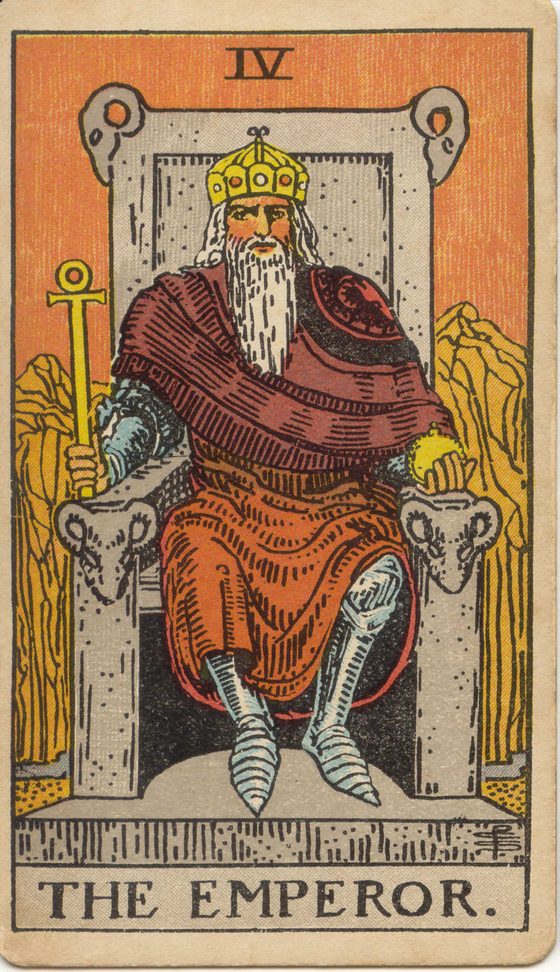
- The Emperor
Life Path 4
Life Path 4 is the number of the thing that holds. It describes a person who builds systems and trusts them, and it is honest that discipline and fear produce very similar behaviour from the outside.
- structure
- method
- endurance
- reliability
- rigidity
How the number is worked out
Add every digit of the birth date and reduce. For 12 January 1998 that is 1 + 1 + 2 + 1 + 9 + 9 + 8 = 31, then 3 + 1 = 4.
The other method reduces each part first. January is 1. The day 12 is 1 + 2 = 3. The year 1998 is 1 + 9 + 9 + 8 = 27, then 2 + 7 = 9. Then 1 + 3 + 9 = 13, and 1 + 3 = 4.
Both give 4, and for most dates they always will, since the order digits are added in cannot change the final single figure. The two methods only separate where one route lands on 11, 22 or 33 and is stopped there by convention. 13 September 1978 totals 38, then 11, and is usually kept; reduce the parts first and it gives 9 + 4 + 7 = 20, then 2. That matters here, because Life Path 22 is the master form of 4 and which method you use can decide whether you get it.
What the number describes
Life Path 4 is read as the number of structure: the person who builds the thing that other people later rely on without noticing. Process, systems, foundations, the unglamorous work that only becomes visible at the moment it is absent. Where 3 is described by output, 4 is described by durability.
What the reading actually points at is a preference for method over improvisation. A 4 wants to know how something will be done before agreeing that it will be done, and treats that as a precondition rather than a delay. This is genuinely valuable and it is also the source of every difficulty the number has, because the same instinct that produces a reliable system produces resistance to changing it once it exists.
The card given is The Emperor, trump IV, seated on a stone throne in a landscape with very little growing in it. Authority through structure rather than through force. Beside Life Path 8 the reading turns toward institutional power. Beside Life Path 5 it becomes the sharpest opposition in the set, one number wanting the exits open and the other wanting them documented. What the reading describes is where a person's attention settles, not the size of it.
What it does well
Finishing. A 4 will complete something after it has stopped being interesting, on a schedule, without requiring anybody to notice. Most of what functions in the world runs on this and very little of it is celebrated.
The second is building things that survive their author. The reading describes somebody who writes the process down, makes the system legible to the next person, and takes the extra week that saves five years. Alongside that comes an unusual tolerance for repetitive work, which is not the absence of imagination but a different allocation of it. None of this predicts security or success. It describes a set of tendencies the number is said to make available, and availability is the whole of the claim.
Where it goes wrong
The failure mode is mistaking the method for the point. A 4 builds a system that works, and then defends the system after the situation it was built for has changed, because dismantling it feels like admitting the original judgement was wrong. It usually was not wrong. It was just about a different year.
The second is contempt for improvisation. People who work quickly and untidily get read as unserious, and a 4 will underrate them consistently and be surprised by what they produce. Over time this narrows the room. The system calls it rigidity, which is accurate but incomplete: the rigidity is downstream of a belief that the alternative to structure is chaos rather than simply a different structure.
In relationships
The reading describes somebody who shows commitment through arrangements rather than declarations. The bills are paid, the appointments are remembered, the arrangements hold. That is a real form of love and it is regularly not received as one, because the person on the other side is listening for something spoken.
The specific difficulty is that a 4 can treat a relationship as a thing that has been established and therefore no longer requires attention, in the way a well-built wall does not. Relationships are not walls. Where the question is whether somebody else is committed, this number will not answer it. It describes how one person expresses commitment, and nothing at all about how another person receives it.
In work
Operations, engineering, law, accounting, logistics, trades, anything where the work is a system that has to hold under load. The reading fits the person who is trusted with the thing that must not fail, and it fits them across wildly different industries.
The practical difficulty is that this competence is quiet, and quiet competence is systematically under-promoted. A 4 will assume the work speaks for itself. It does not, and nobody in the building is going to explain that. Worth saying plainly: none of this recommends a field or a move. It describes a tendency, and the useful correction is to say out loud, once a quarter, what you have actually made work, because nobody else is tracking it.
In money
The reading associates 4 with steady accumulation, caution and long horizons. This is the number most often described as good with money, and that claim should be handled carefully: what is being described is a temperament, not a competence, and cautious people make expensive mistakes of their own kind.
Nothing here is financial advice. The observation worth keeping is that the described tendency, holding a plan after conditions change, is a specific risk in money rather than a protection against risk. Steadiness is only an advantage while the thing being held onto is still worth holding.
The lesson it keeps setting
The lesson 4 is said to keep setting is that a system is a means. It is built for a situation, the situation moves, and the work of noticing that is separate from the work of building.
Concretely, the recurring test is whether you can abandon something you constructed correctly, on the evidence that it is no longer needed, without treating the abandonment as a verdict on the original decision. Most people who read themselves as a 4 can name a process they are still running that nobody requires. The system calls it a lesson because the situation keeps recurring, which is a fair description of how habits behave rather than evidence that anything is arranging the recurrence.
The part people leave out
The popular reading sells 4 as dependable. What it leaves out is where the dependability often comes from. Structure is an excellent way to manage fear, and a life with enough systems in it never has to find out what happens without them.
The practical shape is control that presents as responsibility. The plan that must be followed, the way things are done, the visible discomfort when somebody deviates: all of it is defensible one instance at a time and adds up to something narrower than the person intended. Nothing here diagnoses anybody. It names the shape so it can be checked, which is more use than the flattering half of the description on its own.
How it meets other numbers
With 8 the system reads a working partnership of method and ambition, and the friction is about pace rather than direction. With 2 it reads as calm, because neither number is in a hurry and both prefer arrangements to arguments.
With 5 it produces the sharpest opposition available: one wants the plan agreed, the other wants the option kept open, and each reads the other's core competence as an obstacle. That pairing can work, but only where both people can say out loud what they are actually afraid of, which is rarer than the compatibility charts imply. With 3 the 4 finishes what the 3 starts and quietly resents it. These are tendencies, not matches, and the system has no way to see whether either person is generous.
In a personal year
A Personal Year is your birth month and day, each reduced, plus the reduced current year. For somebody born on 14 July, in 2026: July is 7, the day 14 is 1 + 4 = 5, and 2026 is 2 + 0 + 2 + 6 = 10, so 1. Then 7 + 5 + 1 = 13, and 1 + 3 = 4. That is a Personal Year 4.
A 4 year is read as the working year of the cycle: consolidation, admin, foundations rather than launches, and not much to show anybody. Read plainly, the interpretation is attached to a position in a repeating count of nine. It is a scheduling convention with a mood assigned to it, not a description of what a year contains.
Where the symbol comes from
Four is the first number that encloses space. Three points make a plane; four make a square, a room, a floor plan. The associations follow directly from that and are unusually literal: the four corners, the four walls, the four directions, the four elements of Greek natural philosophy. Where a symbolic system reaches for stability, it tends to reach for four.
Greek arithmology treated the tetrad as the number of material completeness, and the tetraktys, the triangular arrangement of ten dots that the Pythagorean tradition is genuinely associated with, has four rows. The planet given here is Saturn, which comes from a modern correspondence table and brings limitation and time along with it. The tarot pairing is The Emperor, trump IV, and the match is close: a seated figure, a stone throne, a barren landscape, and everything in the picture holding still.
Where this meaning came from
The Pythagorean attribution repeated at the front of nearly every numerology book has no support. Pythagoras wrote nothing that survives, and no ancient text ties him to a system read from a birth date. There is a real tradition of Greek arithmology, recorded by Nicomachus of Gerasa around 100 CE, and the tetraktys is genuinely Pythagorean, but neither one contains this method.
The method is early twentieth century and American. L. Dow Balliett published from 1903 onward, connecting numbers with letters and with vibration, and Juno Jordan, who studied with her, systematised it into the chart still in use, standardising Life Path, Expression, Soul Urge and the Birthday Number through the middle of the century.
There is also a detail specific to this number. The Life Path depends on the Gregorian calendar, introduced in 1582 and not adopted in Britain and its colonies until 1752, when eleven days were removed outright. Anyone born in that window has a birth date that was administratively reassigned. For a number about foundations, that is worth knowing.
The common misreading
The first misreading is that 4 means good with money. It is the most repeated claim about this number and it does not survive contact with what the number describes, which is caution rather than skill. A cautious person with no financial knowledge makes different mistakes from a reckless one, not fewer of them, and the reading gets used to justify decisions it cannot support.
The second is boring. Because the keywords are structure and method, 4 gets delivered as limited, and a person is told their strength is a ceiling. The reading is describing where somebody's attention goes, not how much of it they have.
The third is the inverse, and it is the one that does harm inside families and teams. The number gets used to justify inflexibility, as in I am a 4, this is how I do things. A description of a tendency is not a licence to keep it, and the people living with the consequences are usually clear about the difference even when the person quoting the number is not.
Questions to sit with
- Which of your systems is still running for a situation that ended?
- When did you last change a plan on somebody else's evidence rather than your own?
- Who around you works in a way you privately consider sloppy, and what have they finished lately?
- If the structure came down tomorrow, what specifically are you afraid would happen?
Work out your own number, both ways.