- Entry type
- Life Path
- Number
- 7
- Written form
- 7
- Planetary correspondence
- Neptune
- Element
- Water
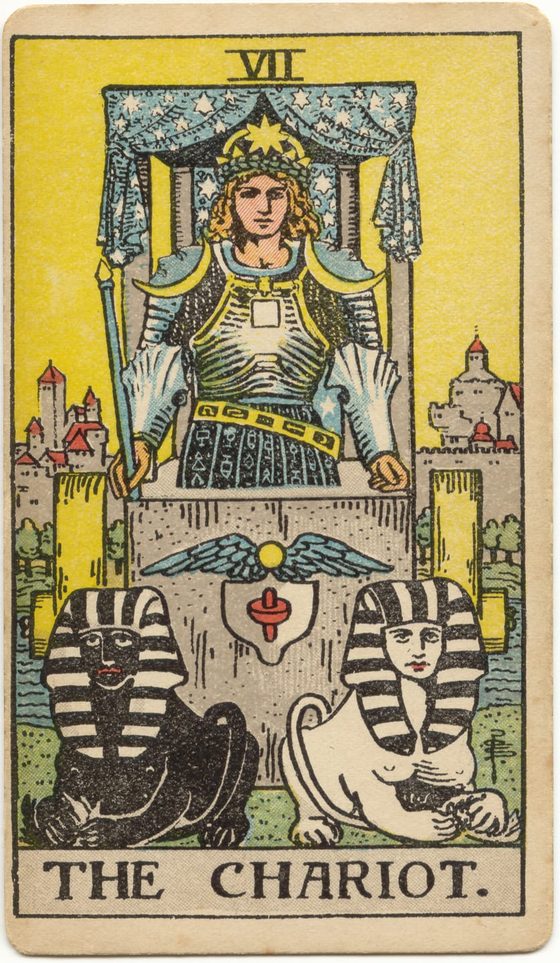
- Matching tarot card
- The Chariot
Life Path 7
Life Path 7 is the number of the person who needs to understand something before they can take part in it. It is honest that depth and distance are produced by the same habit of standing slightly outside.
- analysis
- solitude
- scepticism
- depth
- withdrawal
How the number is worked out
Add every digit of the birth date and reduce. For 17 July 1999 that is 7 + 1 + 7 + 1 + 9 + 9 + 9 = 43, then 4 + 3 = 7.
The other method reduces each part first. July is the seventh month, so 7. The day 17 is 1 + 7 = 8. The year 1999 is 1 + 9 + 9 + 9 = 28, then 2 + 8 = 10, then 1. Then 7 + 8 + 1 = 16, and 1 + 6 = 7.
Both give 7, and for most dates they always will, because changing the order in which digits are added cannot change the final single figure. The methods only diverge where one route lands on 11, 22 or 33 and stops there by convention. 13 September 1978 adds to 38, then 11, and is normally kept as a master number; reduce the parts first and the same date gives 9 + 4 + 7 = 20, then 2. Nothing in the tradition settles which is correct.
What the number describes
Life Path 7 is read as the number of analysis: the person who wants to understand a situation before agreeing to be inside it. Not caution exactly, and not shyness. A preference for knowing the shape of a thing first, and a marked discomfort with being asked to participate on trust.
What the reading describes is a habit of standing slightly outside. That produces the qualities the number is famous for, which are real: independence of judgement, resistance to whatever the room currently believes, and a willingness to sit with a question long past the point where other people have settled it. It also produces the cost, which is that the position outside becomes comfortable and then becomes permanent.
The tarot pairing is The Chariot, trump VII, and it does not fit at all, which is worth saying rather than smoothing over. The card is drive and control; the number is withdrawal and inquiry. Beside Life Path 4 the analysis turns practical and gets built. Beside Life Path 9 it turns abstract, and both numbers become very good at discussing what neither is doing. Beside Life Path 11, which some writers treat as the heightened form of this disposition, the same inwardness is read as vocation rather than avoidance.
What it does well
Not being carried by the room. A 7 will hold a position while everybody around them changes theirs, and will be unmoved by the fact that the pressure is social rather than evidential. That is uncomfortable to be near and extremely valuable to have present.
The second is patience with a difficult question. The reading describes somebody who will stay with something unresolved for months, who reads the source rather than the summary, and who is not embarrassed to say they have not decided. Alongside it sits a well-calibrated scepticism about claims, including this one. None of that predicts insight or expertise, both of which take work the number cannot supply. It describes an inclination, not an ability.
Where it goes wrong
The failure mode is knowing about a thing instead of doing it. A 7 can research a decision so thoroughly that the research becomes the activity, and can hold a very sophisticated account of a life they are not currently living.
The second is intellectualising feeling. Asked what they feel, a 7 will reliably answer what they think about what they feel, which is a different and much safer question. Over years this produces a person who is genuinely insightful about themselves and has changed almost nothing, and who mistakes the insight for progress. The system frames this as detachment, which understates it. The detachment is not from other people first. It is from their own situation.
In relationships
The reading describes somebody slow to enter a relationship and unusually loyal once inside one, on the reasoning that the assessment has already been done. That produces long, stable attachments and a partner who is sometimes waiting a very long time to be let in properly.
The specific difficulty is that a 7 experiences being asked for emotional detail as an intrusion rather than an invitation. What follows is a relationship in which one person is being studied and the other is being loved, and neither would describe it that way. Where the question is what somebody else feels, this number will not say. It describes one person's relationship to disclosure, which is real information about them and none about anybody else.
In work
Research, analysis, engineering, medicine, law, academia, anything where being right matters more than being quick and where solitary work is normal rather than suspect. The reading also fits people whose actual job is unrelated and who conduct a serious private study of something nobody at work knows about.
The practical difficulty is organisational. A 7 tends to be poor at the parts of a career that are social rather than technical, and to regard that as a matter of principle rather than a skill gap. Worth saying plainly: none of this recommends a field. The number knows nothing about your training, your circumstances or what work is available, and it is not a reason to avoid a job that requires talking to people.
In money
The reading associates 7 with modest needs, indifference to display and a tendency to under-manage money rather than over-manage it. Not frugality exactly, more an absence of interest that works fine until it does not.
Nothing here is financial advice. The observation worth keeping is that the described pattern, understanding a decision thoroughly and then not acting on it, applies to money as much as anything else, and inaction in finance is itself a position with consequences. If that sounds familiar, the correction is not more reading. It is setting a date by which the thing gets done.
The lesson it keeps setting
The lesson 7 is said to keep setting is that understanding is not the same as living. A complete account of a situation you are not in is a real achievement and it changes nothing about the situation.
Concretely, the recurring test is whether you can act while still uncertain, and tolerate the discomfort of having committed without a full picture. Most people reading themselves as a 7 can name a decision they have been researching for over a year. The system calls it a lesson because the situation keeps returning, which is how habits behave and not evidence of anything arranging the return. Nothing sets this test but the fact that decisions have deadlines whether or not you have finished thinking.
The part people leave out
The popular reading sells 7 as spiritual depth, and that framing does more damage than any other in this material. Withdrawal gets relabelled as wisdom, and a person who is lonely and hard to reach is congratulated on being an old soul.
The plainer version is that distance is protective. Standing outside a situation means never being wrong in front of anybody, never being obliged, and never having to find out whether you would have been included. Nothing here diagnoses anyone. It names the shape so it can be checked, because this particular number attracts a flattering interpretation that is very comfortable to accept and quite difficult to notice you have accepted.
How it meets other numbers
With 4 the system reads a working pair: one analyses, one builds, and both are content with long silences. With 9 there is genuine mutual understanding and a shared tendency to discuss rather than do, which can go on for years without either person minding.
With 2 the 2 does the emotional interpreting for both of them, which works until the 7 is asked to reciprocate. With 5 there is respect and no infrastructure, since neither wants responsibility for the ordinary running of things. With 3 the pairing is difficult in a specific way: the 3 experiences the 7's silence as withdrawal of approval. These are tendencies. Whether either person will say a hard thing out loud matters far more than any of them.
In a personal year
A Personal Year comes from your birth month and day, each reduced, plus the reduced current year. For somebody born on 21 March, in 2026: March is 3, the day 21 is 2 + 1 = 3, and 2026 is 2 + 0 + 2 + 6 = 10, so 1. Then 3 + 3 + 1 = 7. That is a Personal Year 7.
A 7 year is read as the inward stretch of the cycle: study, reassessment, less visible activity, a year that looks unproductive from outside. What is being described is the seventh position in a repeating count of nine, with a mood attached to the position. It is a scheduling convention, and it knows nothing whatever about your particular year.
Where the symbol comes from
Seven has more symbolic freight than any other single digit, and most of it comes from the sky. Seven classical planets were visible to the naked eye, which gave the seven-day week, and the number then attached itself to almost everything: seven seas, seven virtues, seven notes in a diatonic scale.
Greek arithmology treated the heptad as the virgin number, because within the first ten it neither produces another by multiplication nor is produced by one. That is a real arithmetical observation and it is the origin of the number's association with standing apart. The planet given here is Neptune, and it is worth pausing on that: Neptune was not discovered until 1846, so any correspondence using it is necessarily modern and cannot be part of an ancient tradition. The tarot pairing, The Chariot, matches by number only.
Where this meaning came from
The Pythagorean attribution attached to numerology does not hold. Pythagoras wrote nothing that survives and no ancient source links him to a birth-date method. Greek arithmology existed, recorded by Nicomachus of Gerasa around 100 CE, and the heptad genuinely carried the associations described above, but a philosophy of number is not a technique for reading a person.
The technique is early twentieth century. L. Dow Balliett published from 1903, tying numbers to letters and to vibration, and Juno Jordan systematised her work into the modern chart, standardising Life Path, Expression, Soul Urge and the rest through the middle of the century.
The Neptune assignment settles the question on its own. A system that gives this number a planet discovered in 1846 cannot have been handed down from antiquity, whatever the introduction says. Some of the number lore here is genuinely two thousand years old. The reading that says it describes your personality is roughly a century old, and the correspondence table it sits in is younger than the telephone. Knowing which layer you are reading is most of what separates this from the sites that repeat all three as one tradition.
The common misreading
The first misreading is treating 7 as a spiritual credential. It gets delivered as the seeker, the mystic, the one with access, and a person walks away flattered and no better informed. The number describes a preference for analysis. That is compatible with being devout, with being an atheist, and with simply being someone who likes reading, and the reading cannot tell those apart.
The second is confusing withdrawal with wisdom by default. Sitting outside a situation sometimes produces a clearer view and sometimes produces an uninformed one, and the difference depends on whether anybody checked. The system supplies no way to check, which is exactly why the flattering version is the one that circulates.
The third is the permission slip. I am a 7, I need my solitude, offered where somebody was expecting to be told something. A tendency is not an entitlement, and the people waiting to be let in generally know which of the two they have been handed.
Questions to sit with
- What decision have you been researching for more than a year, and what would finish it?
- When somebody last asked what you felt, what did you actually answer?
- Which of your positions have you tested against a person who disagrees, rather than against a book?
- Is your solitude something you chose this week, or something you defaulted into some years ago?
Work out your own number, both ways.