- Entry type
- Core Number
Soul Urge Number
The Soul Urge Number, sometimes called the Heart's Desire, is calculated from the vowels of the birth name alone. It claims to describe what a person actually wants, as distinct from what they can do.
- desire
- motivation
- wanting
- inwardness
- satisfaction
How the number is worked out
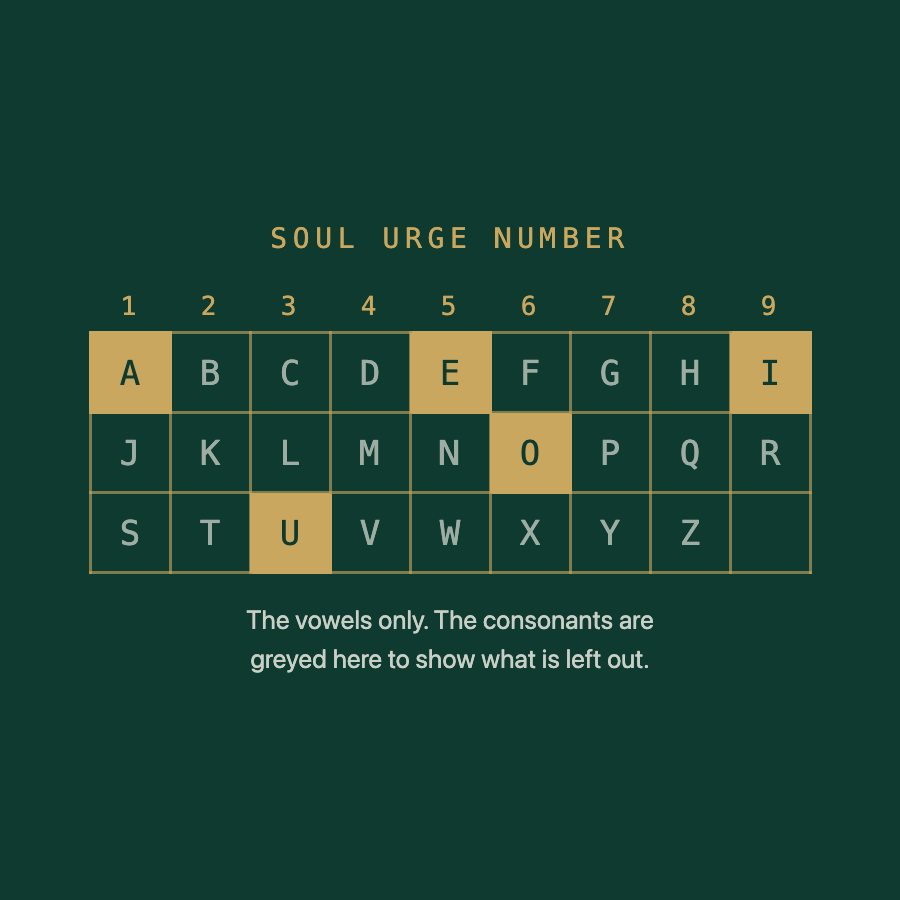
Use the same letter values as the Expression Number and take the vowels only. In the standard grid A is 1, E is 5, I is 9, O is 6 and U is 3.
Take the full name exactly as given at birth. For John Smith the vowels are O and I. O is 6 and I is 9, so the total is 15.
Reduce: 1 + 5 = 6. John Smith has a Soul Urge Number of 6, and Life Path 6 covers what the tradition attaches to that digit.
The unsettled part is Y. Some practitioners count it always, some never, and some only where it does the work of a vowel, so that the Y in Lynn counts and the Y in Yolanda does not. The three conventions give different answers for a great many names and no authority settles it. Anybody calculating this should decide which rule they are using and say so, because a calculator that stays silent has made the decision on your behalf.
What the number describes
The Soul Urge Number is calculated from the vowels of the birth name and read as motivation: what a person wants, what satisfies them, and what they would move toward if nothing were in the way. Its other common name, the Heart's Desire, states the claim more plainly than the first one does.
It is the most private of the four core numbers and the one practitioners treat as least visible from outside. The Personality Number, calculated from the consonants of the same name, is explicitly its opposite: what other people meet. The Expression uses every letter and is read as capacity, and the Birthday Number comes from the date instead. Between them the name-based three divide one name into want, appearance and equipment.
The rationale for using vowels is worth stating because it is so rarely examined. Vowels are the sounds that carry the voice, with consonants shaping and interrupting them, so the tradition assigns vowels to what is inward and consonants to what is presented. That is a pleasing analogy rather than an argument, and it does not become one by being repeated. The method has never been shown to measure anything. What it does well is force a person to name what they want in specific terms, and it is also the core number readers most want to be handed, which is worth holding in mind while reading whatever it returns.
What it does well
What the method is genuinely good for is the question it makes unavoidable. Most people can describe what they are good at and what they do. Considerably fewer can say plainly what they want, and this exercise does not let anybody leave that blank.
The vowel restriction also uses fewer letters and therefore produces a coarser result, which is an advantage here rather than a defect. A wanting described in nine broad categories is easier to sit with than one described precisely, because precision invites arguing about the description instead of about the want.
It also pairs usefully. Read alongside the Expression, the Soul Urge turns a self-description into a comparison, and comparisons are where this material earns its keep.
Where it goes wrong
The Y problem is the method's most serious weakness, and it is structural rather than incidental. Three conventions are in circulation, they disagree for a large share of names, and no source resolves the question. A method whose answer depends on an undeclared convention is not producing a fact about anybody.
The second weakness is shared with the whole scheme: the birth name requirement, which fails for adoption, for transliteration, for misrecorded certificates, and for anybody whose name changed early. There is also no agreed treatment of names in languages that do not write their vowels the way English writes them, a case the method simply does not address.
The third is the reading itself. Nine descriptions of what a person might want, each drawn broadly enough to be recognisable, and the reader locates themselves in one. Recognition feels like confirmation and is not the same thing.
In relationships
In relationships the Soul Urge is the core number practitioners reach for most, since desire is the obvious subject. It is read as what a person is actually looking for, which is frequently not what they say they are looking for and occasionally not what they have noticed.
The useful version of the exercise is comparative and private: work out your own, then ask whether the life you have arranged serves it. The version practitioners run least often, and the one worth running, is the historical comparison: what you wanted ten years ago set against what you would say now. The unhelpful version is calculating a partner's and treating the result as information about them. A name cannot establish what somebody wants, still less what they will do.
In work
At work the Soul Urge is the number that explains dissatisfaction in a job which looks fine on paper. It describes what a person wants from work rather than what they are able to deliver, and those two come apart routinely.
The productive move is to set it against the Expression. Where the two agree, the tradition reads a working life that feels coherent. Where they disagree, it reads the specific and very common situation of somebody competent at work they do not want. Practitioners describe that result as competence without appetite, which is a recognisable and slow-moving kind of unhappiness, and it is a real pattern whatever one makes of the method that surfaced it.
Neither number forecasts anything, and no calculation from a name indicates what job anybody should take.
In money
The Soul Urge describes what money is wanted for rather than any relationship to money itself: security, freedom, standing, the ability to help other people, or simply not having to think about it.
That is a genuinely useful question, and most people have never answered it explicitly, which is why financial decisions so often optimise for a target nobody actually set. The related observation is that a want left unstated tends to get met expensively and indirectly, because nobody has priced the actual thing. Naming the want is the whole contribution here. It is not financial advice, it indicates nothing about anybody's circumstances, and numerology is not in a position to offer guidance on money.
The lesson it keeps setting
The lesson the method sets is admitting the want. The Soul Urge is calculated from the least visible letters of a name, and the tradition's consistent claim is that the corresponding desire is the one a person is least willing to state, usually because stating it would require doing something about it.
The second half of the lesson is proportion. A want named accurately is easier to meet in small ways, and the pattern practitioners describe is somebody who treats their desire as an all-or-nothing proposition and therefore never addresses any part of it.
Neither of those requires the arithmetic to be valid. They are what the exercise reliably surfaces, which is a different and much more defensible claim.
The part people leave out
The part popular writing leaves out is that the Soul Urge is the easiest core number to flatter somebody with. Descriptions of what a person deeply wants are received uncritically, because almost nobody is inclined to argue that their own desires have been described too generously.
The second omission is the convention problem, which goes undisclosed exactly where it matters. A reader who calculates their Soul Urge on two sites and gets two answers will usually assume one of them is broken, when in fact both may be following defensible rules about Y and neither has mentioned that a rule was involved.
Where the symbol comes from
The vowel and consonant split is the one piece of reasoning the modern system offers for why a particular set of letters should mean anything, and it deserves a closer look than it usually gets.
Vowels are voiced continuously and carry the breath; consonants interrupt, shape and stop it. From that the tradition draws the analogy that vowels are the inner sound of a name and consonants its outer form, and assigns them to desire and to appearance accordingly.
It is a good analogy. It is also entirely an analogy, and the older gematria traditions it is loosely modelled on made no such distinction. Hebrew was written without vowels for most of its history, which makes a vowel-based inner meaning difficult to derive from that source. The split is a twentieth-century idea inside a system that presents itself as much older.
Where this meaning came from
The Soul Urge belongs to the same early twentieth-century scheme as the rest of modern numerology. L. Dow Balliett set out the letter-to-number correspondence in books published from about 1903, and Juno Jordan systematised the material into the four core numbers now in general use. Heart's Desire is the older of the two labels; Soul Urge became common later.
Balliett's own framing was explicitly about vibration. She treated numbers, letters, colours and musical tones as expressions of one underlying quantity, and the language of vibration survived into modern practice long after that theory was quietly dropped.
The attribution to Pythagoras has no textual support and cannot have any, since the system maps the modern English alphabet. It is a claim added during the practice's commercialisation and now repeated almost universally.
The vowels-as-inner idea does not appear in the gematria traditions modern numerology gestures at. Hebrew gematria assigns values to consonantal letters, and the vowel points that later appear in the written language are not part of the numerical scheme at all. The division is therefore original to the modern system rather than inherited, which is worth knowing precisely because it is presented as ancient.
The common misreading
The commonest misreading of the Soul Urge is treating it as a discovery. The output is a number derived from two or three letters of a name by an arbitrary mapping, and it cannot tell anybody what they want. What it can do is make somebody articulate a want in order to check it against the description, and the articulation is the part carrying any value.
The second is calculating it for somebody else. This is the core number most often run on a partner, and it produces confident statements about another person's private motivations from the spelling of their name. Nothing supports that, and it is the kind of claim that damages a relationship whether or not it happens to land.
The third is the undeclared Y. Any calculator returning a Soul Urge without stating its convention has made a decision that changes the answer for a large share of names. If two sources disagree about your number, the likeliest explanation is not that one is broken but that they are following different rules, and neither mentioned there was a rule.
Questions to sit with
- What do you actually want, stated in one sentence and without justification?
- When did you last say that out loud to another person?
- Does the life you have arranged serve it, or something adjacent to it?
- What small version of the want could you meet this month?
Work out your own number, both ways.