- What it is worked out from
- Any reduction
Master numbers
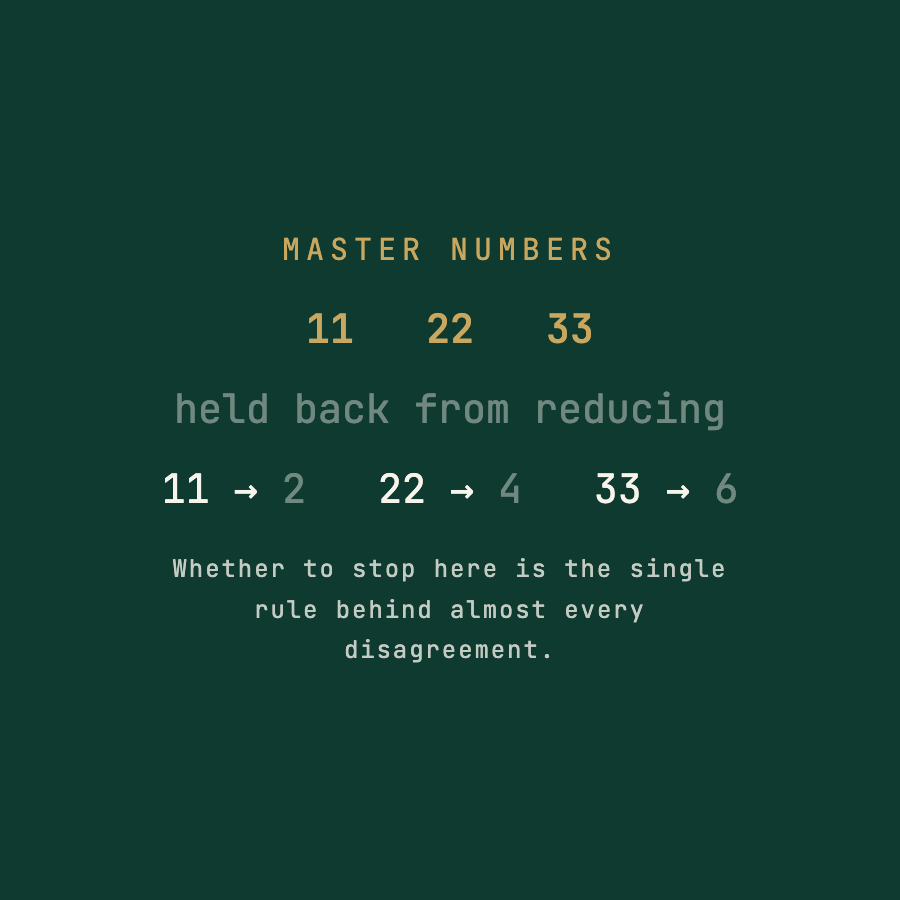
Eleven, twenty-two and thirty-three are held back from reducing, which makes them the only numbers in the system with a special rule. That rule is also the sole reason two standard methods can disagree about a birth date.
- master numbers
- eleven
- twenty-two
- thirty-three
- reduction rule
How the number is worked out
The rule is stated simply and applied inconsistently. When a reduction reaches 11, 22 or 33, you stop rather than reducing to 2, 4 or 6. Everything else reduces all the way down to a single digit.
The complication is where the rule applies. Most practitioners apply it at every stage of a reduction, so a year that reaches 22 stops at 22 and enters any subsequent addition as 22. Some apply it only to the final answer. Those two conventions produce different results, and neither is more standard than the other.
Then there are calculations where the rule is switched off entirely by convention. The personal year is the clearest case: it is a cycle position rather than a character reading, and it runs 1 to 9 and returns to 1, so a master number would break the cycle. This tool reduces personal years past 11 and 22 without stopping, and the output is always a single digit.
The Life Path, the Expression, the Soul Urge and the Personality are all normally read with masters held. The birthday number is usually held too. The personal year is not. Nobody wrote that distinction down as a principle; it is simply what the practice settled into, and the practical rule is to check what any given calculator does rather than assume.
A worked example
Watch a master number appear and then fail to survive.
Take 4 January 1950. By the component method the parts reduce to 1, 4 and 6, which sum to 11. Eleven is a master, so the reduction stops there and the Life Path is 11.
Take the same date by all digits: 1 + 9 + 5 + 0 + 0 + 1 + 0 + 4 = 20, which reduces to 2. No master ever appears, because the running total never passes through 11, 22 or 33. The Life Path is 2.
The two answers are 11 and 2, and 11 reduces to 2. That is not a coincidence, and it holds for every disagreement between the methods.
Now watch masters appear and cancel. 29 November 1961. By components, November is 11 and holds, the 29th reduces to 11 and holds, and 1961 gives 17 and then 8. The sum is 11 + 11 + 8 = 30, which reduces to 3. Two master numbers survived their intermediate reductions and neither reached the answer.
By all digits the same date totals 30 and gives 3 as well. Two masters in the calculation, no master in the result, and complete agreement between the methods. The presence of a master mid-calculation tells you nothing about whether one will come out at the end.
Where the schools disagree
Master numbers are not merely involved in the disagreement between the two Life Path methods. They are the entire cause of it.
The tool was tested across 20,496 birth dates, every date from the first to the twenty-eighth of each month from 1950 to 2010. The two methods returned different Life Paths for 2,756 of them, which is 13.4 per cent. Every one of those 2,756 involves 11, 22 or 33 on one side or the other. Not a single disagreement is between two ordinary digits.
The arithmetic behind that is worth setting out, because it turns an observation into a proof. Repeated digit-summing has a property mathematicians call the digital root: the digital root of a sum equals the digital root of the sum of the parts' digital roots. Whether you add all the digits of a date at once or reduce the month, day and year first and then add, the fully reduced answer is the same. Always.
So without the master rule the two methods could not disagree, and they do not: run both over two centuries of dates with masters switched off and the mismatch count is zero. The master rule is the only thing that breaks the equivalence, because it stops a reduction early and leaves a number nine, eighteen or twenty-seven larger than its reduced form, and multiples of nine are invisible to a digital root.
The consequence is that the whole 13.4 per cent turns on whether a total happens to land exactly on 11, 22 or 33 in one procedure and not the other. The commonest split is 33 against 6, 1,053 times in the test range. Then 11 against 2, 758 times. Then 4 against 22, 496 times, and three smaller pairs after that.
What the number is said to describe
A master number is conventionally read as the same underlying digit at a higher pitch: 11 as a more demanding 2, 22 as a more demanding 4, 33 as a more demanding 6. The standard framing is potential with a cost attached, and it is worth noticing how well that framing insulates itself. If the person is doing well it is the master number; if not, it is the master number's difficulty.
The practical advice is duller and more useful. Read the reduced number first. If you are an 11, read Life Path 2 and see how much of it fits before you read the 11 material at all. The master reading is an intensifier on top of a base, and people who skip the base end up with a description made entirely of superlatives.
And check whether your master is stable. If the two methods split on your date, you are a master by one procedure and an ordinary digit by the other, and there is no fact of the matter to settle it.
One more practical point. If you are using a calculator that does not show its working, you cannot tell which convention it applied, and the two conventions differ often enough to matter. A tool that prints the intermediate steps is not being pedantic; it is the only way to know what you have been given.
Where this method came from
Master numbers are a twentieth-century addition to a twentieth-century system, and they did not all arrive at once.
Eleven and twenty-two come out of the early American numerology literature. L. Dow Balliett's books from around 1903 and the systematisation by her student Juno Jordan established the framework, and the two higher numbers were treated as special within it from early on, carrying the vibration-theory language that the whole system was built with.
Thirty-three arrived later and is still contested. A good many practitioners hold that only 11 and 22 are true masters and that 33 is a modern inflation; others accept 33 and stop there; a smaller group extends the series to 44 and beyond, which most of the field regards as unserious. There is no authority that could settle any of this, because there is no earlier source to appeal to.
The Pythagoras attribution that appears on so many covers does not help here either. Nothing in the Pythagorean record singles out 11, 22 or 33, and nothing in it reduces birth dates. The master numbers are an internal development of a system roughly a hundred and twenty years old, and their inconsistent application is what you would expect of a convention that grew rather than one that was designed.
The common misreading
The first misreading is that a master number is better. The literature does not quite say that and the readings do not quite avoid it. In practice people are told they have exceptional potential and a heavier burden, which is a description that cannot fail. Roughly one date in six produces an 11, 22 or 33 by the all-digits method, so this is not a rare distinction being handed out.
The second is treating a master as fixed. Given how much of the 13.4 per cent disagreement lands on exactly this question, a substantial number of people who have been told they are 11s or 33s are 2s and 6s under a procedure that is just as standard. If a designation can be removed by switching between two ordinary methods, it is a convention rather than a property.
The third is applying the rule where the practice does not. Personal years are not read as masters, and a calculator that returns an 11 for a personal year has applied the wrong convention rather than found something unusual. Compare Life Path 33, the most recently invented of the three and the one where the inflation is easiest to see.
Questions to sit with
- Does your birth date produce a master number under one method, both, or neither?
- If you have been told you are an 11 or a 33, do you know which method produced it?
- When you read the master description, how much of the reduced number's description also fits?
- Would you have accepted the reading as readily if it had come out as an ordinary digit?
Run your own date through both methods.