- What it is worked out from
- A birth date
The component method
Reduce the month, the day and the year separately, add the three results, then reduce once more. It is the older of the two methods in print, and it is the one that can stop at a master number partway through.
- component method
- partial reduction
- master numbers
- life path
- birth date
How the number is worked out
Three reductions, then a fourth. Reduce the month on its own. Reduce the day on its own. Reduce the four-digit year on its own. Add those three single figures together and reduce the total.
Months are easy: eleven of the twelve are already single digits or reduce in one step. November is the interesting one, because 11 is a master number and stays 11 under the standard rule. December reduces to 3.
Days run from 1 to 31. Most reduce in a single step. The eleventh and the twenty-second stop as masters, and the twenty-ninth reduces to 11 and stops there too.
Years take two steps as a rule. 1988 gives 26, and 26 gives 8. 1993 gives 22, which is a master and stops. Years that land on 11, 22 or 33 on the way down are the ones that make this method behave differently from the other.
Then add and reduce. The final total is often larger than the all-digits total for the same date, because master numbers held back at the intermediate stage carry more weight into the final sum than their reduced forms would.
One detail decides everything. The master-number rule is applied at every stage, not only at the end. A year that reduces to 22 stops at 22, and 22 then enters the final addition instead of 4. That single choice is the whole difference between the two methods. Strip the rule out and reduce everything to a single digit throughout, and the two procedures agree on every date without exception, because repeated digit-summing gives the same answer whether you sum the parts first or the whole at once. The master numbers are the only thing that breaks that equivalence.
A worked example
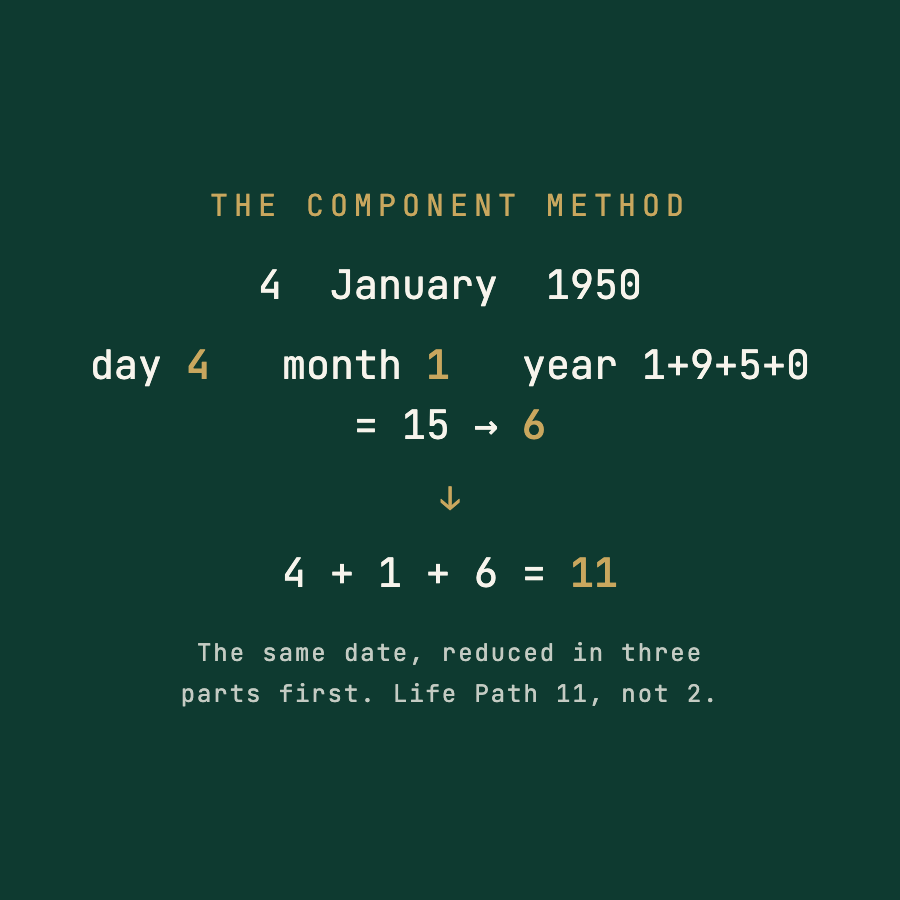
4 January 1950 again, because it is the cleanest split.
The month is January, 1. Already a single digit, nothing to do.
The day is the 4th. Also already single.
The year is 1950. 1 + 9 + 5 + 0 = 15. Fifteen is not a master, so continue: 1 + 5 = 6.
Add the three: 1 + 4 + 6 = 11. Eleven is a master number, so the reduction stops. The component Life Path is 11.
The all-digits method takes the same date, adds its eight digits to get 20, and reduces to 2. The two answers are 11 and 2, and 11 reduces to 2, which is the relationship every one of these splits has.
A second example, going the other way. 29 November 1961. By components: November is 11 and stops as a master; the 29th gives 11 and stops; 1961 gives 17 and then 8. Add: 11 + 11 + 8 = 30, and 3 + 0 = 3. By all digits: the same eight digits also total 30, and 3. Both give 3, despite two master numbers appearing mid-calculation, because swapping a master for its reduced form shifts a total by a multiple of nine and leaves the final digit alone.
Where the schools disagree
This method is often described as the one that preserves master numbers, and the description is half right in a way that is worth pinning down.
It does preserve them mid-calculation. A November birth keeps 11 as its month value; the 22nd keeps 22 as its day value; a year like 1993 keeps 22. Those intermediate masters then enter the final sum at full weight, which the all-digits method never lets them do, because it flattens the whole date into one addition before any reduction happens.
But preserving them along the way does not mean producing them at the end, and on the tested range it produces fewer. Across the 20,496 dates from 1950 to 2010, the component method returned a master Life Path for 10.5 per cent of dates. The all-digits method returned one for 17.5 per cent. The commoner claim, that this is the master-preserving method, is not supported by the arithmetic.
The two methods disagreed on 2,756 of those 20,496 dates, or 13.4 per cent. Every disagreement involves a master number, and the direction is uneven: the component method loses a 33 that all-digits keeps 1,053 times, and loses an 11 that all-digits keeps 758 times, while it gains a 22 that all-digits misses 496 times.
The reason is structural and rather neat. Swapping a master number for its reduced form always changes a total by a multiple of nine: 11 against 2 is nine, 22 against 4 is eighteen, 33 against 6 is twenty-seven. Adding nine never changes a digital root. So the two methods can only ever differ in whether the final total lands exactly on 11, 22 or 33, never in which ordinary digit it reduces to. That is why every one of the 2,756 disagreements involves a master, and why the two would agree on every date if the master rule were dropped. Compare Life Path 6, which absorbs most of the 33s this method declines to keep.
What the number is said to describe
If you use this method, say so, and be ready for the answer to differ from whatever an app told you. The component result is the one more likely to be an ordinary number where the other gives a master, which some people find deflating and which is not a reason to switch.
The intermediate values are worth keeping rather than discarding. A person born in November, or on the 11th or 22nd, carries a master number inside the calculation even when the final Life Path is ordinary, and several traditions read those intermediate figures in their own right: the month value, the day value, the year value. The tool prints all three.
Where the two methods split on your date, the useful move is not to pick the flattering one. It is to read both and notice which parts of each you accept. Compare Life Path 22 against Life Path 4, the pair that splits most often in this method's favour.
Where this method came from
The component method is the older of the two in print, though only by a matter of decades, because the whole system is younger than it advertises.
Modern Western numerology was assembled in the United States in the first decades of the twentieth century. L. Dow Balliett, publishing from around 1903, supplied the letter values and the character meanings. Juno Jordan, her student, organised the material into the form that circulates today, and her mid-century work is where much of the standard procedure is fixed.
In that early literature the calculation is generally set out part by part: reduce the month, reduce the day, reduce the year, add. It reads as the natural way to do it by hand, which is probably why it came first. The all-digits shortcut spread later and is now dominant in popular books and apps, largely because it is a single addition and easier to automate.
The attribution to Pythagoras, which appears on the cover of a great many of these books, has no textual support. The Pythagoreans held that number underlies reality; they left nothing that assigns a character to a person born on a particular date. The label was attached to give a recent American system an ancient Greek pedigree, and it has stuck so thoroughly that the actual authors are rarely named.
The common misreading
The first misreading is the one this page has already had to correct: that the component method preserves master numbers more often. It preserves them during the calculation and produces them less often at the end, 10.5 per cent of dates against 17.5. Both halves of that are worth knowing, and the second half is almost never stated.
The second is that reducing the parts separately is somehow more careful or more traditional in a way that makes it more accurate. It is older in print by a few decades. That is a fact about publishing history, not about correctness, and there is no sense in which either arrangement of the same addition could be the true one.
The third is treating an intermediate master as though it were the answer. A November birth has 11 in the month position; that is not a Life Path of 11 and quoting it as one is simply an error in the procedure. If your final total does not land on 11, 22 or 33, your Life Path is not a master number by this method, whatever appeared along the way. Compare Life Path 2, which is where a great many nearly-11s end up.
Questions to sit with
- What do your month, day and year reduce to on their own?
- Did a master number appear at any intermediate stage, and did it survive to the end?
- If this method gives you a different number from the one you have been using, which had you already told people?
- Are you choosing between the two methods on evidence, or on which answer you prefer?
Run your own date through both methods.