Every few years an article goes around announcing that astrology has been wrong all along, because the Sun is not in the constellation your birthday says it is. The observation is correct. The conclusion does not follow, and the reason why is worth understanding whatever you think of astrology.
The short version: the tropical zodiac used in Western astrology is not a map of the constellations and has not claimed to be for a very long time. It is a map of the seasons. The two coincided once, drifted apart, and the drift is measurable to a fraction of a degree.
Two different questions
There are two reasonable ways to say where the Sun is.
You can measure it against the stars: the Sun is in front of this group of stars rather than that one. That is the sidereal frame, and it is what the word zodiac originally described, a belt of constellations along the Sun's apparent path.
Or you can measure it against the seasons: the Sun is this far past the point where it crossed the celestial equator going north. That crossing is the March equinox, the moment day and night are of equal length and the northern spring begins. That is the tropical frame, and it takes the equinox as its zero.
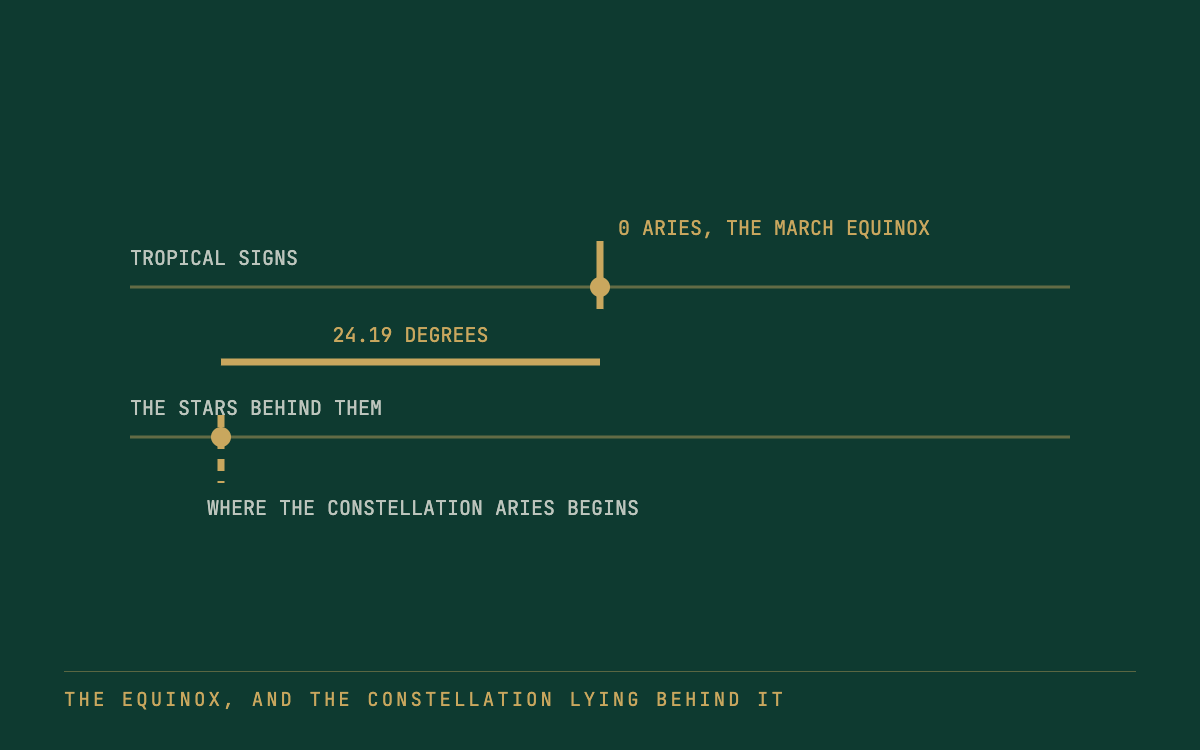
Western astrology uses the second. Aries begins at the March equinox by definition, not by observation. Run the site's ephemeris for the equinox moment in March 2025 and the Sun's tropical ecliptic longitude comes out at 359.9997 degrees, which is zero to within a rounding error. It is zero because zero is where we put it.
What precession does
Earth's axis is tilted by about 23.4 degrees, and it does not hold still. It traces a slow cone, the way a spinning top wobbles, driven by the gravitational pull of the Sun and Moon on Earth's equatorial bulge. One full circuit takes roughly 25,800 years.
Because the equinox is defined by the axis, the equinox point slides westward along the ecliptic as the axis wobbles. The rate is about 50.3 arcseconds a year, which is one degree roughly every 72 years, or about thirty degrees, a full sign, every 2,150 years.
Hipparchus noticed this in the second century before the common era by comparing his own star positions with older Babylonian records. It is not a modern discovery, and it was not hidden from the people who built the astrological tradition. Ptolemy discusses it in the second century of the common era, in the same body of work that fixed the tropical convention.
The gap, measured
The two frames were aligned somewhere around the early centuries of the common era, which is when the tropical convention was formalised. They have been separating ever since at the precession rate.
The gap has a name, the ayanamsa, and it can be computed. One standard way is to anchor it to the star Spica, which the Lahiri convention places at exactly 180 degrees of sidereal longitude. Feed Spica's position through the site's ephemeris and the difference between its tropical longitude and 180 degrees gives the gap directly: 22.45 degrees in 1900, 23.15 in 1950, 23.84 in 2000, and 24.19 degrees in 2025. It grows by about a degree every seventy years, which matches the precession rate to within the precision of the method.
Running that trend backwards puts the moment the gap was zero somewhere in the late third century of the common era. Different ayanamsa conventions place it anywhere across several hundred years, and that spread is itself informative: the sidereal zero point is a choice about where to anchor, not a measurement everyone can agree on.
So the practical answer to how far apart the two zodiacs currently sit is a little over 24 degrees, or four-fifths of a sign. Someone born in the last few days of tropical Taurus is, sidereally, an Aries.
The constellation claim checks out too. At the March 2025 equinox the Sun sits at right ascension zero and declination zero, and running those coordinates against the International Astronomical Union's constellation boundaries puts it in Pisces. Zero degrees of tropical Aries is currently in the constellation Pisces, and has been for around two millennia. That is exactly the fact the debunking articles report, and it is true.
Why neither is the correct one
What the articles get wrong is the inference. A measurement is not wrong for failing to measure something it is not measuring.
If the tropical zodiac claimed to tell you which stars the Sun is in front of, the 24-degree gap would refute it immediately. It does not claim that. It claims to tell you how far the Sun has travelled since the spring equinox, and it does that with complete accuracy, because the equinox is its definition. A tropical chart is a seasonal instrument. It says where in the solar year a moment falls.
The sidereal zodiac, used in Indian astrology and by a minority of Western practitioners, does track the stars, and it does that accurately too. It has its own difficulty, which is that there is no single agreed ayanamsa: the Lahiri value is the most widely used, but several others are in circulation and they differ by a degree or more, which is enough to move a birth near a sign boundary from one sign to another.
So there are two frames, each internally consistent, each answering a different question, and neither is the correct one in the sense the argument usually demands. Asking which zodiac is right is like asking whether a thermometer or a barometer is the correct instrument. It depends what you want to know.
What this does and does not license
Being clear about this cuts in both directions, and it is worth saying both halves.
It defends astrology against a bad objection. The constellation argument is not a refutation of Western astrology, because Western astrology is not making the claim being refuted. Anyone who uses it as a knockdown has not read what the tradition says about its own coordinate system, which has been in print since Ptolemy.
It does not defend anything else. Establishing that the tropical zodiac accurately measures seasonal position tells you nothing about whether seasonal position at birth relates to personality or events. That is a separate claim, it has been tested repeatedly, and it has not been supported. The coordinate system being coherent is a precondition for the astrology being true, not evidence that it is.
There is also a modest and genuine point on the astrological side. If the tropical zodiac measures the seasons, then a tropical chart is partly a statement about the time of year someone was born, and time of year is not astrologically inert as far as the evidence goes. Season of birth has documented associations in the research literature with a handful of physical and health outcomes, through mechanisms like maternal vitamin D and infectious exposure, and those effects are small and reverse between hemispheres. That is a real seasonal signal. It is not the one astrology describes, it does not carry the meanings the signs carry, and it works in the opposite direction below the equator, which the tradition does not accommodate. But it does mean the frame is attached to something physical rather than to nothing at all.
The honest summary is narrow and worth keeping. The tropical zodiac is an accurate seasonal coordinate system, the sidereal zodiac is an accurate stellar one, they are currently about 24 degrees apart and separating by a degree every seventy years, and choosing between them is a choice about which question you are asking. Everything past that is a different argument, and it should be had on its own terms rather than settled by a fact about chart geometry.