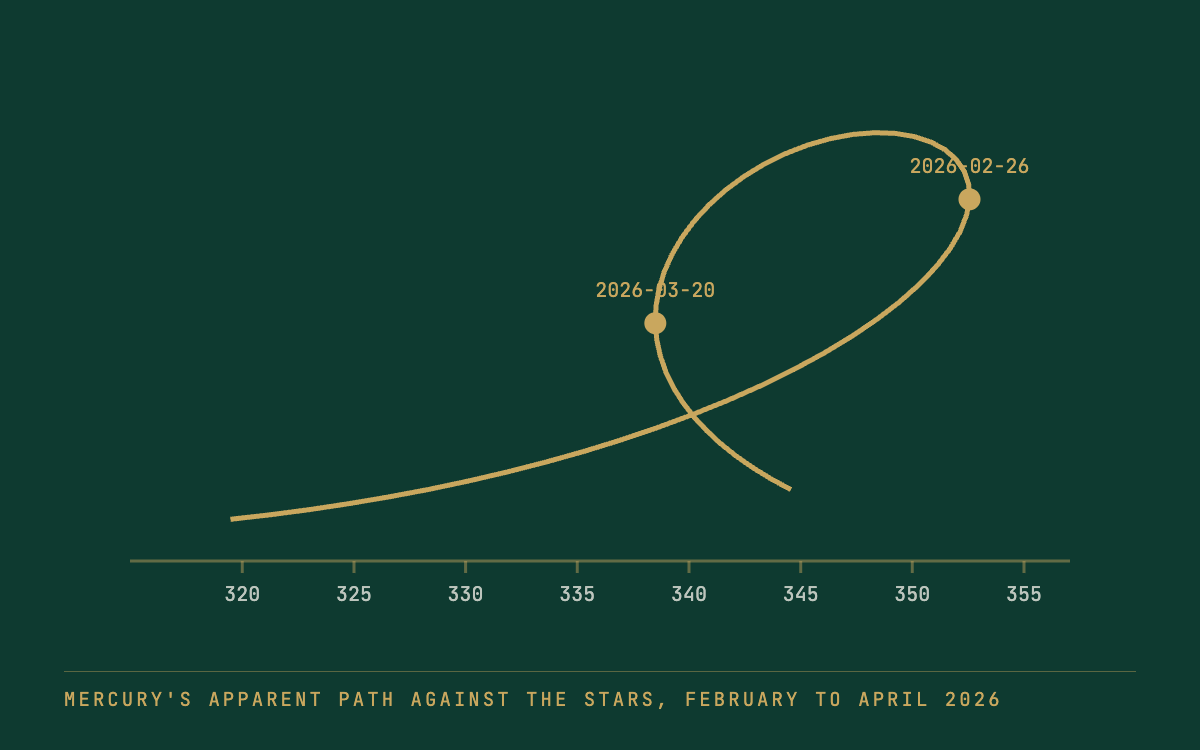
Three or four times a year, Mercury appears to stop, reverse, travel backwards against the fixed stars for about three weeks, stop again and resume. The appearance is real and you can photograph it. The reversal is not.
This piece does two things. It sets out what the planet is actually doing, using the same ephemeris that drives the chart calculator on this site. Then it takes the astrological convention seriously enough to say precisely what kind of claim it is, which is more interesting than either dismissing it or repeating it.
What is actually happening
Mercury takes 87.97 days to go round the Sun. Earth takes 365.26. Mercury is the faster body and it is on the inside track, which means Mercury laps us, roughly three times a year.
Picture overtaking a slower car on a motorway. As you draw level and pass, the other car appears to slide backwards relative to the landscape behind it, even though it is still moving forwards at seventy miles an hour. Nothing about the other car changed. Your line of sight to it swung round as you went past.
That is the whole mechanism, and the geometry confirms it. Take the middle of the retrograde period in March 2025. Mercury sits about four degrees from the Sun in the sky and 0.599 astronomical units from Earth, which is close to the nearest it ever gets. It is passing between us and the Sun. Two months later, in late May, Mercury is again about four degrees from the Sun, but the distance is 1.315 astronomical units. Same apparent position, more than twice as far away, on the far side of the Sun, and moving in the normal direction.
So retrograde motion is not a property of Mercury. It is a property of the angle between two moving observers, and it happens at the point in the cycle where Mercury is nearest to us and overtaking. The same effect produces retrograde loops for Mars and Jupiter, except that there the roles swap: those planets are slower and further out, so Earth does the overtaking.
How often, and for how long
These are countable, so it is worth counting them rather than repeating a figure. Running the site's ephemeris across every six-hour step from 2000 to 2030 and looking for intervals where Mercury's apparent ecliptic longitude decreases gives a clean answer.
Mercury turned retrograde 98 times in those thirty-one years. That is three times in most years and four in a handful: 2003, 2009, 2016, 2022 and 2029 each had four, and every other year in the span had three. The mean is 3.16 per year.
Each period runs between 19.5 and 24 days, averaging 22.0. Adding them up, Mercury is retrograde for a little over nineteen per cent of the time. Roughly one day in five, permanently, forever. That is worth sitting with before attributing a bad week to it.
For the current run: in 2025 the periods were 15 March to 7 April, 18 July to 11 August, and 10 to 29 November. In 2026 they fall on 26 February to 20 March, 30 June to 24 July, and 24 October to 13 November.
Why sources give different dates
Look up the same retrograde in three places and you may get three date ranges. The disagreement is usually not error but a difference in what is being reported.
The retrograde proper runs between the two stations, the moments when apparent motion changes sign. For March 2025 the ephemeris puts those at 15 March, with Mercury at 9.59 degrees of ecliptic longitude, and 7 April, at 356.83 degrees. Twenty-three days.
Many astrologers also count the shadow: the stretch before the first station during which Mercury is already crossing the degrees it will later travel back over, and the stretch afterwards until it regains the degree where it first turned. Computed for that same period, the pre-shadow opens on 1 March and the post-shadow closes on 26 April. That is a span of nearly two months rather than three weeks.
Neither figure is wrong. One reports a fact about apparent motion; the other reports a convention built on top of it. A source that gives you the long range without saying which it is using has left out the part you needed.
What the convention says
The astrological reading is old and it is coherent on its own terms. Mercury rules communication, travel, contracts, commerce and the mechanics of getting information from one place to another. It rules two signs, Gemini and Virgo, which between them cover speech, exchange, analysis and detail work. When a planet is retrograde, the tradition reads its significations as turning inward, doubling back, or running less cleanly than usual. Applied to Mercury, that yields the familiar advice: expect delays, re-read the contract, back up the files, do not sign.
Note the internal logic. The retrograde reading is not a separate claim bolted on; it follows from the rulership plus a general rule about retrograde motion that applies to every planet. Whatever else it is, it is not arbitrary.
What it lacks is a mechanism. There is no proposed physical route by which Mercury's apparent direction against background stars, an effect that exists only from Earth's viewpoint and would look different from Venus, could affect a courier or a hard drive. Astrologers generally do not claim one; the older tradition treats the correspondence as a correspondence rather than as a cause.
Whether it does anything
The claim has been examined and it does not survive. Studies looking for elevated rates of communication failures, travel disruption or transaction errors during retrograde periods have not found them. That is unsurprising given the base rate: a period covering nineteen per cent of all time will contain nineteen per cent of everything bad that happens, and confirmation is easy to come by when a category is that wide and that vaguely bounded.
The failure mode is well understood. Once a frame is available, ambiguous events get sorted into it. A delayed train during retrograde is evidence; a delayed train in August is a delayed train. Nobody keeps the second list, so the first one always looks impressive.
Saying that plainly is not the same as sneering at it. The reading is a genuine piece of cultural machinery with a long history and an internal consistency that a great many modern inventions lack. It is simply not a claim about the physical world, and treating it as one does it no favours, because as a physical claim it is easy to refute and as a convention it is not.
What it is good for
Here is the honest version of the case in its favour. Three or four times a year, for about three weeks, a widely shared convention tells a large number of people to slow down, re-read what they have written, check the booking, back up the work and postpone the irreversible decision.
That is good advice. It is good advice in January and it is good advice in the middle of a retrograde. What the convention supplies is not information about Mercury but a recurring, externally timed prompt to do the checking that people otherwise defer indefinitely. A calendar that says to audit your assumptions three times a year is a useful object, and the fact that its schedule is set by planetary geometry rather than by anything causal does not stop the audit from finding things.
The distinction worth keeping is between the prompt and the excuse. Used as a prompt, retrograde is a scheduled review. Used as an excuse, it is a way of attributing an ordinary mistake to a planet 0.6 astronomical units away, which is both untrue and, more to the point, stops you finding out what actually went wrong.
The chart tool on this site will show you where Mercury sits in a birth chart and whether it was retrograde at the moment of birth, because that is a real position that the ephemeris can report exactly. What it will not do is tell you what that means for your week. That part is convention, and it is yours to weigh.