If you have read the I Ching in English, you have almost certainly read Richard Wilhelm. His German version of 1924, rendered into English by Cary Baynes in 1950 with an introduction by Jung, is the edition that made the book part of Western intellectual furniture. It is also a translation of a translation, and it is still in copyright, which is why you will not find it quoted on this site.
What you will find is James Legge's 1882 version, put into plain modern English. That is a licensing decision before it is an editorial one, but it turns out to have editorial consequences worth setting out, because the two translators wanted different things from the same text.
What Legge did
James Legge was a Scottish missionary and the first professor of Chinese at Oxford, and he translated the Chinese classics on the principle that the translator's job is to say what the text says and put everything else in a footnote. His I Ching appeared in 1882 as part of the Sacred Books of the East.
The result is literal, cautious and frequently baffling, which is largely a property of the original. The core text of the Zhou yi is compressed to the point of obscurity, full of terms whose meaning was already disputed in antiquity. Legge does not smooth this. Where the Chinese is opaque he gives you something opaque, marks his uncertainty, and explains in a note what the commentators have said.
His prose is Victorian and his framing is that of a man who regarded the divinatory use of the book as superstition and its philosophy as worth preserving. He is not a sympathetic guide. He is a reliable one, and his edition is in the public domain, which means anyone can quote it, adapt it, and check what it actually says.
What Wilhelm did
Richard Wilhelm was also a missionary, but he spent twenty-five years in China and worked on his translation with Lao Nai-hsuan, a Confucian scholar of the old school. The book that came out in 1924 is a different kind of object.
Wilhelm was translating a living tradition rather than a historical document. He read the text through the Confucian commentaries, particularly the Ten Wings, and he wrote to convey what a cultivated Chinese reader would understand by it rather than what the bare characters say. Where the original is terse, he supplies the sense the commentary tradition gives it. The famous phrases that English readers quote, about the superior person and about perseverance furthering, are Wilhelm's framing as much as the text's.
Baynes then translated Wilhelm's German into English, and Jung's introduction attached the book to depth psychology and to synchronicity, which is a substantial part of why it took hold in the West at all.
So the standard English I Ching is Chinese to German to English, filtered through Confucian commentary and introduced by a Swiss psychiatrist. That is not a criticism. It is an unusually rich and unusually mediated text, and readers should know which layers they are reading.
The practical difference
Compare the two on the same hexagram and the divergence is not subtle. Legge gives you a difficult sentence and a note saying the commentators disagree. Wilhelm gives you a paragraph of resolved meaning and a passage of counsel.
Wilhelm is far more usable and far more interpreted. Legge is far less usable and much closer to the ground. For a reference site that wants readers to see where meaning comes from rather than receive it finished, Legge is the better base even setting the copyright aside, because the seams still show.
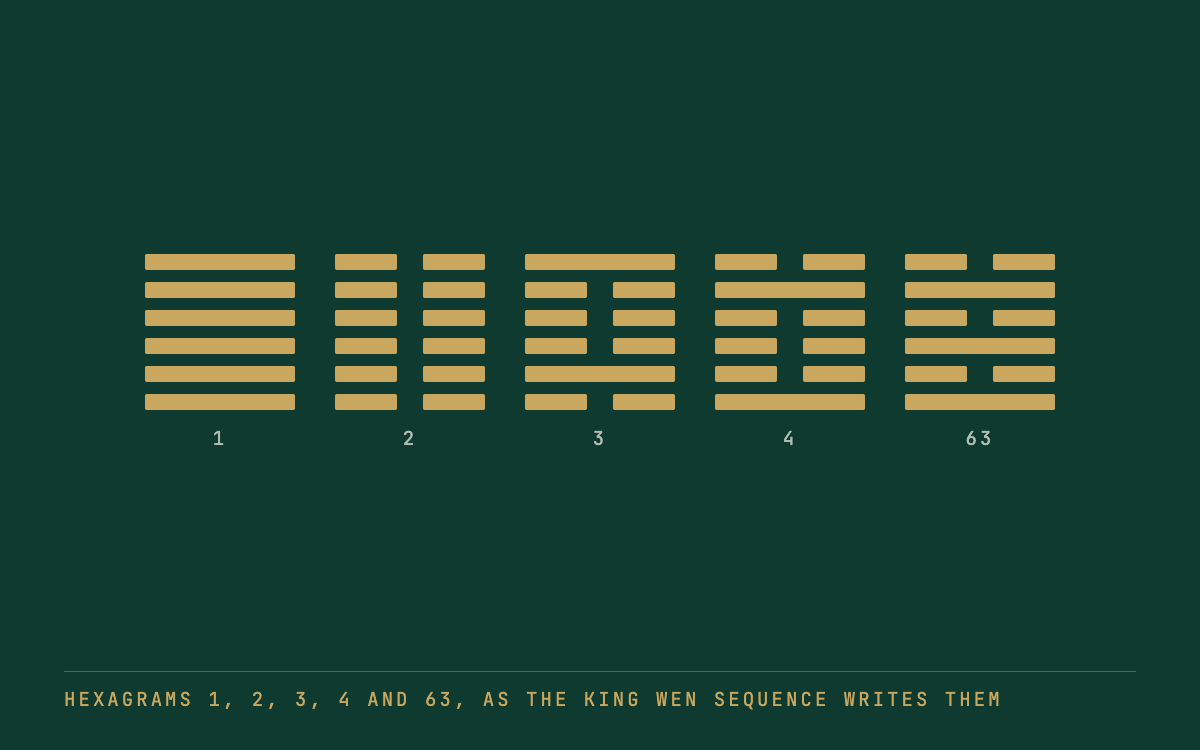
The entries on Hexagram 1 and the rest are written against Legge, rendered into plain English rather than pasted, with the interpretive layer marked as interpretation.
The other versions
Legge and Wilhelm are not the only options, and several others are worth knowing about. John Blofeld's 1965 translation is aimed squarely at the practising diviner and is franker about that aim than either of the older two. Richard John Lynn's 1994 version translates the text together with Wang Bi's third-century commentary, which is a genuinely different reading tradition from the Confucian one Wilhelm followed, and it shows how much the choice of commentary determines the result.
Richard Rutt and Edward Shaughnessy went the other way, stripping the commentary layers off to reconstruct what the Bronze Age divination manual may have said before anyone made it philosophical. Shaughnessy's work draws on the Mawangdui silk manuscript, excavated in 1973 from a tomb sealed in 168 before the common era and the oldest substantial copy known. It carries the hexagrams in a different order from the received text and varies in wording in places, which is a useful corrective to the idea that there is one fixed original sitting underneath all the translations.
Two ways to cast, and they are not equivalent
The translation question has a counterpart on the casting side, and it is less well known.
The three-coin method is fast: throw three coins six times, score the totals, build the hexagram. Three coins land in eight equally likely combinations, and the four line values fall straight out. Old yin is one in eight, young yang three in eight, young yin three in eight, old yang one in eight.
The yarrow stalk method is the older one, described in the Great Treatise and assumed by the classical text. Fifty stalks, one set aside, three divisions per line, eighteen divisions for a full casting, about a quarter of an hour. Its line values come out as one, five, seven and three in sixteen.
Those are different distributions and the difference is not cosmetic. Under the coins, a yang line and a yin line each have a one in four chance of moving: perfectly symmetric. Under the stalks, a yang line moves with probability three in eight and a yin line one in eight, so a change out of yang is three times as likely as a change out of yin. The classical text assumes yang is the restless principle and yin the settled one, and the coins flatten that assumption without announcing it.
What surprised us when checking the arithmetic is how much the two share. Both make yang and yin equally likely overall. Both move a quarter of all lines, averaging one and a half moving lines per casting. Both give identical odds of a still hexagram, 729 in 4,096, about one casting in six, and identical odds of all six lines moving, one in 4,096. The number of lines that move has exactly the same distribution under either method. What differs is only which lines move, and therefore which hexagram you travel towards.
What to take from it
The coin method is a simplification that arrived centuries after the stalks, probably in the Tang or Song period, and there is no evidence anyone at the time noticed it had changed the odds. It reproduces the four line values without reproducing their frequencies. Whether that matters depends on whether you weight yang and yin differently in your reading; if you do not, the difference may never reach you.
The same applies to the translations. If you read Wilhelm you are reading a Confucian reading of the text, competently done and openly so. If you read Legge you are reading a literal one with the difficulties left in. Neither is the I Ching, because the I Ching is in classical Chinese and is genuinely hard.
The thing worth resisting in both cases is the impression of a single authoritative version. There is a text, there are centuries of commentary that shaped what the text is taken to mean, there are translations that made choices, and there are two casting procedures with measurably different behaviour. A reading is the product of all four. Hexagram 4 has a line about asking the oracle two and three times and being told nothing further, which is generally read as a warning against pestering it. It works just as well as a warning against expecting any one version to be the last word.